Harpephyllum caffrum
Bernh. ex Krause
Kaffir plum, Wild plum
iNaturalist· cc-by-nc
(c) Peter Vos, some rights reserved (CC BY-NC)
iNaturalist· cc-by-nc
(c) Peter Vos, some rights reserved (CC BY-NC)
iNaturalist· cc-by-nc
(c) Peter Vos, some rights reserved (CC BY-NC)
Description
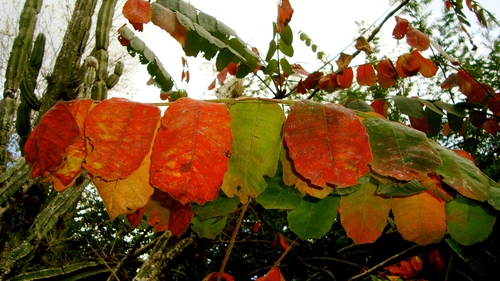
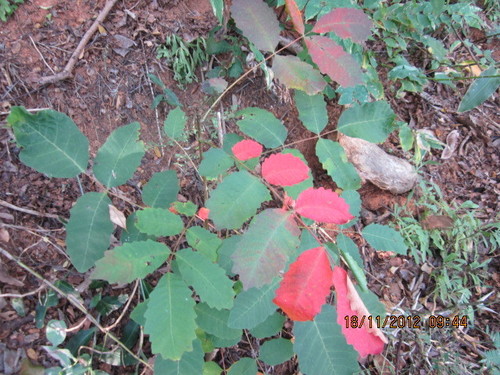
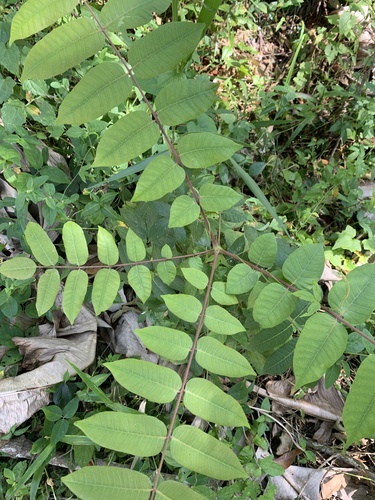
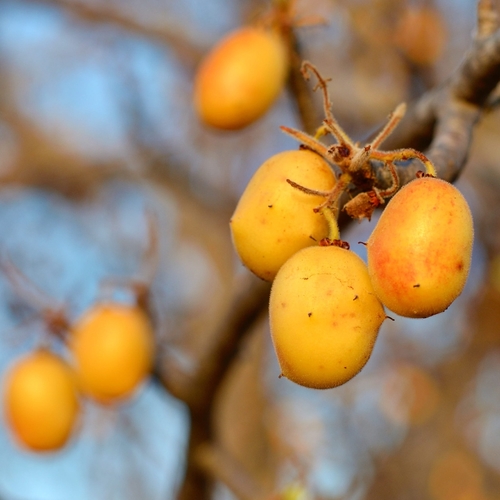
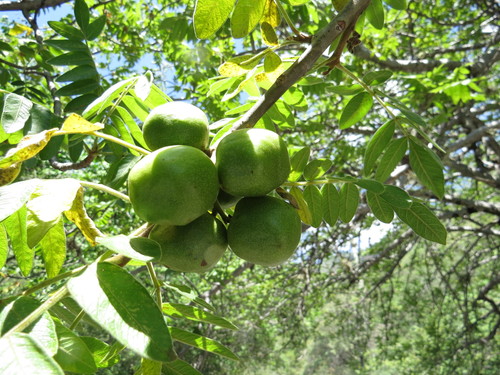
A small evergreen tree. It grows 6-15 m tall. It has a round compact crown. The trunk is usually clean and straight. It forests the trunk has buttresses. The bark is silvery white with crossways ridges. The leaves are up to 30 cm long. They are dark green and shiny. New leaves are red. The leaf stalk is 2.5-5 cm long and has a furrow along it. The leaves are crowded towards the ends of branches. The leaves are made up of 4-8 pairs of leaflets. They do not have stalks and there is a leaflet at the end. The leaves are 5-10 cm long and 1.3-2.5 cm wide. The end leaflet is broader and narrowed to the base while the side leaflets are slender and slightly curved. The leaves are leathery. Individual leaves turn red before they fall. Trees are separately male and female. The flowers are small and white. They occur at the ends of branches. The fruit is small with thin skin and sweet flesh. They are 2.5 cm long and 1.3 cm wide. They are red when ripe. The sour fruit pulp is edible. It has one large seed. It is in a distinctively pitted stone.
Edible Uses
The small red fruit has sour, edible pulp and can be eaten fresh, enjoyed especially by children. The fruit can be dried and develops a pleasant, salty flavor, and can also be used to make wine, jelly, or jam.
Traditional Uses
The fruit are eaten fresh. It is enjoyed especially by children. They can be dried and have a pleasant, salty flavour. They are also used for wine and jelly or jam.
Medicinal Uses
No medicinal uses mentioned in available data.
Distribution
A tropical and subtropical plant. It can stand moderate frosts. It adapts to most soils. It needs reasonably good drainage. The extensive root system can block drains. It can grow in arid places. It grows in Miombo woodland in Africa. It suits hardiness zones 9-11. Wittunga Botanical Gardens. Brisbane Botanical Gardens.
Where It Grows
Africa, Australia, East Africa, Eswatini, Fiji, Hawaii, India, Kenya, Mozambique, North America, Pacific, Puerto Rico, South Africa*, Southern Africa, St Helena, Swaziland, USA, West Indies, Zambia, Zimbabwe,
Cultivation
Plants can be grown from seed. It is best to plant fresh seed. The seeds are removed from the flesh and planted 2 cm deep. Stored seeds should be soaked in warm water for 24 hours before sowing. They germinate in 7-12 days. Plants can be grown from semi-ripe cuttings.
Propagation
Seed - easily grown from seeds[295. Stored seeds should be soaked in water for a day and then scrubbed with a brush to remove the fleshy part. It should not be planted too deeply as it can easily rot. The seeds take 7 to 11 days to germinate. Cuttings and truncheons. The truncheons should be dried before planting; they can be left lying in the shade for a day or until all exudate has dried. The hole in which the truncheon is going to be planted should be filled with a layer of river sand to promote root formation and improve drainage. This also helps to combat fungal diseases.
Other Uses
A mauve or pink dye is obtained from the bark. The pale reddish wood is hard, strong, fairly heavy and elastic. It polishes well but is not very durable. Very handsome when polished, it has been used as a general purpose timber, for furniture and beams and is also used for carving curios.
Production
Trees produce fruit in 4-5 years. A fruit weighs about 5 g.
Notes
There is only one Harpephyllum species.
Nutrition
| Part | Moisture | kJ | kcal | Protein | Vit A | Vit C | Iron | Zinc |
|---|---|---|---|---|---|---|---|---|
| Fruit | 87.5 | 171 | 41 | 0.7 | — | 70.7 | 1.2 | 0.9 |
Also Known As
Amagwenya, Ingwenya, Mmedibibi, Umgonyogonyu, Umgwenya, Umngwenya
References (41)
- Ambasta, S.P. (Ed.), 2000, The Useful Plants of India. CSIR India. p 257
- Bodkin, F., 1991, Encyclopedia Botanica. Cornstalk publishing, p 537
- Cundall, P., (ed.), 2004, Gardening Australia: flora: the gardener's bible. ABC Books. p 672
- Dharani, N., 2002, Field Guide to common Trees & Shrubs of East Africa. Struik. p 118
- Etherington, K., & Imwold, D., (Eds), 2001, Botanica's Trees & Shrubs. The illustrated A-Z of over 8500 trees and shrubs. Random House, Australia. p 370
Show all 41 references Hide references
- Facciola, S., 1998, Cornucopia 2: a Source Book of Edible Plants. Kampong Publications, p 10
- Flora 27(1):349. 1844
- Fox, F. W. & Young, M. E. N., 1982, Food from the Veld. Delta Books. p 72
- Hardwick, G., 2001, Economically Useful Plants for Northern Australia: Master Species List. Crusader eBooks.
- Gouldstone, S., 1983, Growing your own Food-bearing Plants in Australia. Macmillan p 101
- Hibbert, M., 2002, The Aussie Plant Finder 2002, Florilegium. p 119
- https://growwild.co.za Edible Indigenous plants
- INFOODS:FAO/INFOODS Databases
- Jardin, C., 1970, List of Foods Used In Africa, FAO Nutrition Information Document Series No 2.p 141
- Joffe, P., 2007, Creative Gardening with Indigenous Plants. A South African Guide. Briza. p 109
- Long, C., 2005, Swaziland's Flora - siSwati names and Uses http://www.sntc.org.sz/flora/
- Lord, E.E., & Willis, J.H., 1999, Shrubs and Trees for Australian gardens. Lothian. p 57
- Lyle, S., 2006, Discovering fruit and nuts. Land Links. p 235
- Martin, F. W., et al, 1987, Perennial Edible Fruits of the Tropics. USDA Handbook 642 p 13
- Palgrave, K.C., 1996, Trees of Southern Africa. Struik Publishers. p 458
- Palmer, E and Pitman, N., 1972, Trees of Southern Africa. Vol. 2. A.A. Balkema, Cape Town p 1195
- Peters, C. R., O'Brien, E. M., and Drummond, R.B., 1992, Edible Wild plants of Sub-saharan Africa. Kew. p 48
- Recher, P, 2001, Fruit Spirit Botanical Gardens Plant Index. www.nrg.com.au/~recher/ seedlist.html p 2
- Rivero, J. A., y Brunner, B. R., 2007, Arborels frutales exoticas y poco conocidos en Puerto Rico. Universidad de Puerto Rico. p 12
- Royal Botanic Gardens, Kew (1999). Survey of Economic Plants for Arid and Semi-Arid Lands (SEPASAL) database. Published on the Internet; http://www.rbgkew.org.uk/ceb/sepasal/internet [Accessed 25th March 2011]
- Ruiters-Welcome, A. K., 2019, Food plants of southern Africa. Ph.D. thesis. Univ. of Johannesburg p 13
- Schmidt, E., Lotter, M., & McCleland, W., 2007, Trees and shrubs of Mpumalanga and Kruger National Park. Jacana Media p 298
- Shava, S., 2000, The Use of Indigenous Plants as Food by a Rural Community in the Eastern Cape: an Educational Exploration. Masters Thesis Rhodes University. p 65
- Smith, A.C., 1985, Flora Vitiensis Nova: A New flora of Fiji, Hawai Botanical Gardens, USA Vol 3 p 458
- Staples, G.W. and Herbst, D.R., 2005, A tropical Garden Flora. Bishop Museum Press, Honolulu, Hawaii. p 102
- Swaziland's Flora Database http://www.sntc.org.sz/flora
- Tredgold, M.H., 1986, Food Plants of Zimbabwe. Mambo Press. p 105
- van Wyk, Be., & Gericke, N., 2007, People's plants. A Guide to Useful Plants of Southern Africa. Briza. p 44
- van Wyk, Br., van Wyk, P, and van Wyk B., 2000, Photographic guide to Trees of Southern Africa. Briza. p 10, 174
- Van Wyck, B., & Van Wyck, P, 1997, Field Guide to Trees of Southern Africa. Struik. p
- van Wyk, B-E., 2011, The potential of South African plants in the development of new food and beverage products. South African Journal of Botany 77 (2011) 857–868
- Venter, F & J., 2009, Making the most of Indigenous Trees. Briza. p 190
- Wehmeyer, A. S, 1986, Edible Wild Plants of Southern Africa. Data on the Nutrient Contents of over 300 species.
- Welcome, A. K. & Van Wyk, B.-E., 2019, An inventory and analysis of the food plants of southern Africa. South African Journal of Botany 122 (2019) 136–179
- Wilson, A. L. & Downs, C. T., 2012, Fruit nutritional composition and non-nutritive traits of indigenous South African tree species. South African Journal of Botany. 78:30-36
- World Checklist of Useful Plant Species 2020. Royal Botanic Gardens, Kew