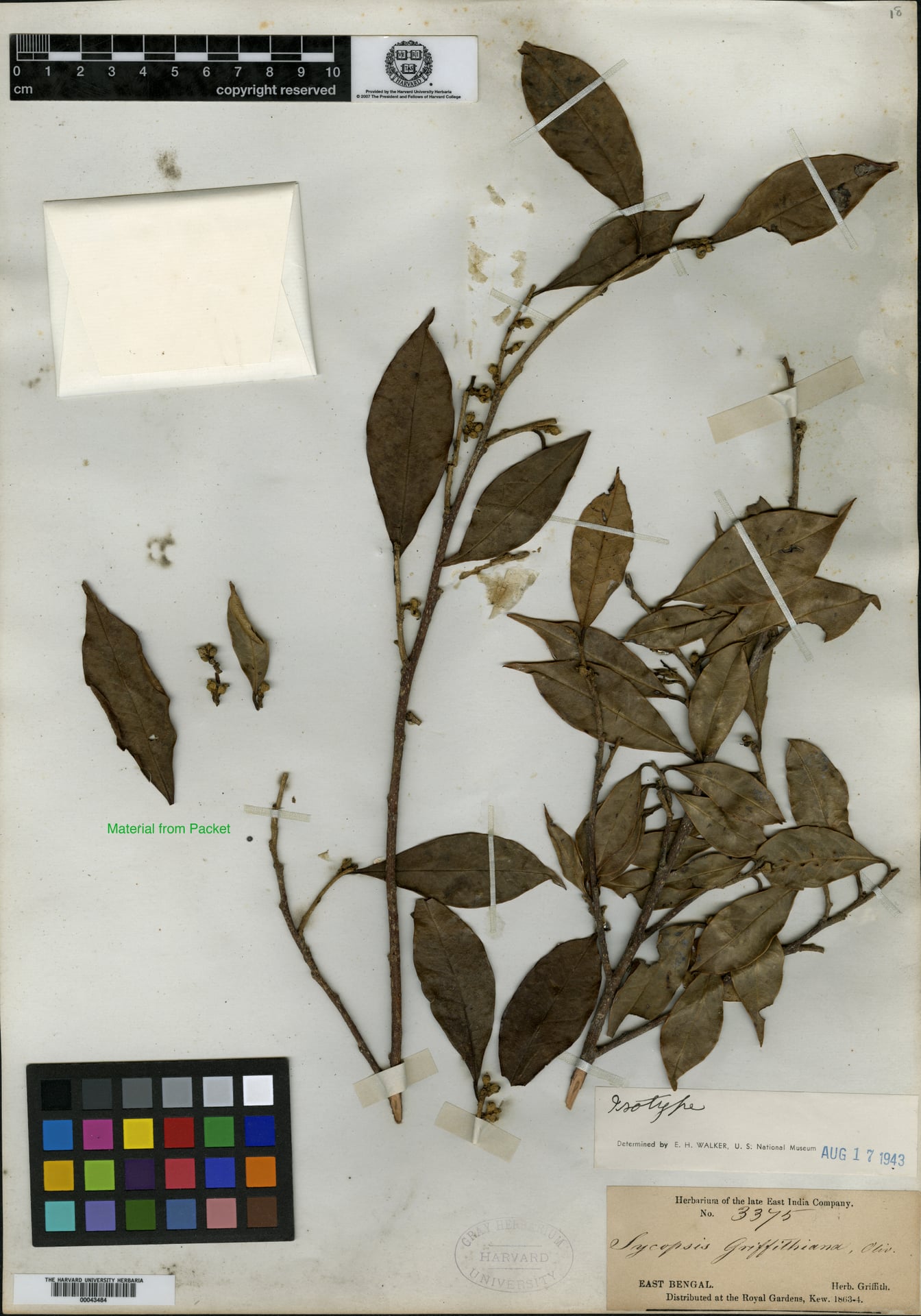
Hamamelis virginiana
L.
Witch Hazel, Virginian Witch Hazel
iNaturalist· cc-by-nc
(c) Paul Marcum, some rights reserved (CC BY-NC), uploaded by Paul Marcum
iNaturalist· cc-by-nc
(c) Stuart Tingley, some rights reserved (CC BY-NC), uploaded by Stuart Tingley
iNaturalist· cc-by-nc
(c) arobey63, some rights reserved (CC BY-NC)
Summary
Source: WikipediaHamamelis virginiana, known as witch-hazel, common witch-hazel, American witch-hazel and beadwood, is a species of flowering shrub native to eastern North America, from Nova Scotia west to Minnesota, and south to central Florida to eastern Texas.
Description
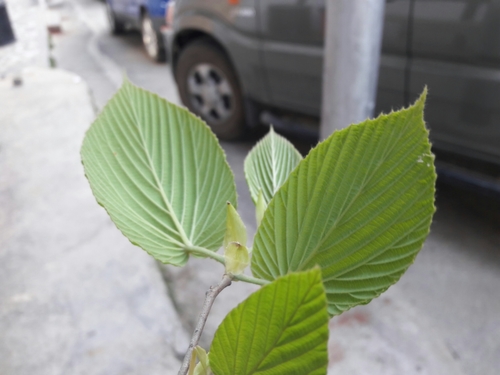
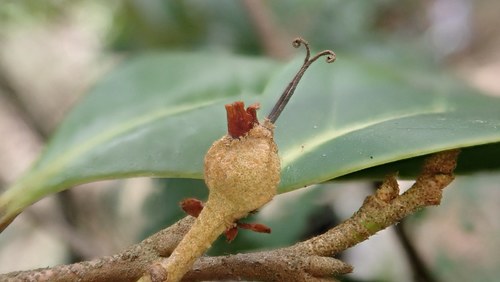
A shrub. It has many trunks. It has an open upright habit. It grows 3.5-6 m high. The trunks can be 1 cm across. The trunk is leaning and crooked. It loses its leaves during the year. The leaves are alternate, simple and have teeth along the edge. The leaves are dark green and broadly oval. They are wavy along the edge. They are 6-15 cm long. They turn yellow and fall in autumn. The flowers are small and twisted. They are yellow and have a scent. The flowers occur in clusters of 3 in the axils of leaves. The fruit are small capsules. They are beaked and woody. They are hairy and orange. They contain 2 black seeds. They mature and split open in about one year. The seeds are ejected forcibly and the capsules remain.
Edible Uses
The seeds can be eaten raw or cooked and have an oily texture. They are roughly the size of a barley grain and have a thick, bony coat. It should be noted that reports of their edibility are questionable, appearing to stem from a single uncertain source in Rafinesque's 'Medical Flora'. A refreshing tea can also be made from the leaves and twigs.
Traditional Uses
The seeds are eaten. The leaves are used for tea. They are sweetened with maple sugar.
This uses section is brief — help expand it
Medicinal Uses
Witch hazel bark has a long history of use among North American Indians, who applied it to wounds, tumours, eye problems, and more. It remains widely used today and appears in proprietary eye drops, skin creams, ointments, and skin tonics. Externally, it is applied to bruises, sore muscles, varicose veins, haemorrhoids, sore nipples, and inflammations. The bark is astringent, haemostatic, sedative, and tonic, with its tannin content thought to be responsible for the astringent and haemostatic actions. Note that bottled witch hazel water is a steam distillate that lacks these tannins and is therefore less effective than a tincture. Internally, the bark is used for diarrhoea, colitis, dysentery, haemorrhoids, vaginal discharge, excessive menstruation, internal bleeding, and prolapsed organs; branches and twigs are harvested for the bark in spring. A leaf infusion is used to reduce inflammations and treat piles, internal haemorrhages, and eye inflammations; leaves are harvested in summer and can be dried for later use. A homeopathic remedy prepared from fresh bark is used for nosebleeds, piles, and varicose veins.
Known Hazards
Avoid long-term use due to cancer risk (from high tannin content). Avoid during pregnancy and breastfeeding. 1g ingested can cause vomiting, nausea, impaction. Topical use may cause dermatitis.
Distribution
A temperate plant. It grows in moist, shaded sites as an understorey tree. It suits hardiness zones 7-9. Arboretum Tasmania.
Where It Grows
Australia, Balkans, Britain, Canada, Europe, Macedonia, Mexico, North America, Slovenia, Tasmania, USA,
Cultivation
Prefers a moist sandy loam in a sunny position, though it tolerates some shade. Prefers a rich well-drained soil. Dislikes dry limy soils but will succeed in a calcareous soil if it is moist. Prefers a position sheltered from cold drying winds in a neutral to slightly acid soil. A very hardy plant tolerating temperatures down to about -35°c. Plants seldom produce seeds in Britain. Witch hazel is a widely used medicinal herb. The bark is harvested commercially from the wild in N. America. The twigs have been used in the past as dowsing rods for water divining. A slow growing shrub, it takes about 6 years to flower from seed. The flowers have a soft sweet perfume. This species is notably susceptible to honey fungus.
Propagation
Seed can be very slow to germinate. For best results, harvest it green — as soon as it is ripe but before it has dried on the plant, around the end of August — and sow immediately in a cold frame. Even then it may take 18 months to germinate, though this is usually faster than using stored seed. Stored seed requires 2 months of warm stratification, followed by 1 month cold, then a further 2 weeks warm, and finally 4 months of cold stratification. Scarification may also help improve germination of stored seed. Prick out seedlings into individual pots as soon as they are large enough to handle, overwinter in a greenhouse, and plant out in late spring. Layering in early spring or autumn takes about 12 months and gives a good success rate. Softwood cuttings can be taken in summer and rooted in a frame.
Other Uses
Witch hazel is used as a rootstock for ornamental species in the genus. The plant is rich in tannin and is used cosmetically in preparations aimed at relieving capillary weakness. The stems have traditionally been used for water divining. The wood is heavy, hard, and very close-grained, weighing 43 lb per cubic foot, though the trees are generally too small to be a practical lumber source.
Notes
There are about 6 Hamamelis species. Witch Hazel solution is used in medicine.
Synonyms
Also Known As
Viržinski nepozebnik
References (21)
- Beckstrom-Sternberg, Stephen M., and James A. Duke. "The Foodplant Database." http://probe.nalusda.gov:8300/cgi-bin/browse/foodplantdb.(ACEDB version 4.0 - data version July 1994)
- Bodkin, F., 1991, Encyclopedia Botanica. Cornstalk publishing, p 536
- Bremness, L., 1994, Herbs. Collins Eyewitness Handbooks. Harper Collins. p 105
- Brickell, C. (Ed.), 1999, The Royal Horticultural Society A-Z Encyclopedia of Garden Plants. Convent Garden Books. p 491
- Cundall, P., (ed.), 2004, Gardening Australia: flora: the gardener's bible. ABC Books. p 671
Show all 21 references Hide references
- Etherington, K., & Imwold, D., (Eds), 2001, Botanica's Trees & Shrubs. The illustrated A-Z of over 8500 trees and shrubs. Random House, Australia. p 370
- Farrar, J.L., 1995, Trees of the Northern United States and Canada. Iowa State University press/Ames p 272
- Hedrick, U.P., 1919, (Ed.), Sturtevant's edible plants of the world. p 337
- Heywood, V.H., Brummitt, R.K., Culham, A., and Seberg, O. 2007, Flowering Plant Families of the World. Royal Botanical Gardens, Kew. p 164
- Hibbert, M., 2002, The Aussie Plant Finder 2002, Florilegium. p 119
- Kermath, B. M., et al, 2014, Food Plants in the Americas: A survey of the domesticated, cultivated and wild plants used for Human food in North, Central and South America and the Caribbean. On line draft. p 403
- Kiple, K.F. & Ornelas, K.C., (eds), 2000, The Cambridge World History of Food. CUP p 1883
- Little, E.L., 1980, National Audubon Society Field Guide to North American Trees. Alfred A. Knopf. p 452
- Lord, E.E., & Willis, J.H., 1999, Shrubs and Trees for Australian gardens. Lothian. p 234
- MacKinnon, A., et al, 2009, Edible & Medicinal Plants of Canada. Lone Pine. p 144
- Menninger, E.A., 1977, Edible Nuts of the World. Horticultural Books. Florida p 117
- Moerman, D. F., 2010, Native American Ethnobotany. Timber Press. p 255
- Plants for a Future database, The Field, Penpol, Lostwithiel, Cornwall, PL22 0NG, UK. http://www.scs.leeds.ac.uk/pfaf/
- Sp. pl. 1:124. 1753
- Toupal, R. S. & Hollenback, K., 2009, An Ethnobotany of Indiana Dunes National Lakeshore: Plant Uses of the Ojibwa People. Bureau of Applied Research in Anthropology. University of Arizona
- Young, J., (Ed.), 2001, Botanica's Pocket Trees and Shrubs. Random House. p 431