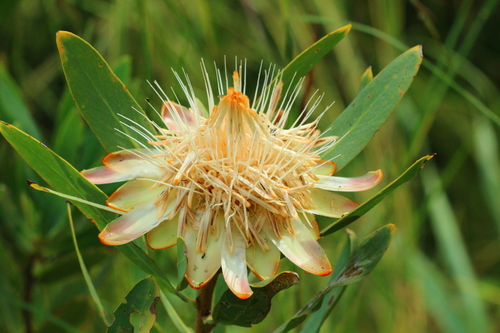
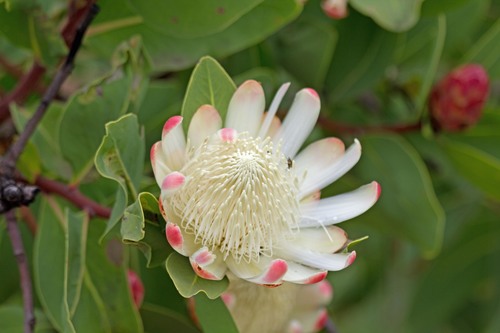
Hakea arborescens
R. Br.
Yellow Hakea, Tree Hakea, Common Hakea
iNaturalist· cc-by-nc
(c) ryanthughes, some rights reserved (CC BY-NC)
iNaturalist· cc-by
(c) Roland Muench, some rights reserved (CC BY)
Summary
Source: WikipediaHakea arborescens, commonly known as the common hakea or the yellow hakea, is a shrub or tree of the genus Hakea native to parts of northern Australia.
Description
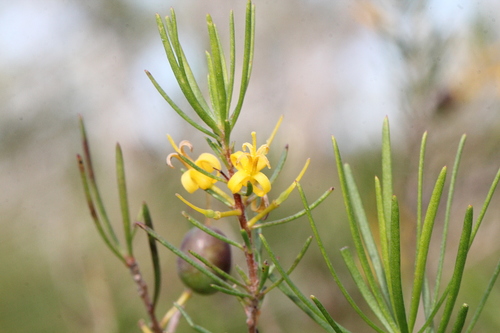
A small tree. It grows 3-6 m high. The young shoots are silky. The leaves are stiff and narrow. They have fine hairs on both surfaces. The blade is 7-18 cm long by 0.5-1.3 cm wide. They are a dull grey-green. The flowers are very small and yellow. The are about 0.3 cm long. They occur in groups about 1.5 cm across. These are produced in the axils of leaves. The fruit are smooth and oval. They are woody with a thick wall. They are 4-5 cm long by 2-2.5 cm wide. They are light brown and split open when ripe.
Edible Uses
The seeds are eaten, particularly by children.
Traditional Uses
The seeds are eaten.
This uses section is brief — help expand it
Distribution
A tropical plant. They grow naturally in open forest in tropical regions. They need well-drained soils. They are suited to seasonally dry climates.
Where It Grows
Australia*,
Cultivation
Plants can be grown from seed.
Other Information
The seeds are eaten especially by children.
Notes
There are about 130-140 Hakea species. They grow in Australia.
References (13)
- Bindon, P., 1996, Useful Bush Plants. Western Australian Museum. p 155
- Brock, J., 1993, Native Plants of Northern Australia, Reed. p 215
- Cherikoff V. & Isaacs, J., The Bush Food Handbook. How to gather, grow, process and cook Australian Wild Foods. Ti Tree Press, Australia p 190, 200
- Dunlop, C.R., Leach, G.J. & Cowie, I.D., 1995, Flora of the Darwin Region. Vol 2. Northern Territory Botanical Bulletin No 20. p 126
- Elliot, W.R., & Jones, D.L., 1990, Encyclopedia of Australian Plants suitable for cultivation. Vol 5. Lothian. p 180
Show all 13 references Hide references
- Lazarides, M. & Hince, B., 1993, Handbook of Economic Plants of Australia, CSIRO. p 126
- Levitt, D., 1981, Plants and people. Aboriginal uses of plants on Groote Eylandt. Australian Institute of Aboriginal Studies, Canberra. p 118
- Milson, J., 2000, Trees and Shrubs of north-west Queensland. DPI p 264
- Paczkowska, G . & Chapman, A.R., 2000, The Western Australian Flora. A Descriptive Calatogue. Western Australian Herbarium. p 491
- Petheram, R.J. and Kok, B., 2003, Plants of the Kimberley Region of Western Australia. UWA Press p 485
- Townsend, K., 1994, Across the Top. Gardening with Australian Plants in the tropics. Society for Growing Australian Plants, Townsville Branch Inc. p 244
- Trans. Linn. Soc. London 10:187. 1810
- Wheeler, J.R.(ed.), 1992, Flora of the Kimberley Region. CALM, Western Australian Herbarium, p 476