Gunnera perpensa
L.
River pumpkin
iNaturalist· cc-by-nc
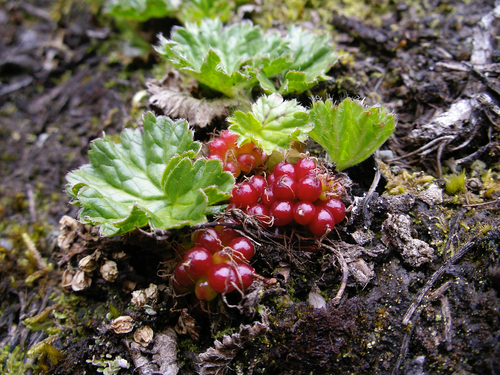
(c) Lizelle Erasmus, some rights reserved (CC BY-NC), uploaded by Lizelle Erasmus
iNaturalist· cc-by-nc
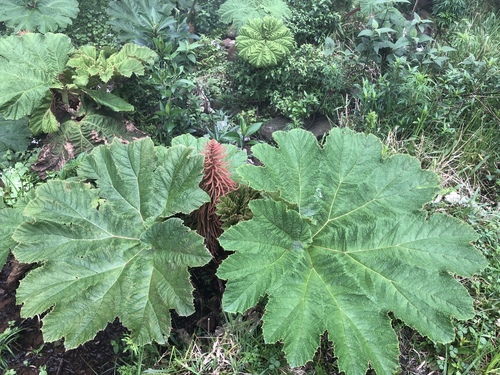
(c) berthapi2, some rights reserved (CC BY-NC), uploaded by berthapi2
iNaturalist· cc-by-sa
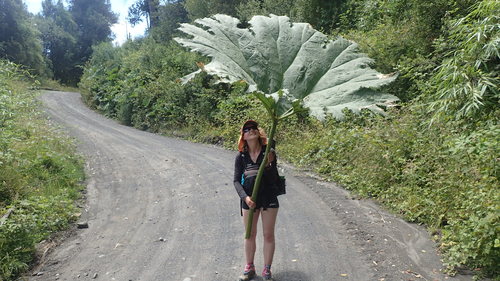
(c) Tony Rebelo, some rights reserved (CC BY-SA), uploaded by Tony Rebelo
Summary
Source: WikipediaGunnera perpensa is a species of Gunnera native to much of eastern and southern Africa, from Sudan south to South Africa, and also in Madagascar. It is a perennial herbaceous wetland plant growing to 1 m tall, with kidney-shaped leaves with an irregularly lobed and serrated margin. It is the type species of the genus Gunnera.
Description
A fleshy perennial herb. It forms suckers. It does not have a stem above ground. The leaves arise from the ground. The leaves are large and kidney shaped and 30 cm across. The leaf stalks are 60 cm long. The flowering stalk arises from the ground. It can be 90 cm high. The flowers are small and coppery-red in open sprays. The fruit are somewhat fleshy.
Edible Uses
Leaves - chewed or cooked. The petioles and flower stalks - raw[295. The petioles have a bitter taste unless the fibrous vascular bundles and the outer covering are removed. The plant (part not specified but likely to be the petiole) is cooked and eaten as a vegetable. The plant is an ingredient in traditional beer.
Traditional Uses
The leaf stalk is eaten raw. The stem is eaten raw as a relish. It is bitter unless the fibres and other coverings are removed. It is also used for making beer. The roots are eaten after removing the outer skin.
Medicinal Uses
None known
Distribution
It is a tropical plant. They grow in wet boggy conditions. It grows on the edges or rivers and pools. It is rare in Swaziland. In Zimbabwe it grows above 1,500 m above sea level.
Where It Grows
Africa, Australia, Botswana, East Africa, Eswatini, Ethiopia, Kenya, Lesotho, Mozambique, Rwanda, South Africa*, Southern Africa, Sudan, Swaziland, Tanzania, Zimbabwe,
Cultivation
Plants can be grown from tuberous rhizomes. It can be grown from divided clumps.
Propagation
Seed is best sown as soon as it is ripe in autumn in a sandy mix in a cold frame, though spring sowing is also possible. Prick seedlings out into individual pots once large enough to handle and grow on in the greenhouse through at least their first winter. Plant out into permanent positions in late spring or early summer, after the last expected frosts. Division can be done as new growth begins in spring. Larger clumps can go directly into permanent positions, but smaller clumps are better potted up in a cold frame until rooting well before planting out in spring.
Other Uses
None known
Notes
There are about 68 Gunnera species. They are in the southern hemisphere and in cool or cold places.
Nutrition
| Part | Moisture | kJ | kcal | Protein | Vit A | Vit C | Iron | Zinc |
|---|---|---|---|---|---|---|---|---|
| Leaves | 93.1 | 64 | 15 | 0.6 | — | — | 1.7 | 0.1 |
Also Known As
Cobho, Gobho, Iphuzi lomlambo Iqhobo, Qobo, Qobho, Rambola-vhadzimu, Shambodavhadzimu, Ugobhe, Uqobho, Wilderabarber
References (15)
- Fox, F. W. & Young, M. E. N., 1982, Food from the Veld. Delta Books. p 236
- Guillarmod, J., 1966, 1971,
- Hibbert, M., 2002, The Aussie Plant Finder 2002, Florilegium. p 117
- Joffe, P., 2007, Creative Gardening with Indigenous Plants. A South African Guide. Briza. p 326
- Magwede, K., van Wyk, B.-E., & van Wyk, A. E., 2019, An inventory of Vhavenḓa useful plants. South African Journal of Botany 122 (2019) 57–89
Show all 15 references Hide references
- Peters, C. R., O'Brien, E. M., and Drummond, R.B., 1992, Edible Wild plants of Sub-saharan Africa. Kew. p 116
- Plants for a Future database, The Field, Penpol, Lostwithiel, Cornwall, PL22 0NG, UK. http://www.scs.leeds.ac.uk/pfaf/
- Plowes, N. J. & Taylor, F. W., 1997, The Processing of Indigenous Fruits and other Wildfoods of Southern Africa. in Smartt, L. & Haq. (Eds) Domestication, Production and Utilization of New Crops. ICUC p 192
- Ruiters-Welcome, A. K., 2019, Food plants of southern Africa. Ph.D. thesis. Univ. of Johannesburg p 65
- Ryan, S., 2008, Dicksonia. Rare Plants Manual. Hyland House. p 103 (As Gunnera perpense)
- Shava, S., 2000, The Use of Indigenous Plants as Food by a Rural Community in the Eastern Cape: an Educational Exploration. Masters Thesis Rhodes University. p 65
- Swaziland's Flora Database http://www.sntc.org.sz/flora
- Wehmeyer, A. S, 1986, Edible Wild Plants of Southern Africa. Data on the Nutrient Contents of over 300 species
- Welcome, A. K. & Van Wyk, B.-E., 2019, An inventory and analysis of the food plants of southern Africa. South African Journal of Botany 122 (2019) 136–179
- World Checklist of Useful Plant Species 2020. Royal Botanic Gardens, Kew