Gunnera tinctoria
(Mol.) Mirbel
Chilean rhubarb
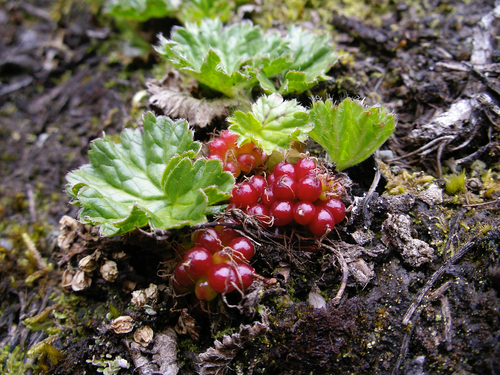
iNaturalist· cc-by-nc
(c) Oliver Barker, some rights reserved (CC BY-NC), uploaded by Oliver Barker
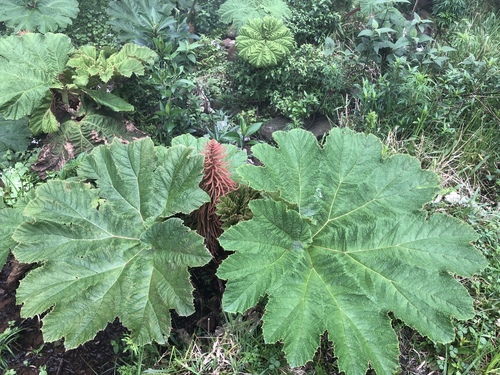
iNaturalist· cc-by-nc
(c) Cristian Sánchez, some rights reserved (CC BY-NC), uploaded by Cristian Sánchez
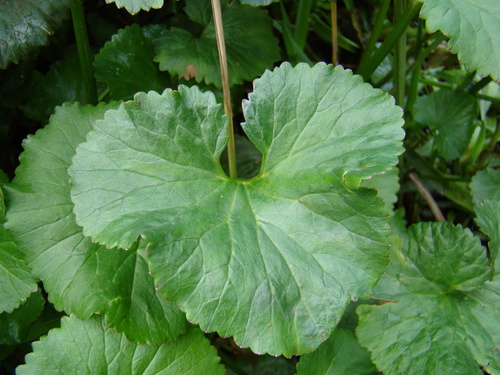
iNaturalist· cc-by-nc
(c) Michael 2020, some rights reserved (CC BY-NC), uploaded by Michael 2020
Summary
Source: WikipediaGunnera tinctoria, known as giant-rhubarb, Chilean rhubarb, quirusilla or nalca, is a flowering plant species native to southern Chile and neighboring zones in Argentina and Bolivia. It is not closely related to rhubarb, as the two plants belong to different orders, but looks similar from a distance and has similar culinary uses. It is a large-leaved perennial plant that grows to more than 2 m (6.6 ft) tall. It has been introduced to many parts of the world as an ornamental plant. In some countries, such as New Zealand, the United Kingdom, and Ireland, it has spread from gardens and is becoming an introduced species of concern. It is known under the synonyms Gunnera chilensis Lam. and Gunnera scabra Ruiz & Pav.
Description
A shrub. It grows 1-2 m tall. The leaves are 1.2-1.5 m across. The leaves can be 2.6 m across. The leaf stalk is 1 m long. The flowers are in dense spikes. They are reddish-green in colour.
Edible Uses
The young leaf stalks are peeled and eaten raw or cooked as a vegetable. They have an acid, refreshing flavour.
Traditional Uses
The leaf stalks are used as an ingredient in sweet meats and for making preserves. They are used for pickles. The leaf stalk is peeled and eaten as a vegetable. It is also used in confectionary.
Medicinal Uses
The whole plant is astringent.
Distribution
A temperate plant. They need plenty of moisture. They can tolerate frost and snow. It grows along riverbanks. It grows with its roots in water. It can grow in shade. In Chile it grows from sea level to 2,000 m altitude. In Argentina it grows from sea level to 1,000 m above sea level. It suits hardiness zones 7-9. Arboretum Tasmania.
Where It Grows
Argentina, Australia, Chile*, Europe, France, South Africa, Southern Africa, South America, Tasmania,
Cultivation
Plants can be grown from fresh seed. These are planted onto waterlogged soil.
Propagation
Seed is best sown as soon as it is ripe in autumn in a sandy mix in a cold frame, or in a shady position in a greenhouse in spring. Germination typically occurs within 2–8 weeks at 15°C. Prick seedlings into individual pots once large enough to handle and grow on in the greenhouse for at least their first winter. Plant out into permanent positions in late spring or early summer, after the last expected frosts. Division can be carried out as new growth begins in spring, and clumps can be planted directly into their permanent positions.
Other Uses
A black dye is obtained from the root, which also contains 9% tannin. The large leaves are used as a roof covering.
Notes
There are about 68 Gunnera species. They are in the southern hemisphere and in cool or cold places. There is only one genus in the Gunneraceae. They are mostly herbs with rhizomes or stolons and large leaves.
Nutrition
| Part | Moisture | kJ | kcal | Protein | Vit A | Vit C | Iron | Zinc |
|---|---|---|---|---|---|---|---|---|
| Leaf stalks | 93.7 | — | — | 0.2 | — | 0.3 | — | — |
Synonyms
Also Known As
Nalca, Pangue, Panke, Rhuibarbo chileno
References (21)
- Barreau, A., et al, 2016, How Can We Teach Our Children if We Cannot Access the Forest? Generational Change in Mapuche Knowledge of Wild Edible Plants in Andean Temperate Ecosystems of Chile. Journal of Ethnobiology 36(2): 412–432
- Cordero, S. E., Abello, L. A., & Galvez, F. L., 2017, Plantas silvestres comestibles y medicinales de Chile y otras partes del mundo. CORMA p 180
- Cundall, P., (ed.), 2004, Gardening Australia: flora: the gardener's bible. ABC Books. p 658
- Daly, A. B., 20014, Narrating changing foodways: wild edible plant knowledge and traditional food systems in Mapuche lands of the Andean Temperate Forests, Chile. Masters Thesis Vancouver. p 45
- Facciola, S., 1998, Cornucopia 2: a Source Book of Edible Plants. Kampong Publications, p 121
Show all 21 references Hide references
- Hedrick, U.P., 1919, (Ed.), Sturtevant's edible plants of the world. p 335
- Heywood, V.H., Brummitt, R.K., Culham, A., and Seberg, O. 2007, Flowering Plant Families of the World. Royal Botanical Gardens, Kew. p 161
- Hibbert, M., 2002, The Aussie Plant Finder 2002, Florilegium. p 117
- Kermath, B. M., et al, 2014, Food Plants in the Americas: A survey of the domesticated, cultivated and wild plants used for Human food in North, Central and South America and the Caribbean. On line draft. p 401
- Ladio, A. H. & Lozada, M., 2000, Edible Plant Use in a Mapuche Community of North-western Patagonia, Human Ecology. Vol. 28, No. 1. pp. 53-71
- Ladio, A. H., 2001, The Maintenance of Wild Edible Plant Gatherings in a Mapuche Community of Patagonia. Economic Botany, Vol. 55, No. 2, pp. 243-254
- Ladio, A. H. and Lozada, M., 2003, Comparison of wild edible plant diversity and foraging strategies in two aboriginal communities of northwestern Patagonia. Biodiversity and Conservation 12: 937–951
- Ladio, A. H. and Lozada, M., 2004, Patterns of use and knowledge of wild edible plants in distinct ecological environments: a case study of a Mapuche community from northwestern Patagonia. Biodiversity and Conservation 13:1153-1173
- Ladio, A., Lozada, M. & M. Weigandt, 2007, Comparison of traditional wild plant knowledge between aboriginal communities inhabiting arid and forest environments in Patagonia, Argentina. Journal of Arid Environments 69 (2007) 695–715
- Leon-Lobos, P., et al, 2022, Patterns of Traditional and Modern Uses of Wild Edible Native Plants of Chile: Challenges and Future Perspectives. Plants (Basel) v 11 (6) Table S1
- Rapoport, E., H., et al, 2003, Plantas Nativas Comestibles de la Patagonia Andina Argentino/Chilena Parte 1, Department de Ecologi Centro Regional Universitario Briloche p 40
- Romanowski, N., 2007, Edible Water Gardens. Hyland House. p 106
- Ryan, S., 2008, Dicksonia. Rare Plants Manual. Hyland House. p 104
- Slocum, P.D. & Robinson, P., 1999, Water Gardening. Water Lilies and Lotuses. Timber Press. p 120
- Smith, N., Mori, S.A., et al, 2004, Flowering Plants of the Neotropics. Princeton. p 177
- www.chileflora.com