Grewia retusifolia
Kurz
Emu berry, Dysentry bush, Turkey fruit
iNaturalist· cc-by-nc
(c) Russell Cumming, some rights reserved (CC BY-NC), uploaded by Russell Cumming
wikimedia· cc-by-sa
Wikimedia Commons - Mark Marathon
Summary
Source: WikipediaGrewia retusifolia is a shrub species in the family Malvaceae. Common names include dysentery bush, emu-berry, dog's balls, turkey bush and diddle diddle. It is widespread in tropical and subtropical areas of Eastern Australia and Northern Western Australia. The species produces small, sweet, two-lobed fruit with a fibrous acidic pulp surrounding the seeds. Leichhardt described the fruits as having a very agreeable taste, which could be boiled to make a refreshing drink. Indigenous Australians use the bark and leaves in medications. The crushed leaves were used as a poultice to relieve toothaches.
Description
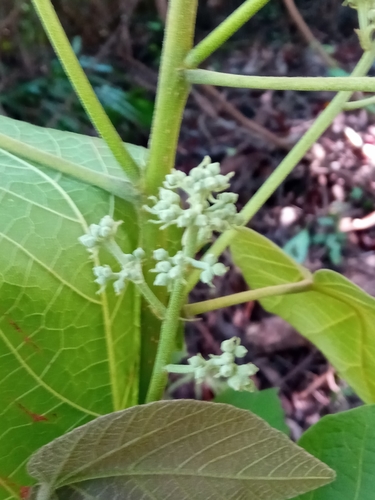
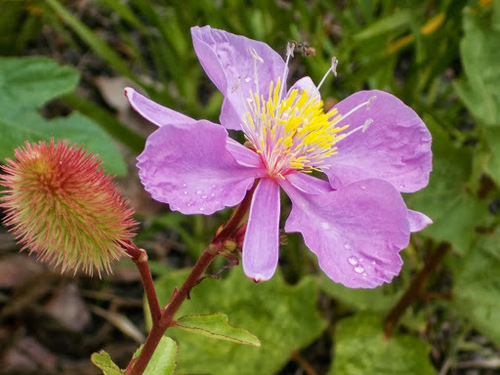
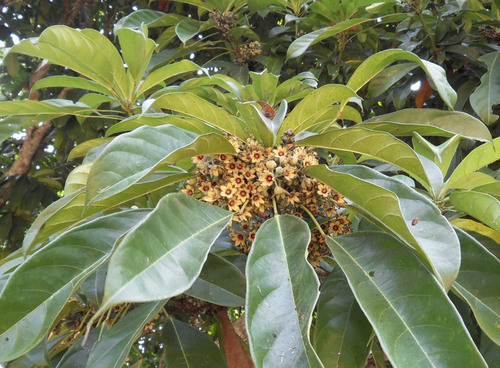
A shrub. It grows to 1.5 m high. The stems have coarse hairs. The leaves are oval. The blade is 6.5-12 cm long by 2-4 cm wide. They are dull green and hairy on the top surface and whitish underneath. The edges have teeth. The flowers are white and 0.7 cm long. They occur in clusters in the axils of leaves. The fruit are fleshy and oblong. They have 2-4 lobes and are 0.6 cm long by 1.2 cm wide. They are red-brown when ripe and with hard seeds inside. The fruit are edible.
Edible Uses
Fruit - raw. A thin but sweet flesh. The fruit is often lobed, usually 2-4-lobed, with scattered brown hairs on the outer surface. Seeds about 3 x 2.5 mm, enclosed in a thick hard endocarp. The small drupe, which is rusty-brown when ripe and possesses a very sweet taste, though containing a large seed, is eaten by the natives throughout North Australia. 'I found a great quantity of ripe Grewia seeds, and, on eating many of them, it struck me that their slightly acidulous taste, if imparted to water, would make a very good drink. I therefore gathered as many as I could, and boiled them for about an hour; the beverage which they produced was at all events the best we had tasted on our expedition, and my companions were busy the whole afternoon in gathering and boiling the seeds.' (Leichhardt, Overland Expedition to Port Essington, p. 295.). (As Grewia polygama)
Traditional Uses
The fruit are eaten. They have a pleasant acid taste. The new leaves and fruit are used to make tea.
This uses section is brief — help expand it
Medicinal Uses
New leaves and fruit are made into tea.
Distribution
A tropical plant. They suit tropical locations. They grow naturally in open woodland on sandy soils.
Where It Grows
Asia, Australia, China, India, Indochina, Indonesia, Laos, Papua New Guinea, PNG, SE Asia, Vietnam,
Cultivation
Plants can be grown from seed.
Propagation
Seed - we have no specific information for this species but seed of this genus is generally best sown as soon as it is ripe. Stored seed has a hard seedcoat and may benefit from scarification before sowing in order to speed up and improve germination. This can usually be done by pouring a small amount of nearly boiling water on the seeds (being careful not to cook them!), allowing the mix to cool somewhat and then leaving it in a warm place to soak for 12 - 24 hours. Sow the seeds in situ or in a nursery seedbed or trays - do not allow the compost to become dry. Germination and early growth are usually quite quick. Cuttings - best taken with a heel.
Notes
There are about 200 Grewia species. They are mostly tropical. The fruit of most may be edible. These were in the Sparrmanniaceae and the Tiliaceae.
Nutrition
| Part | Moisture | kJ | kcal | Protein | Vit A | Vit C | Iron | Zinc |
|---|---|---|---|---|---|---|---|---|
| Fruit | 33.1 | 799 | 191 | 3.8 | — | 4 | 5.9 | 1.9 |
Synonyms
Also Known As
Andjodmo, Bull-dog, Gara, Giam la-ta, Kangarn, Marwurrangyi, Mayawung, Mutamuta
References (29)
- Bodkin, F., 1991, Encyclopedia Botanica. Cornstalk publishing, p 519
- Brock, J., 1993, Native Plants of Northern Australia, Reed. p 210
- Cherikoff V. & Isaacs, J., The Bush Food Handbook. How to gather, grow, process and cook Australian Wild Foods. Ti Tree Press, Australia p 200
- Cribb, A.B. & J.W., 1976, Wild Food in Australia, Fontana. p 37
- Elliot, W.R., & Jones, D.L., 1990, Encyclopedia of Australian Plants suitable for cultivation. Vol 5. Lothian. p 160
Show all 29 references Hide references
- Garde, M., et al, 2003, A Preliminary List of Kundedjnjenghmi Plant Names. Northern Land Council. (Arnhem Land, Australia)
- Hardwick, G., 2001, Economically Useful Plants for Northern Australia: Master Species List. Crusader eBooks.
- Hiddins, L., 1999, Explore Wild Australia with the Bush Tucker Man. Penguin Books/ABC Books. p 139
- Isaacs, J., 1987, Bush Food, Aboriginal Food and Herbal Medicine. Weldons. p 73
- Kenneally, K.E., Edinger, D. C., and Willing T., 1996, Broome and Beyond, Plants and People of the Dampier Peninsula, Kimberley, Western Australia. Department of Conservation and Land Management. p 193
- Kiple, K.F. & Ornelas, K.C., (eds), 2000, The Cambridge World History of Food. CUP p 1873
- Lazarides, M. & Hince, B., 1993, Handbook of Economic Plants of Australia, CSIRO. p 125
- Low, T., 1991, Wild Food Plants of Australia. Australian Nature FieldGuide, Angus & Robertson. p 116
- Milson, J., 2000, Trees and Shrubs of north-west Queensland. DPI p 296
- Paczkowska, G . & Chapman, A.R., 2000, The Western Australian Flora. A Descriptive Calatogue. Western Australian Herbarium. p 562
- Pham-Hoang Ho, 1999, An Illustrated Flora of Vietnam. Nha Xuat Ban Tre. p 485
- Smith, N and Wightman, G.M., 1990, Ethnobotanical Notes from Belyuen Northern Territory Australia. Northern Territory Botanical Bulletin No 10. Parks and Wildlife Commission of the Northern Territory. p 14.
- Smith, N. M., 1991, Ethnobotanical Field Notes from the Northern Territory, Australia, J. Adelaide Bot. Gard. 14(1): 1-65
- Smith, Nicholas et al. 1993, Ngarinyman Ethnobotany: Aboriginal Plant Use from the Victoria River Area Northern Australia. Northern Territory Botanical Bulletin No 16. Parks and Wildlife Commission of the Northern Territory. p 30, 29.
- Tiwi Plants and Animals. 2001, Aboriginal flora and fauna knowledge from Bathurst and Melville Islands, northern Australia. Northern Territory Botanical Bulletin; No. 24 p 56
- Townsend, K., 1994, Across the Top. Gardening with Australian Plants in the tropics. Society for Growing Australian Plants, Townsville Branch Inc. p 242
- Townsend, K., 1999, Field Guide to Plants of the Dry Tropics. Society for Growing Australian Plants, Townsville Branch Inc. p 116
- Vigilante, T., et al, 2013, Island country: Aboriginal connections, values and knowledge of the Western Kimberley islands in the context of an island biological survey. Records of the Western Australian Museum Supplement 81: 145-182
- Wheeler, J.R.(ed.), 1992, Flora of the Kimberley Region. CALM, Western Australian Herbarium, p 168
- Wightman, G. & Andrews, M., 1991, Bush Tucker Identikit. Common Native Food Plants of Australia’s top end. Conservation Commission Northern Territory. p 56
- Wightman, Glenn et al. 1992, Mangarrayi Ethnobotany: Aboriginal Plant Use from the Elsey Area Northern Australia. Northern Territory Botanical Bulletin No 15. Parks and Wildlife Commission of the Northern Territory. p 28, 29.
- Wightman, Glenn et al. 1994, Gurindji Ethnobotany: Aboriginal Plant Use from Daguragu Northern Australia. Northern Territory Botanical Bulletin No 18. Parks and Wildlife Commission of the Northern Territory. p 32, 31.
- Wightman, G. & Brown, J., 1994, Jawoyn Plant Identikit, Common Useful Plants in the Katherine Area of Northern Australia. Conservation Commission Northern Territory. p 50
- Yunupinu Banjgul, Laklak Yunupinu-Marika, et al. 1995, Rirratjinu Ethnobotany: Aboriginal Plant Use from Yirrkala, Arnhem Land, Australia. Northern Territory Botanical Bulletin No 21. Parks and Wildlife Commission of the Northern Territory. p 45.