Grewia latifolia
F. Muell. ex Benth.
Emu berry, Dysentery Plant
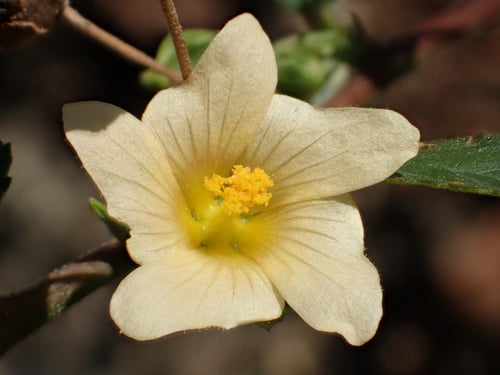
iNaturalist· cc-by-nc
(c) Dave Walter, some rights reserved (CC BY-NC)
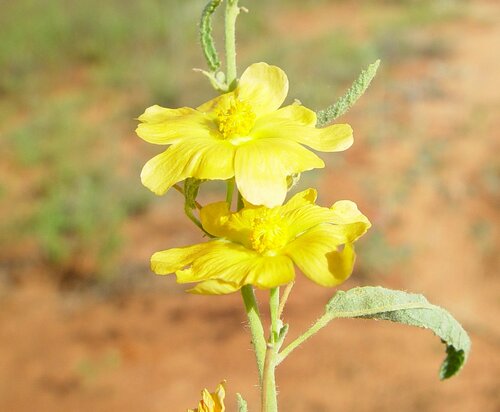
iNaturalist· cc-by-nc
(c) Dave Walter, some rights reserved (CC BY-NC)
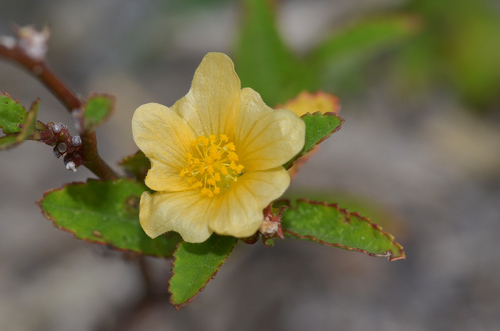
iNaturalist· cc-by-nc
(c) kotp, some rights reserved (CC BY-NC)
Summary
Source: WikipediaGrewia latifolia is a small shrub that is endemic to Northern and Eastern Australia. Its fruits have a distinct similarity to dog testicles, giving rise to the common name of dogs balls. Other common names include emu berry and dysentery plant. Growing to a height of 2m, the species is characterised by ovate leaves with serrated margins. The leaves are discolourous with green papery upper surfaces and pale green to yellow pubescent lower surfaces. The species is deciduous, shedding leaves in response to dry conditions. Cream coloured flowers are produced year round. Fruits are woody capsules with four externally visible compartments covered with coarse hairs.
Description
A medium sized shrub. It grows 4-6 m high and spreads 1-2 m wide. The young growth is hairy. The leaves are 3-15 cm long and 2.5-13 cm wide. They can be broadly oval or have 3 lobes. There are coarse teeth along the edges. Leaves are dark green above and paler underneath. They are slightly hairy on top and woolly underneath. The leaf stalks are 0.5-2 cm long. The flowers are about 0.7 cm across. They are greenish. The fruit are 1.2-1.5 cm across and have 4 lobes.
Edible Uses
The acidic fruit is used in curries and chutneys, and the nuts are also edible.
Traditional Uses
The fruit are acid and can be used in curries and chutneys.
This uses section is brief — help expand it
Medicinal Uses
Grewia species are valued in many cultures for their medicinal virtues. The main medicinal action appears to come from the mucilage that is found in the leaves, stems and roots, which has been shown to have soothing and healing properties. Taken internally it is often used as a remedy for diarrhoea and dysentery, for example, whilst externally it is applied to wounds, cuts, ulcers, irritations etc. The plant can be taken as a simple infusion or decoction, or it can be applied topically as a poultice of the plant, or the mucilage can be extracted from the plant, if required, by maceration and then decoction. . The fruit is used as a remedy for dysentery. The plant (leaves, root) contains a mucilage and this is of benefit in the treatment of diarrhoea and dysentery. A decoction of the root is drunk.
Distribution
A tropical plant. It grows in rainforests and moist locations in warm temperate climates. They need to be in a shady position.
Where It Grows
Australia, Malaysia, SE Asia, Singapore,
Cultivation
Plants are grown from fresh seed. The flesh is removed before sowing. The germination can be improved by pouring boiling water over them and allowing to soak for 24 hours.
Propagation
Seed - we have no specific information for this species but seed of this genus is generally best sown as soon as it is ripe. Stored seed has a hard seedcoat and may benefit from scarification before sowing in order to speed up and improve germination. This can usually be done by pouring a small amount of nearly boiling water on the seeds (being careful not to cook them!), allowing the mix to cool somewhat and then leaving it in a warm place to soak for 12 - 24 hours. Sow the seeds in situ or in a nursery seedbed or trays - do not allow the compost to become dry. Germination and early growth are usually quite quick. Cuttings - best taken with a heel.
Other Uses
The wood is hard, close-grained, and takes a good polish.
Notes
There are about 200 Grewia species. They are mostly tropical. The fruit of most may be edible. These were in the Sparrmanniaceae and the Tiliaceae.
Nutrition
| Part | Moisture | kJ | kcal | Protein | Vit A | Vit C | Iron | Zinc |
|---|---|---|---|---|---|---|---|---|
| Fruit | 59.8 | — | — | 1 | — | 1 | 1.2 | 0.3 |
Also Known As
Chenderai gajah, Damak-damak bulu, Dog’s Balls, Tajam damak
References (8)
- Bodkin, F., 1991, Encyclopedia Botanica. Cornstalk publishing, p 519
- Burkill, I.H., 1966, A Dictionary of the Economic Products of the Malay Peninsula. Ministry of Agriculture and Cooperatives, Kuala Lumpur, Malaysia. Vol 1 (A-H) p 1130
- Edible and Useful Native Plants (off internet)
- Elliot, W.R., & Jones, D.L., 1990, Encyclopedia of Australian Plants suitable for cultivation. Vol 5. Lothian. p 160
- Lazarides, M. & Hince, B., 1993, Handbook of Economic Plants of Australia, CSIRO. p 125
Show all 8 references Hide references
- Low, T., 1991, Wild Food Plants of Australia. Australian Nature FieldGuide, Angus & Robertson. p 116
- Melzer, R. & Plumb, J., 2011, Plants of Capricornia. Belgamba, Rockhampton. p 348
- Townsend, K., 1994, Across the Top. Gardening with Australian Plants in the tropics. Society for Growing Australian Plants, Townsville Branch Inc. p 241