Glycyrrhiza lepidota
(Nutt.) Pursh
American liquorice
iNaturalist· cc-by-nc-sa
(c) Belinda Lo, some rights reserved (CC BY-NC-SA), uploaded by Belinda Lo
iNaturalist· cc-by-nc
(c) whitemudwayne, some rights reserved (CC BY-NC)
iNaturalist· cc-by-nc
(c) Matthias Buck, some rights reserved (CC BY-NC)
Summary
Source: WikipediaGlycyrrhiza lepidota (American licorice) is a species of Glycyrrhiza (a genus in the pea/bean family, Fabaceae) native to most of North America, from central Canada south through the United States to California, Texas and Virginia, but absent from the southeastern states. It is also sometimes known in the United States as "wild licorice", to distinguish it from the related European licorice (Glycyrrhiza glabra) which is occasionally cultivated. The plant grows in moist soils; although it will grow in heavy soil it prefers sandy soil. It grows to 40–100 cm (16–39 in) tall, and has long tough brown roots which are said to be sweet and were used as food and for medicinal purposes by Native Americans. After eating a roasted root in 1806, Meriwether Lewis described an "agreeable flavor not unlike the sweet pittaitoe (sweet potato)." American licorice is not sweet from sugar but from glycyrrhizin. Glycyrrhizin may increase blood pressure (aka hypertension) by interfering with cortisol conversion. The Zuni people chew the root to keep the mouth sweet and moist. American licorice is grazed by cattle, but not preferred and will increase under grazing as competing plants are grazed off. The new growth can be toxic. It has light green to white flowers in the spring which ripen in the fall to clusters of burs which contain pods of small bean-like seeds. It can be used as a pioneer species to revegetate bare or disturbed ground and is often the first species to invade a receding alkali flat. There is a market for American licorice root both for medicinal uses and flavoring; also the sweetening of tobacco products.
Description
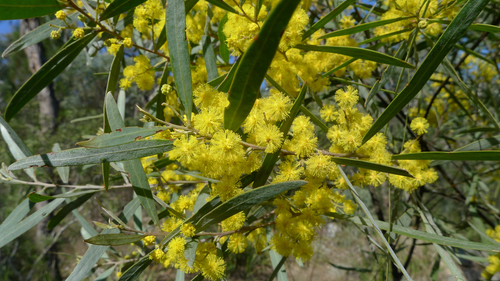
A herb that continues to grow from year to year. It grows 25-75 cm tall. There are several compound leaves. There are 11-19 pale green leaflets. They are oblong and have gland dots. The flowers are yellowish-white. They are showy. The flowers are 1.2 cm long and occur in dense clusters. They have 5 sepals and 5 petals. The fruit is an oblong reddish-brown pod. It is 12-18 mm long. It is covered with hooked prickles.
Edible Uses
The root can be eaten raw or cooked. It is long, sweet, and fleshy — when slow roasted it is said to taste like sweet potato — and can also be used as a flavouring in other foods. Raw, it makes an excellent masticatory, serving as an effective tooth cleaner and being very good for teething children. The root contains 6% glycyrrhizin, a substance 50 times sweeter than sugar. The tender young shoots can be eaten raw in spring.
Traditional Uses
The roots are cooked and eaten. They can be roasted. The raw roots were chewed. They are also used to flavour other foods. They can be dried and brewed into tea. The young tender shoots can be eaten raw.
Medicinal Uses
American liquorice was widely used medicinally by a number of native North American Indian tribes across a range of conditions. All parts of the plant have medicinal value, but the roots are the most active. This species has properties similar to other liquorices widely used in medicine, though it is rather neglected in modern literature. An infusion of the root is used to speed delivery of the placenta after childbirth and to treat coughs, diarrhoea, chest pains, fevers in children, and stomach aches. It is also applied as a wash or poultice on swellings. Chewed root is held in the mouth to treat toothache and sore throats. Mashed leaves are applied as a poultice on sores, and leaves have also been placed inside shoes to absorb moisture.
Distribution
It grows on prairie slopes and stream banks. It suits hardiness zones 3-8.
Where It Grows
Alaska, Canada, Central America, Mexico, North America, USA,
Propagation
Pre-soak seed for 24 hours in warm water, then sow in spring or autumn in a greenhouse. Prick out seedlings into individual pots when large enough to handle and grow on through their first winter under glass. Plant out in late spring or early summer when in active growth. Plants are rather slow to grow from seed. Divide roots in spring or autumn, ensuring each division has at least one growth bud. Autumn divisions can be replanted immediately or stored in clamps until spring. Pot up smaller divisions and grow them on in a cold frame until established before planting out in spring or summer.
Other Uses
Nitrogen fixer. Acts as a dynamic accumulator, gathering minerals and nutrients from the soil and storing them in a more bioavailable form for use as fertilizer or mulch improver.
Notes
There are about 18 Glycyrrhiza species. The roots contain 6% glycyrrhizin.
References (13)
- Beckstrom-Sternberg, Stephen M., and James A. Duke. "The Foodplant Database." http://probe.nalusda.gov:8300/cgi-bin/browse/foodplantdb.(ACEDB version 4.0 - data version July 1994)
- Cormack, R. G. H., 1967, Wild Flowers of Alberta. Commercial Printers Edmonton, Canada. p 174
- Facciola, S., 1998, Cornucopia 2: a Source Book of Edible Plants. Kampong Publications, p 105
- Fl. Amer. sept. 2:480. 1813-1814
- Hedrick, U.P., 1919, (Ed.), Sturtevant's edible plants of the world. p 331
Show all 13 references Hide references
- http://www.stoller-eser.com/Flora/ethnobotany_table.htm
- Jackes, D. A., Edible Forest Gardens
- Kiple, K.F. & Ornelas, K.C., (eds), 2000, The Cambridge World History of Food. CUP p 1802
- MacKinnon, A., et al, 2009, Edible & Medicinal Plants of Canada. Lone Pine. p 259
- Moerman, D. F., 2010, Native American Ethnobotany. Timber Press. p 248
- Plants for a Future database, The Field, Penpol, Lostwithiel, Cornwall, PL22 0NG, UK. http://www.scs.leeds.ac.uk/pfaf/
- Scotter, G. W., & Flygare, H., 1993, Wildflowers of the Canadian Rockies. Hurtig. p 60
- Seidemann J., 2005, World Spice Plants. Economic Usage, Botany, Taxonomy. Springer. p 169