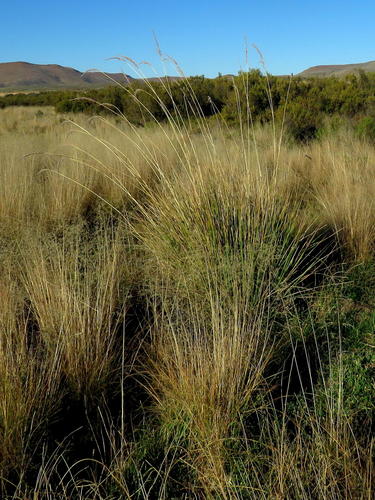
Glyceria occidentalis
(Piper) J. C. Nelson
North-western Manna Grass
wikimedia· cc0
Wikimedia Commons - Gordon Leppig & Andrea J. Pickart
wikimedia· cc0
Wikimedia Commons - Chase, Agnes; Hitchcock, A. S.
Summary
A perennial grass reaching 1 m in height with hermaphrodite, wind-pollinated flowers. Tolerates light sandy, medium loamy, and heavy clay soils across mildly acidic to mildly alkaline pH ranges. Grows in semi-shade or full sun, favoring wet soils and capable of thriving in water.
Description
A perennial grass reaching 1 m in height with hermaphrodite, wind-pollinated flowers. Tolerates light sandy, medium loamy, and heavy clay soils across mildly acidic to mildly alkaline pH ranges. Grows in semi-shade or full sun, favoring wet soils and capable of thriving in water.
Edible Uses
The seeds can be cooked, ground into flour, and used as a cereal. Native Indians used them as a food source. Bear in mind that the seeds are very small and fiddly to harvest.
Traditional Uses
The seeds are dried and ground into flour.
This uses section is brief — help expand it
Medicinal Uses
None known.
Distribution
It is a temperate plant.
Where It Grows
Canada, North America, USA,
Propagation
Sow seed in spring in a greenhouse in a pot standing in 3–5cm of water. Surface sow or barely cover the seed; germination should occur within 3 weeks. Once seedlings are large enough to handle, prick them out into individual pots and plant out in early summer. With sufficient seed, sow outdoors in situ in mid to late spring. For division, split clumps in spring — larger clumps can go directly into permanent positions, while smaller ones are best potted up and grown on in a cold frame until rooting well, then planted out in spring.
Other Uses
None known.
Notes
Possibly Glyceria x occidentalis.
References (3)
- Plants for a Future database, The Field, Penpol, Lostwithiel, Cornwall, PL22 0NG, UK. http://www.scs.leeds.ac.uk/pfaf/
- Romanowski, N., 2007, Edible Water Gardens. Hyland House. p 58
- Torreya 19:224. 1919