Allanblackia stuhlmannii
(Engl.) Engl.
Mkani, Msambo
iNaturalist· cc-by
(c) Carrie Seltzer, some rights reserved (CC BY), uploaded by Carrie Seltzer
iNaturalist· cc-by
(c) Carrie Seltzer, some rights reserved (CC BY), uploaded by Carrie Seltzer
iNaturalist· cc-by
(c) Carrie Seltzer, some rights reserved (CC BY), uploaded by Carrie Seltzer
Summary
Source: WikipediaAllanblackia stuhlmannii is a species of flowering plant in the family Clusiaceae. It is found only in Tanzania.
Description
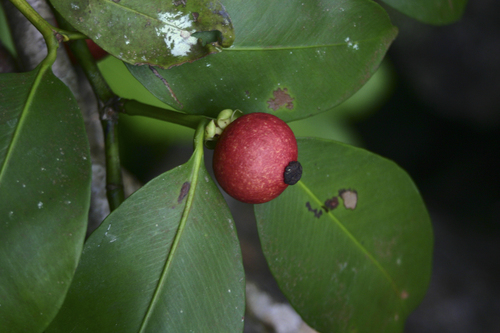
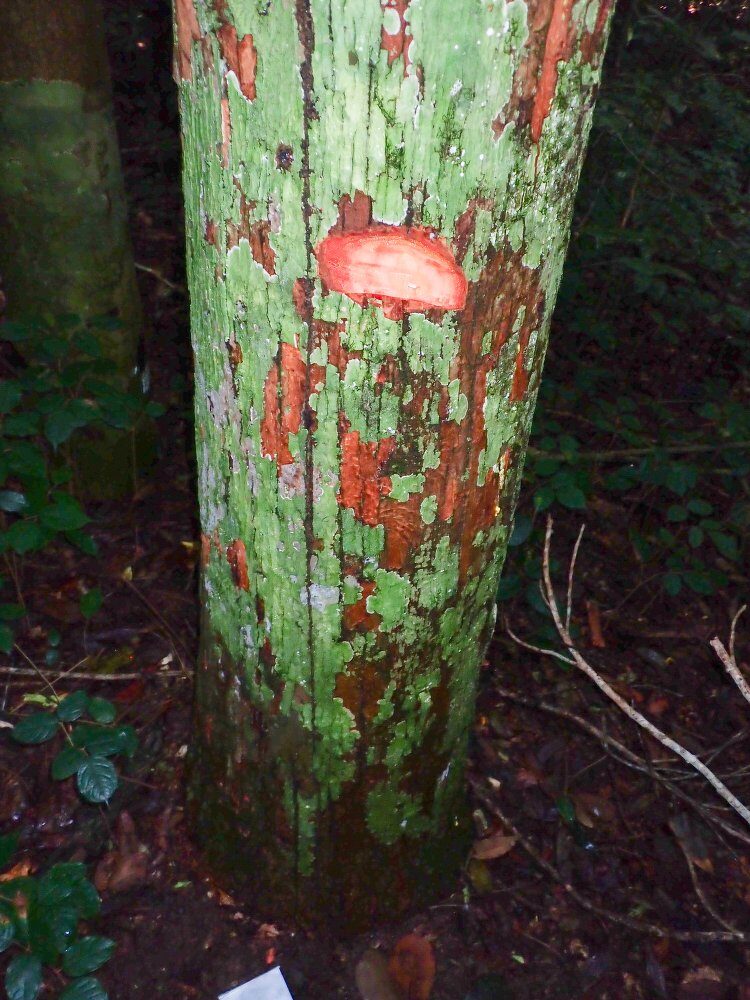
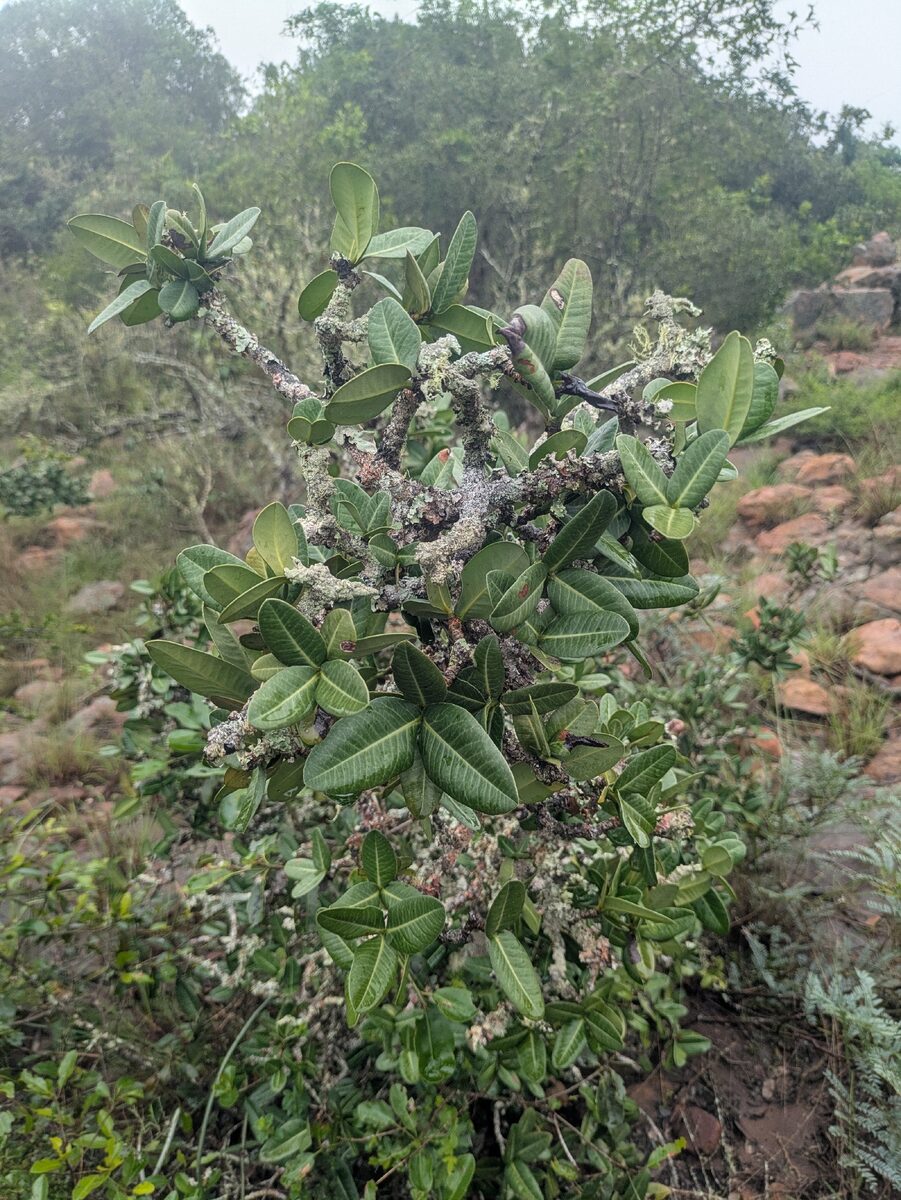
An evergreen tree. It grows 35 m tall. The trunk is cylinder shape with buttresses near the base. The bark is smooth and dark grey. The branches droop and are hollow. They have wrinkles along them. The leaves are simple and opposite. They are 5-20 cm long by 1-7 cm wide. They are leathery and dark green and taper to a short tip. Trees are separately male and female. The flowers occur singly in the axils of leaves. They are also crowded near the ends of branches. The fruit is a long or cone shaped berry. It is 16-34 cm long by 15-17 cm wide. They contain 60-140 seeds. The seeds have 4 angles. They are 4 cm long by 2-3 cm wide.
Edible Uses
An edible non-drying fat called Mkani fat is obtained from the seed and is locally important for cooking; it has also been used as a substitute for butter and cocoa butter. Air-dried seeds contain about 50% fat, composed mainly of stearic acid (45–58%) and oleic acid (40–51%), with only traces of other fatty acids. The resulting high melting point of 35°C makes the fat valuable as a raw material that can be used without transformation to improve the consistency of margarines, cocoa butter substitutes, and similar products. Seeds are extracted by crushing fruits between the hands and rubbing them clean. Traditionally, seeds are then dried and crushed, the mass mixed with water and boiled until the fat separates and floats to the surface, where it is scooped off. The slimy, jelly-like fruit pulp can be used in jam making.
Traditional Uses
The oil is edible and used in cooking and as a substitute for butter. The seeds of mature fruit are dried in the sun and then pounded and cooked to extract the oil-fat. The slimy jelly like pulp is used for jam making.
Medicinal Uses
The leaves are chewed in traditional medicine to treat cough, while leaves, bark, and roots are used to treat impotence. A seed extract is rubbed into the body to treat rheumatism. The fat is applied as a liniment on aching joints, wounds, and rashes, and small quantities are also taken orally to treat rheumatism. A mixture of the fat and pounded seeds of Psorospermum febrifugum is rubbed onto deep cracks in the soles of the feet. Guttiferone F, a prenylated benzophenone, has been isolated from the wood of the roots and is related to a group of compounds investigated for anti-HIV properties.
Known Hazards
None reported.
Distribution
It is a tropical plant. In Tanzania trees grow between 800-1,200 m altitude. The temperature range is 25°C - 35°C.
Where It Grows
Africa, Central America, Costa Rica, East Africa, Tanzania*,
Cultivation
Although trees can be grown from seeds, it is better to take cuttings (or air layers) from female trees. These can form roots in 8-12 weeks.
Propagation
Although trees can be grown from seed, taking cuttings or air layers from female trees is preferable; these can form roots in 8–12 weeks. For seed propagation, well-matured fruits are kept for about 2 weeks to soften the pulp and ease seed extraction; fruits may be stored for up to 3 months if covered with banana leaves. Clean seeds are placed in a nursery where germination typically begins after about 3 months, though it may take more than 7 months to start and a further 18 months to complete. After germination, seedlings are transferred to polythene tubes filled with soil. Mycorrhizae are essential for successful seedling growth, so soil from around the base of mother trees should be added to the substrate. Cuttings are placed a few centimetres deep at a 45° angle in polythene tubes with at least one node above the substrate, and strike root in 8–12 weeks, after which rooted cuttings are moved to polybags. Methods of layering and budding are being developed. Initial tests with wildlings have shown good survival rates both with farmers and in experiments.
Other Uses
The bark yields both a red dye and a yellow dye. Fat from the seed is used to make candles. The heartwood is dark brown to purplish and typically forms only a small core — around 10cm of heartwood in a bole of 65cm — with pale grey-brown sapwood. The texture is medium with a straight grain. The wood air-dries slowly with a moderate tendency to cup but little or no splitting. It is difficult to saw when green but once dry saws easily, machines well, and holds nails well. The sapwood is not durable but is permeable to preservatives; the heartwood is very resistant. The wood is used for construction, cheap joinery, boxes, crates, beehives, and water containers, as well as for fuel.
Production
Trees flower when about 12 years old. Fruit take more than a year to develop and mature. A fruit weighs 2.5-6 kg. A mature tree can produce 150 fruit in one year. This yields 50 kg of fat. Dried seeds can be stored for several months.
Other Information
The edible oil is used locally and traded. The seeds are sold in local markets.
Notes
Guttiferae/Clusiaceae are mostly confined to the tropics and subtropics. The oil is considered a functional food.
Synonyms
Also Known As
Mkange, Mkani, Mkanye, Mkimbo, Msambu, Mwaka
References (17)
- Bircher, A. G. & Bircher, W. H., 2000, Encyclopedia of Fruit Trees and Edible Flowering Plants in Egypt and the Subtropics. AUC Press. p 18
- Crockett, S. L., 2015, Allanblackia Oil: Phytochemistry and Use as a Functional Food. Int. J. Mol. Sci. 2015, 16, 22333-22349
- Davis, S.D., Heywood, V.H., & Hamilton, A.C. (eds), 1994, Centres of plant Diversity. WWF. Vol 1. p 250
- Food Composition Tables for use in Africa FAO http://www.fao.org/infoods/directory No. 434
- FAO. 1983, Food and fruit-bearing forest species 1: Examples from Eastern Africa. FAO Food and Forestry Paper 44/1 p 3
Show all 17 references Hide references
- http://www.fao.org/forestry/25323-096344a3de335832e8f363c3ac5184a66.pdf
- INFOODSUpdatedFGU-list.xls
- Jardin, C., 1970, List of Foods Used In Africa, FAO Nutrition Information Document Series No 2.p 38
- Lovett, J. C. et al, Field Guide to the Moist Forest Trees of Tanzania. p 65
- Msuya, T. S., et al, 2010, Availability, Preference and Consumption of Indigenous Foods in the Eastern Arc Mountains, Tanzania, Ecology of Food and Nutrition, 49:3, 208-227
- Mwaura, L. & Munjuga, M., 2007. Allanblackia stuhlmannii (Engl.) Engl. [Internet] Record from Protabase. van der Vossen, H.A.M. & Mkamilo, G.S. (Editors). PROTA (Plant Resources of Tropical Africa / Ressources végétales de l’Afrique tropicale), Wageningen, Netherlands. < http://database.prota.org/search.htm>. Accessed 13 October 2009.
- Peters, C. R., O'Brien, E. M., and Drummond, R.B., 1992, Edible Wild plants of Sub-saharan Africa. Kew. p 83
- Reis, S. V. and Lipp, F. L., 1982, New Plant Sources for Drugs and Foods from the New York Botanical Garden herbarium. Harvard. p 185
- Ruffo, C. K., Birnie, A. & Tengnas, B., 2002, Edible Wild Plants of Tanzania. RELMA p 116
- Wickens, G.E., 1995, Edible Nuts. FAO Non-wood forest products. FAO, Rome. p 131
- World Checklist of Useful Plant Species 2020. Royal Botanic Gardens, Kew
- www.worldagroforestrycentre.org/treedb/