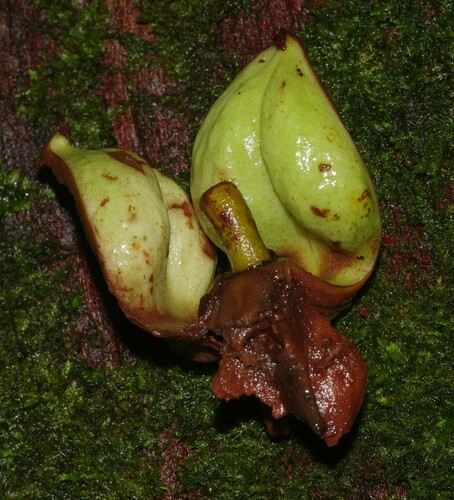
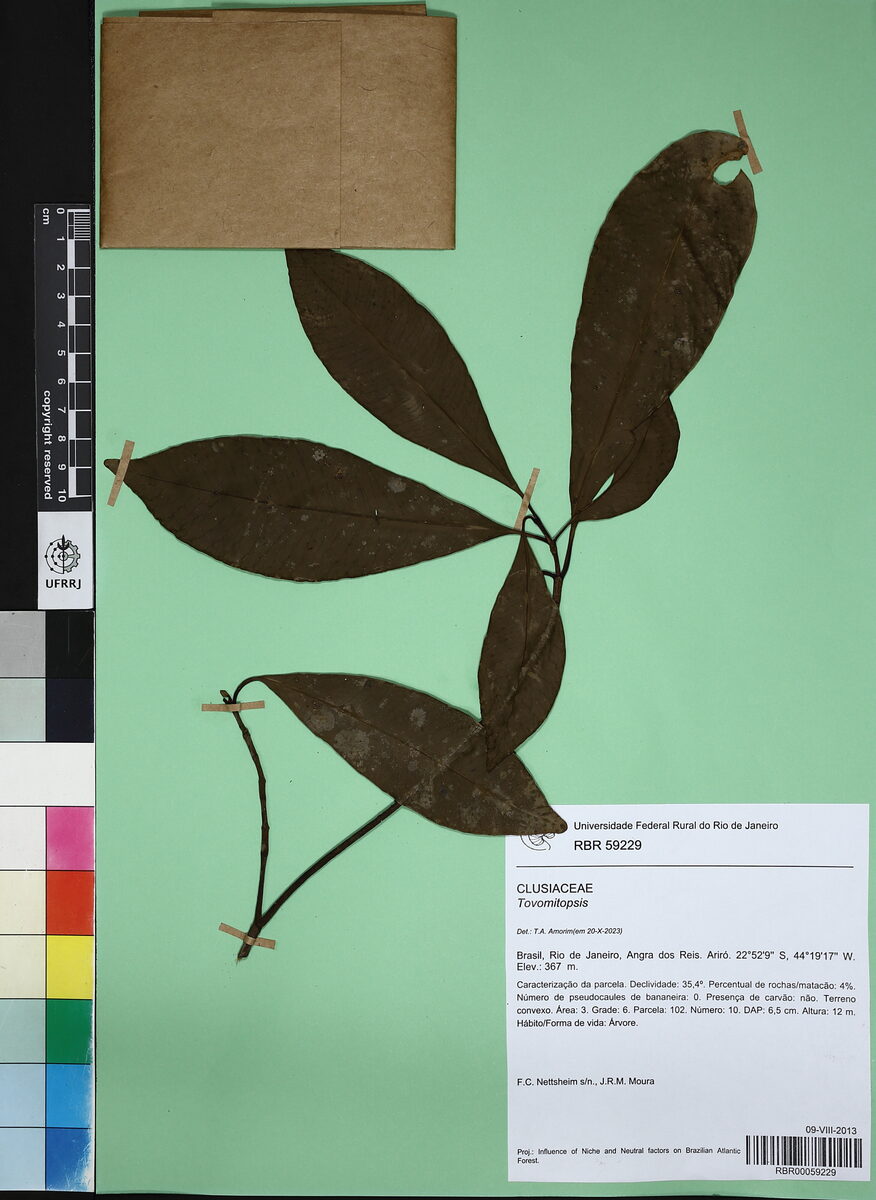
Allanblackia floribunda
Oliv.
Tallow tree, Vegetable tallow tree
iNaturalist· cc-by-nc
(c) Scamperdale, some rights reserved (CC BY-NC)
iNaturalist· cc-by-nc
(c) Scamperdale, some rights reserved (CC BY-NC)
Summary
Source: WikipediaAllanblackia floribunda, known in English as 'tallow tree', is a species of flowering plant in the family Clusiaceae that has been long used in traditional African medicine to treat hypertension. It is a common understory tree in rainforests in western central Africa - from Sierra Leone to western Cameroon, and on into the Democratic Republic of Congo and Uganda. The medium-sized tree (up to 30 meters tall) is evergreen and dioecious (male and female flowers on different plants). The wood is said to be resistant to termites but is not particularly durable. It is fairly easy to work and finishes well but it is of little commercial importance though it has appeared on the market in Liberia as "lacewood".
Description
A tree up to 30 m tall. The trunk is straight. The bark is dark brown. The branches are slender and drooping. They are often in rings. The leaves are 10-25 cm long and 3.5-7.5 cm wide. They are rounded at the base and taper to the tip. The flowers are large and white, pink or red. They have a fragrant smell. The fruit are sausage shape pods 45 cm long and 12 cm across. They hang on the ends of short branches. They taper towards each end. They are brown and roughly fleshy with grooves along them. They contain up to 50-100 red-brown seeds. The seeds are about 4 cm by 2 cm and irregular in shape. They have flattened surfaces. The seeds are in a pink pulp.
Edible Uses
The seed yields a fat known as 'allanblackia fat' or 'beurre de bouandjo' in Congo, used in food preparation. The kernel makes up about 60% of the seed and contains around 72% fat, composed of approximately stearic acid (45–58%) and oleic acid (40–51%), with only traces of other fatty acids. Its high melting point of 35°C makes it suitable as a raw material — without further transformation — for improving the consistency of margarines, cocoa butter substitutes, and similar products. The international food industry has taken growing interest in it for this purpose. To process the fat, seeds are dried and crushed, the mass is mixed with water and boiled until the fat separates and floats to the surface, where it is scooped off. Hydraulic and screw press equipment is also now used. To reach the seeds, fruits are stored under a cover of leaves until the pulp disintegrates, then crushed between the hands and rubbed clean. The seeds themselves are eaten in times of food scarcity. The slimy fruit pulp can be made into jams and jellies. The fruit is large — up to 30cm long by 10cm in diameter — and contains upward of 100 seeds held within a translucent mucilage.
Traditional Uses
The fat of the seeds is eaten. It can be used to make margarine. The fruits slimy pulp can be made into jams and jellies. The seeds are roasted and eaten.
Medicinal Uses
A decoction of the inner bark is taken to treat diarrhoea, dysentery, and stomach aches, and is also used as a mouthwash to relieve toothache pain. The bark is anodyne and, when pounded, is rubbed on the body to relieve painful conditions. A decoction of bark or leaves is taken for asthma, bronchitis, and cough. Sap squeezed from the bark contributes to a medicine for urethral discharge; sap from a crushed mixture of the bark combined with that of Mammea africana, maleguetta, and sugar-cane is taken for the same purpose. A decoction of the whole fruit is used to relieve elephantiasis of the scrotum, though this application may be based on the Theory of Signatures given the fruit's size and shape. A prenylated xanthone named allanxanthone A has been isolated from the bark, along with 1,5-dihydroxyxanthone and 1,5,6-trihydroxy-3,7-dimethoxyxanthone; these compounds showed moderate in-vitro cytotoxicity against the KB cancer cell line. Bark and root material has been reported to contain abundant flavonoids, some tannins, and traces of steroids and terpenes.
Distribution
It is a tropical plant. It occurs in Sierra Leone, Cameroon, Congo and Uganda. It grows in forest.
Where It Grows
Africa, Angola, Benin, Cabinda, Cameroon, Central Africa, Central African Republic, CAR, Congo DR, Congo R, Côte d'Ivoire, East Africa, Equatorial-Guinea, Gabon, Ghana, Ivory Coast, Liberia, Nigeria, Sierra Leone, Tanzania, Togo, Uganda, West Africa,
Cultivation
It grows best in areas where the maximum mean annual temperature ranges from 24 - 33c, whilst the minimum can fall below 10c. It prefers a mean annual rainfall in the range 1,200 - 2,400mm. Grows best in a sunny position. Prefers well-drained soils especially lithosols. Common in the wild on strongly leached, acid soils with pH 3.8 - 4.1. Under natural conditions, trees start flowering after about 12 years, with the flowering occurring during a large part of the year. Fruits take nearly a year to mature and ripe fruits are also found during a large part of the year. The degree of maturity of fruits on the tree can not be estimated, so mature fruits are left to drop to the ground and are then collected. The fat from the seeds of Allanblackia floribunda is very similar in composition to that of Allanblackia parviflora and Allanblackia stuhlmannii. A dioecious species, both male and female forms need to be grown if fruit and seed are required.
Propagation
Seed – germination takes 6–18 months and germination rates are very low. Storing fruits for a few months on damp sites, covered with banana leaves and partially buried, along with scarification of the seed coat, improve germination rates only slightly. Methods of propagation by cuttings and grafting are currently being developed.
Other Uses
Trees are commonly retained when clearing land for cultivation and managed specifically for shading cocoa. Seed oil is used in soap making and the cosmetics industry. Small twigs serve as chew-sticks or toothpicks, and have also been used as candlesticks. A sticky yellow resin is obtained from the inner bark. The heartwood is pale red or brown, usually clearly demarcated from the thick pinkish beige sapwood. The grain is fairly straight with a medium to coarse texture and low lustre. The wood is fairly hard and durable, moderately resistant to termites, and resistant to marine borers. Green wood may spring on conversion, but dry wood saws well and is fairly easy to work with hand and machine tools. It is used locally in house construction in Nigeria, though it is considered of secondary commercial importance.
Production
The kernel is about 62% of the seeds by weight.
Other Information
It is valued for its nuts.
Notes
There are 10 Allanblackia species. Guttiferae/Clusiaceae are mostly confined to the tropics and subtropics.
Nutrition
| Part | Moisture | kJ | kcal | Protein | Vit A | Vit C | Iron | Zinc |
|---|---|---|---|---|---|---|---|---|
| Seeds dried | 6 | 2709 | 648 | 3.6 | — | — | — | — |
Synonyms
Also Known As
Anyoe, Bianji, Ebungo matatolo, Egba, Izeni, Kisidwe, Mbawandje, Nionzo nzibu, Nsangomo, Nyonne, Orongbo-erin, Ouotera, Sangoma
References (23)
- Atangana, A. R., 2010, Phenotypic Diversity in Fruit and Seed Traitsand Neutral Genetic Diversity in Allanblackia floribunda. PhD thesis, Quebec
- Burkill, H. M., 1985, The useful plants of west tropical Africa, Vol. 5. Kew.
- Busson, 1965,
- Crockett, S. L., 2015, Allanblackia Oil: Phytochemistry and Use as a Functional Food. Int. J. Mol. Sci. 2015, 16, 22333-22349
- Dalziel, J. M., 1937, The Useful plants of west tropical Africa. Crown Agents for the Colonies London.
Show all 23 references Hide references
- Fobane, J. L., et al, 2014, Population structure and natural regeneration of Allanblackia floribunda Oliv. (Clusiaceae) in a forest concession of East Cameroon. J. Bio. & Env. Sci. 4(2): 403-410
- Hwang, L. C., et al, 2020, Traditional Botanical Uses of Non-Timber Forest Products (NTFP) in Seven Counties in Liberia. ACS Symposium Series; American Chemical Society: Washington, DC, 2020.
- Ingram, V. & Schure, J. 2010, Review of Non Timber Forest Products (NTFPs) in Central Africa, Cameroon. Center for International Forestry Research (CIFR). p 34
- Jardin, C., 1970, List of Foods Used In Africa, FAO Nutrition Information Document Series No 2.p 38
- J. Linn. Soc., Bot. 10:43. 1867
- Keay, R.W.J., 1989, Trees of Nigeria. Clarendon Press, Oxford. p 104
- Latham, P. & Mbuta, A. K., 2014, Useful Plants of Bas-Congo Province, Democratic Republic of Congo. Volume 1. p 35
- Latham, P. & Mbuta, A. K., 2017, Plants of Kongo Central Province, Democratic Republic of Congo. Volume 1. 3rd ed p 39
- Menninger, E.A., 1977, Edible Nuts of the World. Horticultural Books. Florida p 46
- Moutsambote, J., 1996, Vegetation forestiere et plantes alimentaires de la region de la Sangha. Chp. 11 of Bien Manger et Bien Vivre. ORSTOM p 119
- Nkeoua, G. & Boundzanga, G. C., 1999, Donnees sur les produits forestieres non ligneux en Republique du Congo. FAO. p 20
- Peters, C. R., O'Brien, E. M., and Drummond, R.B., 1992, Edible Wild plants of Sub-saharan Africa. Kew. p 83
- Vivien, J. & Faure, J.J., 1985, Abres des forets dense d'Afrique Centrale. Agence de Cooperation Culturelle et Technique. Paris. p 212
- Vivien, J., & Faure, J.J., 1996, Fruitiers Sauvages d'Afrique. Especes du Cameroun. CTA p 119
- Wickens, G.E., 1995, Edible Nuts. FAO Non-wood forest products. FAO, Rome. p 131
- Wiersema, J. H. & Leon, B., 2013, World Economic Plants. A Standard Reference CRC Press. 2nd Ed. p 32
- World Checklist of Useful Plant Species 2020. Royal Botanic Gardens, Kew
- www.worldagroforestrycentre.org/treedb/