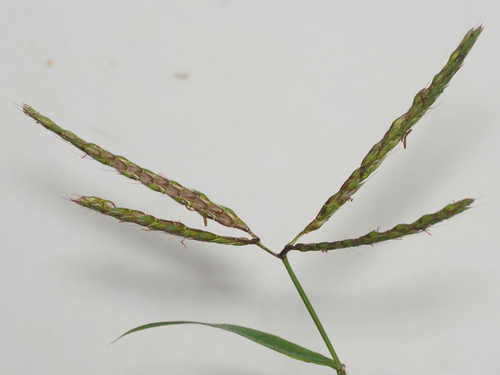
Gigantochloa atroviolacea
Widjaja
Giant Black bamboo
iNaturalist· cc-by-sa
(c) Ong Jyh Seng, some rights reserved (CC BY-SA), uploaded by Ong Jyh Seng
iNaturalist· cc-by-sa
(c) Wie146, some rights reserved (CC BY-SA)
iNaturalist· cc-by-sa
(c) Wie146, some rights reserved (CC BY-SA)
Summary
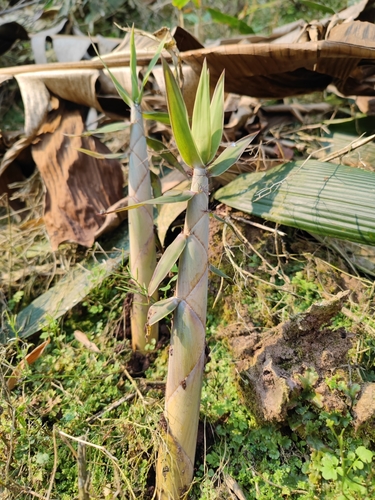
Gigantochloa atroviolacea is a medium-growing evergreen bamboo reaching 12 m tall and 4 m wide. Wind-pollinated and hardy to UK zone 10. Tolerates light, loamy, or clay soils with well-drained conditions and mildly acidic to neutral pH. Grows in semi-shade to full sun, preferring moist soil. Culms grow to 12 m, 6–8 cm diameter at base with 8 mm thick walls and internodes 40–50 cm long. Young canes are dark green, aging to greenish or dark brownish-purple with pale rings at nodes and dark brown hairs.
Description
A bamboo. It forms loose tufts. The stems are 12 m tall and 6-8 cm wide. The internodes are 40-50 cm long.
This description is brief — help expand it
Edible Uses
The young shoots are edible and turn yellow-pinkish after cooking.
Traditional Uses
The young shoots are cooked and eaten.
This uses section is brief — help expand it
Medicinal Uses
None known
Distribution
A tropical plant. It grows well in humid lowlands in areas with an annual rainfall of 1,500-3,700 mm. In the Cairns Botanical Gardens.
Where It Grows
Asia, Australia, Indonesia, SE Asia, Singapore, USA,
Cultivation
Grows well in the perhumid lowland tropics, with an annual rainfall of 1,500 - 3,700 mm, relative humidity of over 70% and average temperature of 20 - 32°c. In Java it occurs mostly on red and reddish-brown latosols and lateritic soils, but it prefers drier limestone soils. In dry areas the purplish colour of the culms is more prominent. A slow growing bamboo, usually only 1 - 2 young shoots arise from the rhizome at the base of an old culm so that clumps are usually smaller than those of other bamboos. However, it has been recorded that 2 years after planting 15 culms can be present. Bamboos have an interesting method of growth. Each plant produces a number of new stems annually - these stems grow to their maximum height in their first year of growth, subsequent growth in the stem being limited to the production of new side branches and leaves. In the case of some mature tropical species the new stem could be as much as 30 metres tall, with daily increases in height of 30cm or more during their peak growth time. This makes them some of the fastest-growing species in the world. Culms reach their maximum length within 5 months. The average growth rate is about 9 cm per day. Culm size increases with the age of the clump; average height is 3 metres in the first year after planting, 6.4 metres in the 2nd and 9.3 metres in the 3rd; average diameter increases from 2.2 cm in the first year, 5.5 cm in the 2nd, to 7.6 cm in the 3rd year after planting. Harvesting may start 4 - 5 years after planting. It is recommended to harvest only in the dry season. The average yield of mature clumps is estimated at 20 culms per 3 years (or with 200 clumps per ha, about 4000 culms per ha every 3 years). Traditionally, harvested culms are immersed in running or stagnant water for 15 - 30 days and then air dried. Chemical preservation is possible by soaking the culms in a 5% borax solution for 3 days. Penetration in the walls of whole culms is about 50% for borax. Branching starts by the formation of some rudimentary branches at the first node from below. Then branching continues at about the 10th node from the top, followed by the next two nodes down, and then development continues both up and down the culm from this area until branches have been produced from all nodes situated higher than 2 - 3 metres from the ground. Bamboos in general are usually monocarpic, living for many years before flowering, then flowering and seeding profusely for a period of 1 - 3 years before usually dying.
Propagation
This species is propagated vegetatively only, using rhizome or culm cuttings. In an Indonesian experiment, 1-noded cuttings of 20cm length taken from one-year-old culms were used in a nursery protected from heavy rain, achieving a 60% survival rate. Plants were transplanted to the field approximately one year later when about 75cm tall.
Other Uses
The thin culms have specific acoustic properties that make them suitable for manufacturing the traditional bamboo musical instruments angklung, calung, gambang, and celempung. Though once used almost exclusively for this purpose, the distinctive blackish culms have attracted the handicraft and furniture industries, creating a shortage of material for musical instrument production. The culms grow up to 12 metres tall, are 6–8cm in diameter at the base, with walls up to 8mm thick and internodes up to 40–50cm long. They are dark green when young, turning greenish to dark brownish-purple with age, with distinct pale or whitish rings at the nodes and covered by dark brown glabrescent hairs.
Production
It grows slowly.
Synonyms
Also Known As
Awi hideung, Bambu hitam, Pring wulung
References (3)
- Hibbert, M., 2002, The Aussie Plant Finder 2002, Florilegium. p 111
- PROSEA (Plant Resources of South East Asia) handbook, Volume 7, 1995, Bamboos.
- Sukarya, D. G., (Ed.) 2013, 3,500 Plant Species of the Botanic Gardens of Indonesia. LIPI p 843