Gentiana lutea
Linn.
Bitterwort, Gentian, Yellow gentian
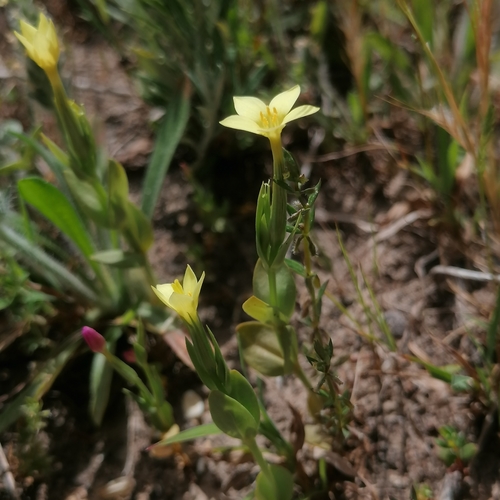
iNaturalist· cc-by-nc
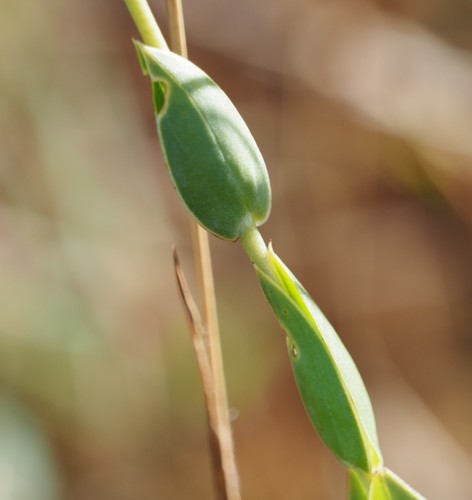
(c) Thomas Menut, some rights reserved (CC BY-NC), uploaded by Thomas Menut
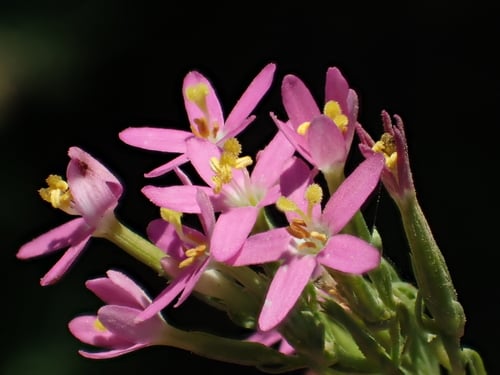
iNaturalist· cc-by-nc
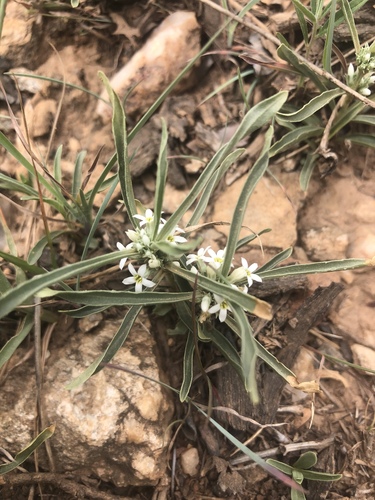
(c) Patricia Morales, some rights reserved (CC BY-NC), uploaded by Patricia Morales
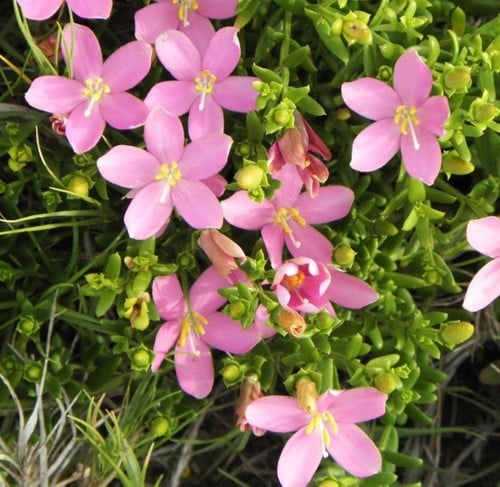
iNaturalist· cc-by-sa
(c) Udo Schmidt, some rights reserved (CC BY-SA)
Summary
Source: WikipediaGentiana lutea, the great yellow gentian, is a species of gentian native to the mountains of central and southern Europe, including the Alps, the Carpathians (where scarce), the Pyrenees, the Apennines, and the mountains of the Balkan Peninsula. It is the type species of the genus Gentiana.
Description
A herb which keeps growing from year to year. It forms clumps. It has fleshy roots. The stems are stout and hollow. It grows 1.5 m tall. The leaves are broadly oval and pleated. They are 30 cm long. The flowers are star shaped and in rings in clusters. They are yellow.
Edible Uses
The root is sometimes used in the manufacture of gentian bitters. It contains sugar and mucilage (likely a reference to its medicinal properties) and was occasionally used as a flavouring in beer before hops (Humulus lupulus) became the predominant bittering agent.
Traditional Uses
The roots are used to make bitter liqueur. They are used as an aromatic flavour in alcoholic drinks. Caution: Alcohol is a cause of cancer. It is also used to flavour pork, poultry and rice dishes.
Medicinal Uses
Gentian root has a long history as a herbal bitter in the treatment of digestive disorders and is an ingredient in many proprietary medicines. It contains some of the most bitter compounds known and serves as a scientific benchmark for measuring bitterness. It is especially valuable in states of exhaustion from chronic disease and in cases of debility, weakness of the digestive system, and poor appetite. It is one of the finest strengtheners of the human system, stimulating the liver, gall bladder, and digestive system, and combines well with a purgative to offset that treatment's debilitating effects. The root is anthelmintic, anti-inflammatory, antiseptic, bitter tonic, cholagogue, emmenagogue, febrifuge, refrigerant, and stomachic. Taken internally, it treats liver complaints, indigestion, gastric infections, and anorexia. It should not be prescribed for patients with gastric or duodenal ulcers. The root, which can be as thick as a person's arm and has few branches, is harvested in autumn and dried for later use. Roots from plants that have not yet flowered are thought to be the richest in medicinal properties. The German Commission E Monographs, a therapeutic guide to herbal medicine, approve Gentiana lutea as a tonic.
Known Hazards
Gentiana lutea is remarkable for the intense bitterness of the root and every part of the herbage. Gentian was used occasionally in brewing. Gentian root has a long history of use as a herbal bitter and is an ingredient of many proprietary medicines. The parts used include the dried, underground parts of the plant. The root is long and thick, usually about 30 cm (12 in) long and 2.5 cm (1 in) diameter, but sometimes 90 cm or more long and 5 cm in diameter, yellowish-brown in colour and very bitter in taste. The rhizome and roots are collected in autumn and dried. Caution should be exercised as to its use because it is endangered in some regions, although the species as a whole is not threatened. The related species Centaurium erythraea shares many of its constituents and actions. The name is a tribute to Gentius, an Illyrian king who was thought to have found out that the herb had tonic properties. In veterinary pharmacopeia in the 1860s, gentian root or gentian radix was considered useful as a tonic and stomachic. Extracts of gentian root can be found in several liqueurs. It is used in France to produce a number of bitter liqueurs (genziana liqueurs), including Salers in the Cantal, and a Limousin specialty liqueur and aperitif called Avèze. The plants are now cultivated in the Auvergne area in view of their protected status, and they are no longer harvested from the wild in the Auvergne mountains. The European Gentian Association in Lausanne has the objective to develop the knowledge and uses of yellow gentian and other species of Gentianaceae. Gentiana lutea is depicted on the reverse of the Albanian 2000 lek banknote, issued in 2008. The note depicts King Gentius on its obverse.
Distribution
It is a temperate plant. It grows naturally in mountain locations that are sunny but not too hot. It needs moist conditions and a deep, humus-rich soil. It can tolerate frost.
Where It Grows
Albania, Alps, Andorra, Australia, Austria, Balkans, Bulgaria, Czech Republic, Europe, France, Germany, Hungary, Italy, Macedonia, Mediterranean, Portugal, Romania, Slovenia, Spain, Switzerland, Tasmania, Turkey, Türkiye,
Cultivation
In general, gentians require a moist well-drained soil in a sheltered position, a certain minimum of atmospheric humidity, high light intensity but a site where temperatures are not too high. They are therefore more difficult to grow in areas with hot summers and in such a region they appreciate some protection from the strongest sunlight. Most species will grow well in the rock garden. This species is easily grown in any good garden soil so long as it is deep enough to accommodate its roots, though it prefers alkaline conditions. It prefers full sun but succeeds in partial shade. A slow-growing plant, it takes many years to reach its full stature. A moisture loving plant, growing well by water, it prefers to grow with full exposure to the sun but with plenty of underground moisture in the summer and it grows better in the north and west of Britain. Plants are very deep-rooted and are intolerant of root disturbance. They are very long lived, to 50 years or more. A very ornamental plant, it takes about 3 years to reach flowering size from seed. Cultivated as a medicinal plant in Europe.
Propagation
Seed is best sown as soon as it is ripe in a light position in a cold frame. It can also be sown in late winter or early spring, though germination is best after a period of cold stratification; stored seed loses viability quickly, with older seed germinating slowly and erratically. Keeping seed at around 10°c for a few days after sowing allows it to absorb moisture. Following this with at least 5–6 weeks of temperatures between 0 and -5°c will usually produce reasonable germination. Clay pots are preferable to plastic, as plastic drains less freely and the resulting moisture encourages moss growth that can prevent germination. Sow seed on the surface or cover with only the lightest dressing of compost. Seed requires darkness to germinate, so cover pots with newspaper or keep them in the dark. Pot seedlings into individual pots as soon as they are large enough to handle, and grow on in light shade in the greenhouse for at least their first winter. Seedlings are slow-growing, taking 2–7 years to reach flowering size. Move plants to their permanent positions in late spring or early summer once large enough. Basal shoot cuttings can be taken in late spring.
Other Uses
None known.
Production
It is slow growing.
Other Information
About 6,000 tons of fresh root are harvested in Europe each year.
Notes
There are about 400 Gentiana species. It is used in herbal medicine.
Synonyms
Also Known As
Einsangna, Genciana, Genziana
References (21)
- Abbet, C., et al, 2014, Ethnobotanical survey on wild alpine food plants in Lower and Central Valais (Switzerland). Journal of Ethnopharmacology 151 (2014) 624–634
- Brouk, B., 1975, Plants Consumed by Man. Academic Press, London. p 367
- Brown, D., 2002, The Royal Horticultural Society encyclopedia of Herbs and their uses. DK Books. p 223
- Christanell, A., et al, 2010, The Cultural Significance of Wild Gathered Plant Species in Kartitsch (Eastern Tyrol, Austria) and the Influence of Socioeconomic Changes on Local Gathering Practices. Chapter 3 in Ethnobotany in the New Europe. Berghahn Books.
- Denes, A., et al, 2012, Wild plants used for food by Hungarian ethnic groups living in the Carpathian Basin. Acta Societatis Botanicorum Poloniae 81 (4): 381-396
Show all 21 references Hide references
- Esperanca, M. J., 1988. Surviving in the wild. A glance at the wild plants and their uses. Vol. 1. p 378
- Facciola, S., 1998, Cornucopia 2: a Source Book of Edible Plants. Kampong Publications, p 117
- Hedrick, U.P., 1919, (Ed.), Sturtevant's edible plants of the world. p 327
- Hibbert, M., 2002, The Aussie Plant Finder 2002, Florilegium. p 109
- Joyce, D., 1998, The Garden Plant Selector. Ryland, Peters and Small. p 229
- Kiple, K.F. & Ornelas, K.C., (eds), 2000, The Cambridge World History of Food. CUP p 433
- Marinelli, J. (Ed), 2004, Plant. DK. p 180
- Pieroni, A.,& Giusti, M. E., 2009, Alpine Ethnobotany in Italy: Journal of Ethnobiology and Ethnomedicine. 5:32
- Rigat, M et al, 2009, Ethnobotany of Food Plants in the High River Ter Valley (Pyrenees, catalonia, Iberian Peninsula): Non-Crop Food Vascular Plants and Crop Food Plants with medicinal Properties. Ecology of Food and Nutrition, 48:303-327
- Sansanelli, S., et al, 2014, Wild food plants traditionall consumed in the area of Bologna (Emilia Romagna region, Italy). Journal of Ethnobiology and Ethnomedicine 10:69
- Seidemann J., 2005, World Spice Plants. Economic Usage, Botany, Taxonomy. Springer. p 163
- Simkova, K. et al, 2014, Ethnobotanical review of wild edible plants used in the Czech Republic. Journal of Applied Botany and Food Quality 88, 49-67
- Sp. pl. 1:227. 1753
- Tardio, J., et al, Ethnobotanical review of wild edible plants in Spain. Botanical J. Linnean Soc. 152 (2006), 27-71
- Wiersema, J. H. & Leon, B., 2013, World Economic Plants. A Standard Reference CRC Press. 2nd Ed. p 320
- World Checklist of Useful Plant Species 2020. Royal Botanic Gardens, Kew