Gaylussacia baccata
(Wangenh.) K. Koch
Black huckleberry
iNaturalist· cc-by-nc
(c) Kent McFarland, some rights reserved (CC BY-NC)
iNaturalist· cc-by-nc
(c) Ian Bryson, some rights reserved (CC BY-NC)
Summary
Source: WikipediaGaylussacia baccata, the black huckleberry, is a common huckleberry found throughout a wide area of eastern North America.
Description
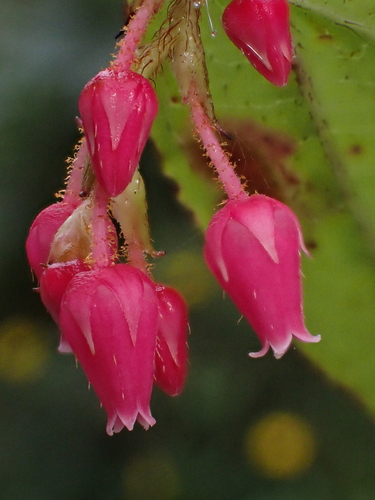
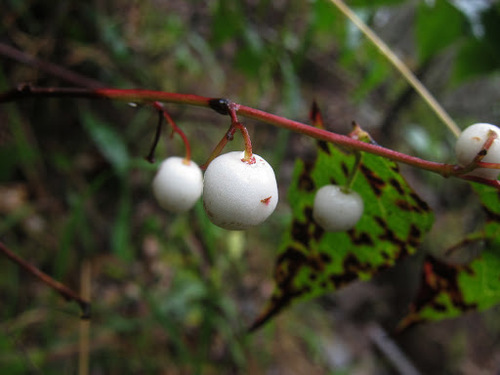
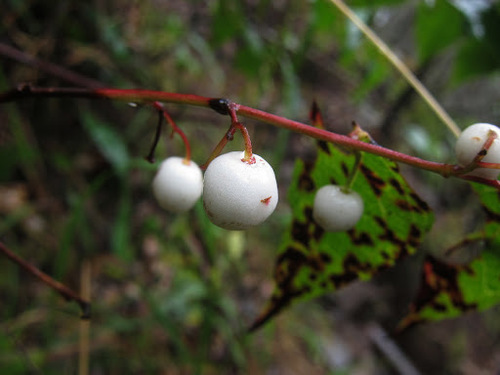
A small shrub. It loses its leaves in the winter. It grows 1 m tall and spreads 1 m wide. The flowers are dull red and urn shaped. The fruit are round and shiny. They are about 5 mm across.
Edible Uses
The fruit can be eaten raw or cooked — deliciously spicy and sweet, it works well straight off the bush or used in pies and preserves. It can also be dried for later use, and the dried fruit can be ground into a powder and mixed with cereal flours to make bread. The fruit is about 8mm in diameter and tends to be rather seedy.
Traditional Uses
The fruit are eaten raw. They can be used in preserves or cooked with sugar. They are used in pies and jams. They are also used for wine. They can be mixed with four or cornmeal and made into bread.
Medicinal Uses
An infusion of the leaves or bark has been used to treat dysentery. An infusion of the leaves has also been used in the treatment of Bright's disease.
Distribution
It is a temperate plant. In Canada it grows in dry rocky or sandy soils. It also grows in woodlands and swamps. It suits hardiness zone 3-7.
Where It Grows
Britain, Canada, Europe, North America*, USA,
Propagation
Seed is best sown in autumn in a cold frame. Seeds are short-lived and difficult to germinate; stored seed requires 1 month of warm stratification followed by 2 months cold. Once seedlings are large enough to handle, prick them out into individual pots of lime-free compost and grow them on in light shade in a greenhouse or cold frame for at least their first winter. Plant out into permanent positions in late spring or early summer when at least 15cm tall. Cuttings of half-ripe wood can be taken in July/August in a frame. Layering and division in spring are also suitable methods.
Other Uses
No other uses are known.
Notes
There are about 42 Gaylussacia species in tropical America. The fruit are edible but sometimes have many seeds. Larger kinds have been selected for cultivation.
Synonyms
References (25)
- Beckstrom-Sternberg, Stephen M., and James A. Duke. "The Foodplant Database." http://probe.nalusda.gov:8300/cgi-bin/browse/foodplantdb.(ACEDB version 4.0 - data version July 1994)
- Brickell, C. (Ed.), 1999, The Royal Horticultural Society A-Z Encyclopedia of Garden Plants. Convent Garden Books. p 458
- Brouk, B., 1975, Plants Consumed by Man. Academic Press, London. p 181
- Dendrologie 2(1):93. 1872
- Duke, J. A., 1992, Handbook of Edible Weeds. CRC Press. p 104
Show all 25 references Hide references
- Elias, T.S. & Dykeman P.A., 1990, Edible Wild Plants. A North American Field guide. Sterling, New York p 167
- Esperanca, M. J., 1988. Surviving in the wild. A glance at the wild plants and their uses. Vol. 1. p 116
- Facciola, S., 1998, Cornucopia 2: a Source Book of Edible Plants. Kampong Publications, p 96
- Fisk, J. R. & Hoover, E., 2015, Wild Fruits of Minnesota. A Field Guide. University of Minnesota p 25
- Glowinski, L., 1999, The Complete Book of Fruit Growing in Australia. Lothian. p 166
- Hanelt, P. et al, (Eds.), 2001, Mansfield's encyclopedia of agricultural and horticultural crops. p 1687
- Hedrick, U.P., 1919, (Ed.), Sturtevant's edible plants of the world. p 326 (As Gaylussacia resinosa)
- Jackes, D. A., Edible Forest Gardens
- John, L., & Stevenson, V., 1979, The Complete Book of Fruit. Angus & Robertson p 286
- Kermath, B. M., et al, 2014, Food Plants in the Americas: A survey of the domesticated, cultivated and wild plants used for Human food in North, Central and South America and the Caribbean. On line draft. p 386 (As Gaylussacia resinosa)
- Kiple, K.F. & Ornelas, K.C., (eds), 2000, The Cambridge World History of Food. CUP p 1787
- Lyle, S., 2006, Discovering fruit and nuts. Land Links. p 222
- MacKinnon, A., et al, 2009, Edible & Medicinal Plants of Canada. Lone Pine. p 109
- Moerman, D. F., 2010, Native American Ethnobotany. Timber Press. p 245
- Plants for a Future database, The Field, Penpol, Lostwithiel, Cornwall, PL22 0NG, UK. http://www.scs.leeds.ac.uk/pfaf/
- Toupal, R. S. & Hollenback, K., 2009, An Ethnobotany of Indiana Dunes National Lakeshore: Plant Uses of the Ojibwa People. Bureau of Applied Research in Anthropology. University of Arizona
- Trehane, J., 2004, Blueberries, Cranberries and Other Vacciniums. Timber Press. p 182
- USDA, ARS, National Genetic Resources Program. Germplasm Resources Information Network - (GRIN). [Online Database] National Germplasm Resources Laboratory, Beltsville, Maryland. Available: www.ars-grin.gov/cgi-bin/npgs/html/econ.pl (10 April 2000)
- Wiersema, J. H. & Leon, B., 2013, World Economic Plants. A Standard Reference CRC Press. 2nd Ed. p 319
- World Checklist of Useful Plant Species 2020. Royal Botanic Gardens, Kew