Gardenia ternifolia
Schum. et Thonn.
Large-leaved common gardenia
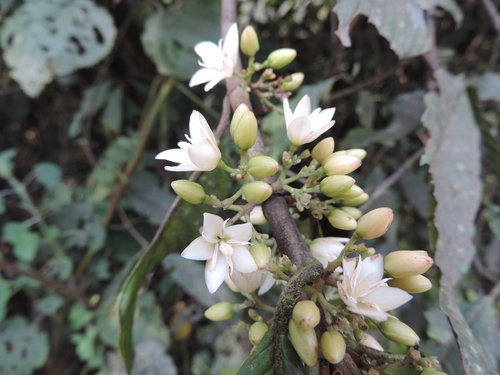
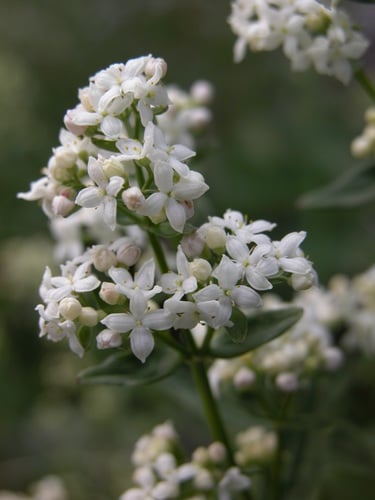
iNaturalist· cc-by-nc
(c) alassanesakpega, some rights reserved (CC BY-NC)
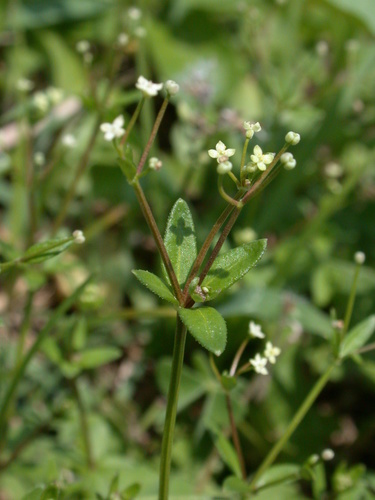
iNaturalist· cc-by-nc
(c) jordivanoort, some rights reserved (CC BY-NC), uploaded by jordivanoort
Description
A shrub or small spreading tree. It grows to 7 m high. The bark is grey or yellowish-brown and smooth. The small branches occur in rings or 3 at right angles to the branches. They are covered with rusty coloured powder. The leaves are opposite or in rings of 3. They are crowded near the ends of small branches. They are oblong and 13 cm long by 8 cm wide. They are yellowish-green to shiny dark green above. They are paler underneath. There are short hairs on both surfaces. The edges of the leaf is wavy. The flowers are white but turn yellow with age. They are 4 cm across. They have a tube up to 4.5 cm long. The fruit is oval and 5 cm long by 3.5 cm wide. They are finely velvety. They are yellowish-brown when mature. There is the remains of the calyx lobes at the end.
Edible Uses
Fruit. Generaly not edible. The hard, roundish fruit is up to 7cm long. Young leaves - cooked. The leaves are occasionally eaten as a vegetable.
Traditional Uses
CAUTION: The fruit can cause diarrhoea. The fruit are eaten raw.
This uses section is brief — help expand it
Medicinal Uses
A decoction of the roots is used to restore failing strength. When boiled with sorghum flour, the root is used to treat Black Water fever. The macerated root is laxative and vermifuge. It is used in the treatment of stomach aches and kwashiorkor.
Known Hazards
The fruit can cause diarrhoea.
Distribution
A tropical plant. It grows in wooded grassland. In East Africa it grows from sea level to 2,100 m altitude. It grows in the Sahel. It can grow in arid places.
Where It Grows
Africa, Benin, Burkina Faso, East Africa, Ethiopia, Ghana, Hawaii, Kenya, Malawi, Mozambique, Namibia, Pacific, Sahel, Senegal, Sierra Leone, South Africa, Southern Africa, South Sudan, Sudan, Uganda, USA, West Africa, Zimbabwe,
Cultivation
The plant grows wild on poor, rocky or bouldery soils; compacted soils; sands and laterite crusts. Plants often grow in areas where the soil is seasonally inundated.
Other Uses
A black stain is obtained from the seed - it is used to colour the skin. A fragrant resin, known as Abu Beka, is obtained from the plant. The wood is burnt to provide potash, which is used in making soap. A decoction of the wood ashes is used in dyeing. The light yellow to pale red wood is dense, even-grained and very hard. It is used for making knife and other tool handles.
Notes
There are about 200 Gardenia species.
Synonyms
Also Known As
Bouhnirou, Brmaiyta, Dajeda, Dajugo, Duwong, Ekoroi, Erwo, Gaaba, Gambeelloo, Gambilo, Geninyet, Ikuirikua, Kimwemwe, Large-leaved Transvaal gardenia, Mboss, Mukumuti, Odwong, Yellow gardenia
References (32)
- Addis, G., Asfaw, Z & Woldu, Z., 2013, Ethnobotany of Wild and Semi-wild Edible Plants of Konso Ethnic Community, South Ethiopia. Ethnobotany Research and Applications. 11:121-141
- Awas, T., 1997, A Study on the Ecology and Ethnobotany of Non-cultivated Food Plants and Wild Relatives of Cultivated crops in Gambella Region, Southwestern Ethiopia. Addis Ababa University. p 64
- Belem, M., et al, 2017, Strategy of Conservation and Protection of Wild Edible Plants Diversity in Burkina Faso. ANADOLU 27 (2) 2017, 82- 90
- Berihun, T. & Molla, E., 2017, Study on the Diversity and Use of Wild Edible Plants in Bullen District Northwest Ethiopia. Hindawi Journal of Botany. Article ID 8383468
- Bonou, A., et al, 2013, Valeur economique des Produits Forestiers Non Ligneux (PFNL) au Benin. Editions Universitaires Europeennes p 98
Show all 32 references Hide references
- Dalziel, J. M., 1937, The Useful plants of west tropical Africa. Crown Agents for the Colonies London.
- Dansi, A., et al, 2008, Traditional leafy vegetables and their use in the Benin Republic. Genet Resour Crop Evol (2008) 55:1239–1256
- Dansi, A., et al, 2009, Traditional leafy vegetables in Benin: folk nomenclature, species under threat and domestication. Acta Bot. Gallica 156(2), 183-199
- Dharani, N., 2002, Field Guide to common Trees & Shrubs of East Africa. Struik. p 235
- Diouf, M., et al, Leafy Vegetables in Senegal. Bioversity webite
- Emire, A., et al, 2021, Ethnobotanical Study of Wild Edible Fruit Tree and Shrub Species in Adola Rede and Odo Shakiso Midland Districts of Guji Zone, Southern Ethiopia. Int. J. Adv. Res. Biol. Sci. (2021). 8(12): 96-109
- Gallagher, D. E., 2010, Farming beyond the escarpment: Society, Environment, and Mobility in Precolonial Southeastern Burkina Faso. PhD University of Michigan.
- Goode, P., 1989, Edible Plants of Uganda. FAO p 41
- Grivetti, L. E., 1980, Agricultural development: present and potential role of edible wild plants. Part 2: Sub-Saharan Africa, Report to the Department of State Agency for International Development. p 43
- Gueye, M. & Meissa, D., 2007, Traditional Leafy Vegetables in Senegal: Diversity and medicinal Uses. Afr. J. Trad. CAM (2007) 4 (4): 469 – 475
- Jardin, C., 1970, List of Foods Used In Africa, FAO Nutrition Information Document Series No 2.p 140
- Le Houerou, H. N., (Ed.), 1980, Browse in Africa. The current state of knowledge. International Livestock Centre for Africa, Ethiopia. p 163
- Lulekal, E., et al, 2011, Wild edible plants in Ethiopia: a review on their potential to combat food insecurity. Afrika Focus - Vol. 24, No 2. pp 71-121
- Masters, T., 2021, Traditional food plants of the upper Aswa River catchment of northern Uganda—a cultural crossroads. Journal of Ethnobiology and Ethnomedicine (2021) 17:24
- Maydell, H. von, 1990, Trees and shrubs of the Sahel: their characteristics and uses. Margraf. p 287
- Mengistu, F. & Hager, H., 2008, Wild Edible Fruit Species Cultural Domain, Informant Species Competence and Preference in Three Districts of Amhara Region, Ethiopia. Ethnobotany Research & Applications 6:487-502
- Moksia, F., et al, 2019, Diversity and Socio-Economic Value of Wild Edible Plants in the Mounts Mandara Region, Cameroon. International Journal of Sciences. Vol. 8:10
- Mutie, F. M., et al, 2023, Important Medicinal and Food Taxa (Orders and Families) in Kenya, Based on Three Quantitative Approaches. Plants 2023, 12, 1145
- Ojelel, S., et al, 2019, Wild edible plants used by communities in and around selected forest reserves of Teso-Karamoja region, Uganda. Journal of Ethnobiology and Ethnomedicine (2019) 15:3
- Palgrave, K.C., 1996, Trees of Southern Africa. Struik Publishers. p 856
- Peters, C. R., O'Brien, E. M., and Drummond, R.B., 1992, Edible Wild plants of Sub-saharan Africa. Kew. p 170
- C. F. Schumacher, Beskr. Guin. pl. 147. 1827
- Siegenthaler, (As Gardenia lutea)
- Staples, G.W. and Herbst, D.R., 2005, A tropical Garden Flora. Bishop Museum Press, Honolulu, Hawaii. p 490
- Tebkew, M. et al, 2014, Underutilized wild edible plants in the Chilga District, northwestern Ethiopia: focus on wild woody plants. Agriculture & Food Security 3:12
- Tebkew, M., et al, 2018, Uses of wild edible plants in Quara district, northwest Ethiopia: implication for forest management. Agriculture and Food Security (2018) 7:12
- World Checklist of Useful Plant Species 2020. Royal Botanic Gardens, Kew