Garcinia buchananii
Baker
Granite garcinia, Granite mangosteen
iNaturalist· cc-by-nc
(c) robburrett, some rights reserved (CC BY-NC)
iNaturalist· cc-by-nc
(c) Bart Wursten, some rights reserved (CC BY-NC)
Description
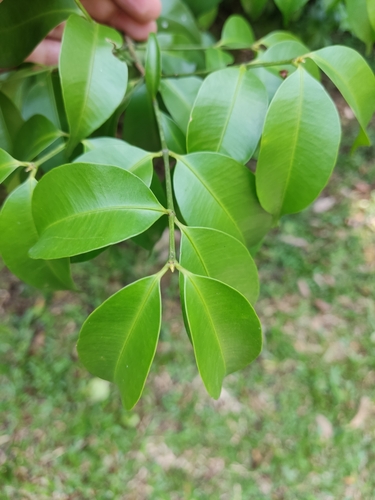
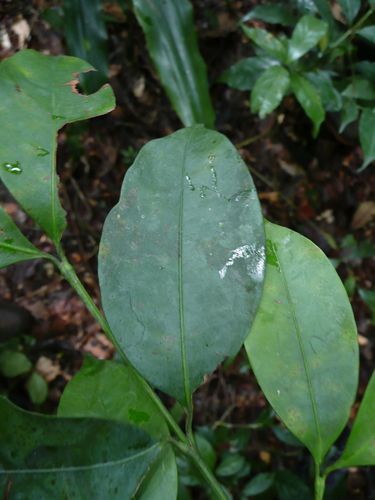
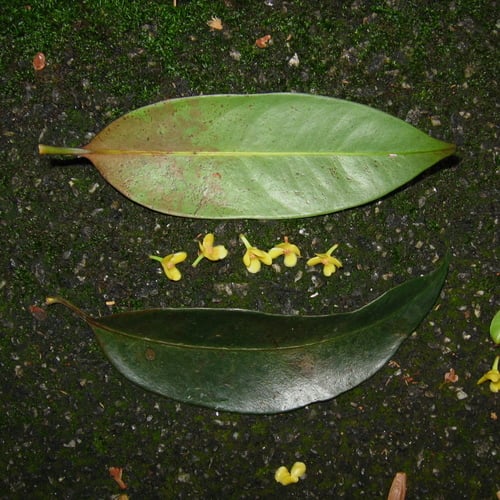
A small evergreen understorey tree. It grows 6-13 m high. The crown is often thick and dark with many branches. All parts of the plant contain a sticky yellow sap. The bark is smooth and dark grey but becomes rough and flaky. The leaves are produced opposite each other. They are thick and leathery. The upper surface is shiny dark green and they are paler underneath. The edge of the leaf is rolled up and wavy. The leaves are oval and 6-12 cm long. The tip has a long point. The base is narrowed to a very short leaf stalk. The leaf stalk and main midrib is often tinged red. The flowers are white, yellow or orange. They are about 1 cm across. The female flower occurs alone and the male flowers in clusters of 2-3. There are 4 petals and sepals around a sticky orange centre. The flower is x-shaped when open. The fruit are fleshy berries. They are yellow-orange when mature. They are rounded and 2.5 cm across. They are edible but acid.
Edible Uses
The fruit are eaten raw and are acid but edible with high vitamin C content. The seeds are baked and eaten. Fruit are used to make wine.
Traditional Uses
The fruit are eaten raw. The seeds are baked and eaten. Fruit are used to make wine.
This uses section is brief — help expand it
Medicinal Uses
An infusion from the roots is used as an aphrodisiac and as a lotion for sores.
Distribution
A tropical plant. It grows in high rainfall savannah woodland in Uganda. It grows in both wet and dry regions. It grows near the edges of forests along rivers. In Zimbabwe it grows between 920-1,820 m above sea level. In Tanzania it grows from sea level to 1,800 m above sea level and in areas with a rainfall between 800-1,800 mm. It grows well on sandy loams.
Where It Grows
Africa, Angola, Burundi, Central Africa, Congo DR, East Africa, Ethiopia, Kenya, Mozambique, Rwanda, Southern Africa, Sudan, Tanzania, Uganda, Zambia, Zimbabwe,
Cultivation
Plants grow naturally from seed. They can be grown from seeds and it is best to put them in nursery pots then transplant. To collect seed, ripe fruit are put in a cool place for the flesh to rot away then dried in the sun before separating the seed. The seed should be soaked overnight before sowing to break the seed coat. Seed should be sown fresh. They can be stored for 2 months in a cool place.
Propagation
Seed - we have no specific information on this species, but the seed of most members of the genus can be slow to germinate, even if sown fresh, often taking 6 months or more.
Other Uses
The sap yields a yellow dye. The wood is used to make tool handles, spoons, milk pots and stools. The wood is used for fuel and to make charcoal. The species can be grown as a pure fruit orchard or intercropped with coffee.
Production
In Uganda flowers occur in December to January and fruit in January to April. In Zimbabwe fruit are ready from November to January. In Tanzania fruit are collected from April to June. Fruit are harvested by climbing the tree.
Notes
The fruit has a high vitamin C content. There are about 300 Garcinia species.
Also Known As
Amasarasi, Atenum, Kasolyo, Mgobwe, Miduma, Museka, Musela, Mutunduru, Nsaali, Umusalasi, Unsongwa
References (22)
- Agea, J. G., et al 2011, Wild and Semi-wild Food Plants of Bunyoro-Kitara Kingdom of Uganda: etc. Environmental Research Journal 5(2) 74-86
- Bigirimana, C., et al, 2016, Utilisation of Indigenous Fruit Tree Species within the Lake Victoria Basin, Rwanda. Agricultural Science: An International Journal. (AGRIJ) Vol. 1, No. 1
- Bull. Misc. Inform. Kew 1894:354. 1894
- Drummond, R. B., 1981, Common Trees of the Central Watershed Woodlands of Zimbabwe, National Herbarium Salisbury. p 150
- Godfrey, J. et al, 2013, Harvesting, preparationand preservation of commonly consumed wild and semi-wild food plants in Bunyoro-Kitara Kingdom, Uganda. Int. J. Med. Arom. Plants. Vol.3 No.2 pp 262-282
Show all 22 references Hide references
- Goode, P., 1989, Edible Plants of Uganda. FAO p 27
- http://www.fao.org/forestry/25323-096344a3de335832e8f363c3ac5184a66.pdf
- Katende, A.B., Birnie, A & Tengnas B., 1995, Useful Trees and Shrubs for Uganda. Identification, Propagation and Management for Agricultural and Pastoral Communities. Technical handbook No 10. Regional Soil Conservation Unit, Nairobi, Kenya. p 336
- Lovett, J. C. et al, Field Guide to the Moist Forest Trees of Tanzania. p 65
- Maundu, P. et al, 1999, Traditional Food Plants of Kenya. National Museum of Kenya. 288p
- Mangambu Mokoso Jean De Dieu, et al, 2015, Etudes ethnobotanique et ethnolinguistique des ressources forestieres ligneuses utilisees par la population du coulour Ecologique du Parc National de Kahuzi-biega (R. D. Congo). European Journal of Scientific Research May 2015.
- Mpasiwakomu, R. A., 2017, The Diversity and Utilization of Wild Edible and Medicinal Plant Species found in Uvinza Miombo Woodlands, Tanzania. M. Sc. thesis University of Tanzania.
- Msola, D. K., 2007, The role of Wild Foods in Household Income and Food Security in Mufundi District, Tanzania. Morogoro, Tanzania. p 44
- Mutie, F. M., et al, 2023, Important Medicinal and Food Taxa (Orders and Families) in Kenya, Based on Three Quantitative Approaches. Plants 2023, 12, 1145
- Palgrave, K.C., 1996, Trees of Southern Africa. Struik Publishers. p 613
- Peters, C. R., O'Brien, E. M., and Drummond, R.B., 1992, Edible Wild plants of Sub-saharan Africa. Kew. p 83
- Ruffo, C. K., Birnie, A. & Tengnas, B., 2002, Edible Wild Plants of Tanzania. RELMA p 340
- Tredgold, M.H., 1986, Food Plants of Zimbabwe. Mambo Press. p 103
- Tugume, P. & Nyakoojo, C., 2020, Traditional use of wild edible plants in the communities adjacent to Mabira Central Forest Reserve, Uganda. Ethnobotany Research & Applications 20:15 (2020)
- World Checklist of Useful Plant Species 2020. Royal Botanic Gardens, Kew
- www.zimbabweflora.co.zw 2011
- Yimer, A., et al, 2021, Ethnobotanical study of wild edible plants used by Meinit Ethnic Community at Bench-Maji Zone, Southwest Ethiopia. Research Square. p 6