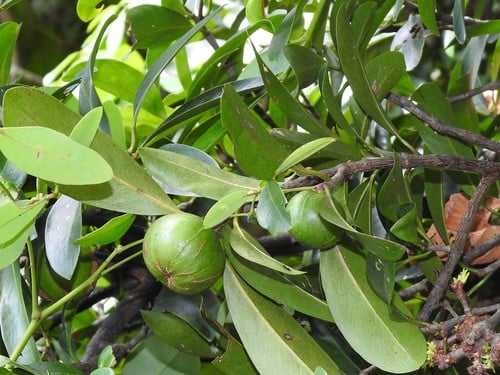
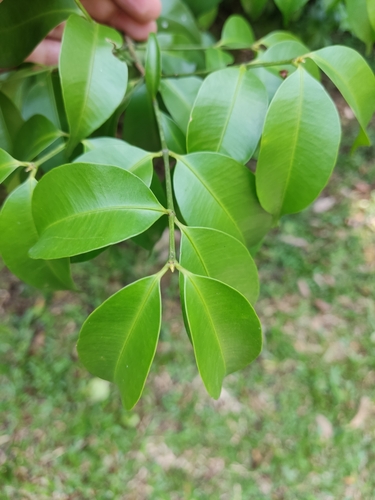
Garcinia mangostana
L.
Mangosteen
iNaturalist· cc-by-nc-sa
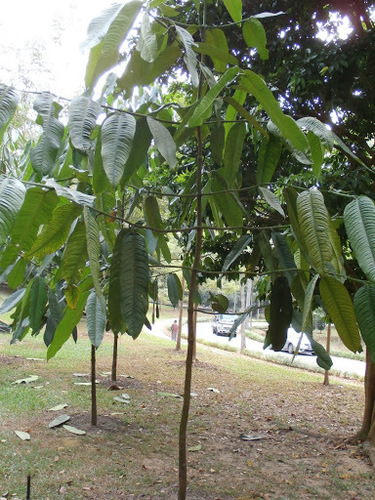
(c) Ahmad Fuad Morad, some rights reserved (CC BY-NC-SA)
iNaturalist· cc0
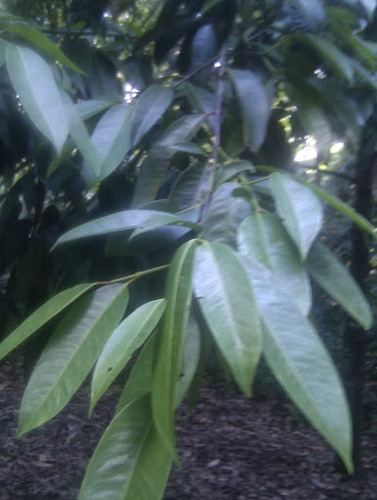
no rights reserved, uploaded by Christine Braaten
iNaturalist· cc-by-nc
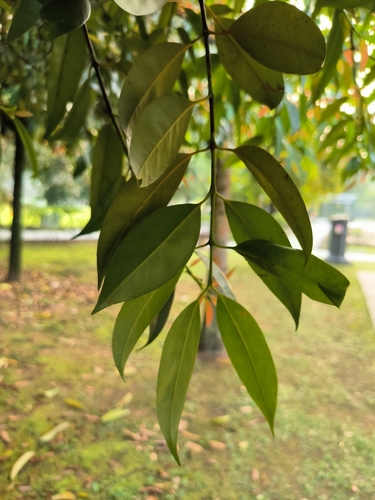
(c) Tan Kok Hui, some rights reserved (CC BY-NC)
Summary
Source: WikipediaGarcinia mangostana is an evergreen tree growing to 12 m tall and 10 m wide at a slow rate. Self-fertile, it grows in medium loamy or heavy clay, well-drained soils with mildly acidic to neutral pH, tolerating very acidic conditions. The tree tolerates semi-shade or full sun but prefers moist soil and is not wind-tolerant. It is frost-tender and hardy to UK zone 10.
Description
A medium sized tree 10-20 m high with bright glossy leaves. Trees keep their leaves all year. Leaves are 15-25 cm long and leathery. Male and female flowers are on separate trees. Commercial trees only have female flowers. Male trees occur but are rare. Flowers are produced on shoots near the end of branches. Female flowers have 4 cream petals and 4 sepals and a round ovary with a thick stigma composed of 4 to 8 lobes. No pollination is required because fruit develop without fertilisation. The fruit is dark blue with 4-8 white juicy segments inside the thick skin. Each segment is enclosed in fine pinkish veins. It is 8 cm across and has flower sepals attached to the stalk end. It leaks yellow sap from wounds. Fruit is produced on side branches near to the tips of the main branches. Fruit often have no seeds or up to 2. These are not true seeds but they will grow.
Edible Uses
The white fruit is eaten raw and is considered delicious — aromatic and juicy with a texture so soft it almost melts in the mouth and a sweet, delicate flavour. About the size of an apple, removing the skin reveals approximately 6 kernels of white pulp with a flavour that is tart and sweet, resembling a cross between grapes and strawberries. The fruit is a globose berry 34–75mm in diameter. Fruits with the highest number of stigma lobes at the apex have the most fleshy segments and fewest seeds and are considered the best table fruit. The seeds are occasionally eaten after boiling or roasting, adding a delicious nutty flavour to preserves when cooked with the pulp.
Traditional Uses
Fruit is best eaten fresh. It is the arillus or layer around the seeds which is eaten. They are also cooked and used in desserts. The seeds are eaten after boiling or roasting. They can be ground to produce a vegetable butter.
Medicinal Uses
The rind is astringent and has been used internally to treat dysentery, diarrhoea, cystitis, and gonorrhoea, and applied externally for eczema and other skin disorders. Partially ripe fruit rind yields a polyhydroxy-xanthone derivative called mangostin, while fully ripe fruit rind contains the xanthones gartanin, 8-disoxygartanin, and normangostin. A derivative of mangostin, mangostin-e,6-di-O-glucoside, acts as a central nervous system depressant and causes a rise in blood pressure. A decoction of the leaves and bark is used as an astringent, febrifuge, and treatment for thrush, diarrhoea, dysentery, and urinary disorders. A bark extract called 'amibiasine' has been marketed for the treatment of amoebic dysentery. An infusion of the leaves combined with unripe banana and a little benzoin is applied to the circumcision wound. A root decoction is taken to regulate menstruation.
Distribution
It is a tropical plant. It needs a hot humid climate (25°C to 35°C). Temperatures below 5°C will kill the plant and temperatures below 20°C slow growth. It grows from sea level up to 1000 m altitude in the equatorial tropics although they grow very slowly at this altitude. It can stand light shade. It often does not do well with sea breezes, and needs protection from wind. It cannot tolerate drought. It needs fertile soil. Good fertility enables earlier bearing. It suits high rainfall areas over 2500 mm per year. It cannot tolerate alkaline soils. It needs a pH between 5.5-6.8. It grows between 10°N-10°S. It suits hardiness zones 11-12.
Where It Grows
Africa, Andamans, Asia, Australia, Bangladesh, Brazil, Cambodia, Cameroon, Central Africa, Central America, China, Colombia, Congo DR, Cook Islands, Costa Rica, Cuba, Dominican Republic, East Africa, East Timor, Ecuador, Fiji, Ghana, Haiti, Hawaii, India, Indochina, Indonesia*, Jamaica, Laos, Malaysia, Mexico, Myanmar, Nicaragua, North America, Pacific, Palau, Papua New Guinea, PNG, Philippines, Pohnpei, Puerto Rico, Sao Tome and Principe, SE Asia, Singapore, Solomon Islands, South America, Sri Lanka, Suriname, Taiwan, Thailand, Timor-Leste, USA, Vietnam, West Africa, West Indies, Zambia,
Cultivation
Trees breed true from seed because they are produced asexually. This means trees are very uniform. As well some seeds can produce more than one seedling. They germinate between 10 and 54 days. Seeds need to be fresh (less than 5 days after extraction) and undamaged, and cleaned of pulp. They quickly lose their viability. Transplanting is done with care after 2 years. Long tap roots make this difficult. Young trees require shade during hot weather. The slow early growth is because the original roots of the seedling are replaced by new roots from the base of the stem. A spacing of 7 - 10 m suits. Grafting onto vigorous root stocks is difficult. It has been performed on Garcinia tinctoria. Budding, cuttings and layering have been unsuccessful.
Propagation
Seed has very short viability and should be sown as soon as it is ripe. Technically, the 'seeds' are not true seeds but adventitious embryos or hypocotyl tubercles formed without sexual fertilisation. A shoot emerges from one end and a root from the other, though this root is short-lived and replaced by roots developing at the base of the shoot. Because reproduction is vegetative, there is little variation among resulting trees and fruits. Some seeds are polyembryonic, producing more than one shoot; individual nucellar embryos can be separated before planting if desired. Germination percentage is directly related to seed weight — only plump, fully developed seeds should be selected. Because of the long, delicate taproot and poor lateral root development, transplanting is notoriously difficult and must not be attempted once plants reach 60cm, at which point the taproot may already exceed the height of the plant. Seedling survival is greater when seeds are planted directly in the nursery row rather than started in containers. Nursery soil should be at least 1 metre deep. Young plants take 2 or more years to reach 30cm, after which they can be lifted with a deep ball of earth. Seeds are recalcitrant and should be stored in the fruit at room temperature or in moist peat moss; removed from the fruit, they lose viability within 5 days, though they remain viable for 3–5 weeks inside the fruit. Viability can be maintained for 1–2 months in moist storage at 20°C; storage at 10°C is damaging. Propagation is also possible from greenwood cuttings and by budding onto seedlings.
Other Uses
The fruit rind is a source of tannins, containing 7–14% catechin tannin and rosin, and can be used as a black dye. The twigs are used as chewsticks. The fruit hulls show antifungal and antiprotozoal activity. The dark-brown wood is strong, heavy enough to almost sink in water, and moderately durable. Usually only available in small sizes, it has been used in construction and cabinetwork and for making spear handles and rice pounders.
Production
Trees are slow growing and begin to bear after 8-20 years. Fruit are produced on shoots which are more than two years old so pruning is unnecessary. Fruiting is seasonal once or twice a year. Often more fruit are produced every second year. The main fruiting season is November to March. Fruit need to be harvested when mature and ripe. Fruit can only be transported with difficulty. They can be stored under refrigeration. (10°C for up to eight weeks). Between 500 to 1500 fruit are produced per tree. Fruit are best opened by cutting the skin around the middle to prevent tannins from the skin spoiling the flavour. Fruit can be stored for 3 weeks if undamaged.
Other Information
It is a cultivated food plant. A few trees have been planted in lowland areas of Papua New Guinea. It is a very popular fruit. It is commercially cultivated.
Notes
There are about 300 Garcinia species. Correct name is probably Garcinia x mangostana L.
Nutrition
| Part | Moisture | kJ | kcal | Protein | Vit A | Vit C | Iron | Zinc |
|---|---|---|---|---|---|---|---|---|
| Fruit | 81.3 | 299 | 72 | 0.6 | — | 2.7 | 0.4 | — |
Synonyms
Also Known As
Cay mang-cut, Gamus, Kokam, Lashai, Manggis, Mangistan, Mangkhud, Mangkhut, Mangkut, Mangostan, Mangostane, Mangostanier, Mangostano, Mangostao, Mangosuchin, Mangus kai, Mangus, Mangusta, Mangustan, Mangut, Masta, Mingut thi, Mongkhut, Mungkud, Ple semeta, Pohon manggis manis, Sulambali
References (120)
- Mangosteen references Garcinia mangostana
- Abbiw, D.K., 1990, Useful Plants of Ghana. West African uses of wild and cultivated plants. Intermediate Technology Publications and the Royal Botanic Gardens, Kew. p 46
- Alain & Martorell. 1982. Flora of Puerto Rico.
- Alexander, D.M., Scholefield, P.B., Frodsham, A., 1982, Some tree fruits for tropical Australia. CSIRO, Australia. p 37
- Allen, B.M., 1975, Common Malaysian Fruits. Longmans. p
Show all 120 references Hide references
- Ambasta, S.P. (Ed.), 2000, The Useful Plants of India. CSIR India. p 230
- Arora, R. K., 2014, Diversity in Underutilized Plant Species - An Asia-Pacific Perspective. Bioversity International. p 73
- Ashton, M. S., et al 1997, A Field Guide to the Common Trees and Shrubs of Sri Lanka. WHT Publications Ltd. p 148
- Backer & Bakhuisen, f. 1963-1968. Flora of Java
- Barwick, M., 2004, Tropical and Subtropical Trees. A Worldwide Encyclopedic Guide. Thames and Hudson p 194
- Blench, R., 2004, Fruits and Arboriculture in the Indo-Pacific Region. Indo-Pacific Prehistory Association Bulletin 24. (Taipei Papers Volume 2) p 38
- Bodkin, F., 1991, Encyclopedia Botanica. Cornstalk publishing, p 485
- Brouk, B., 1975, Plants Consumed by Man. Academic Press, London. p 185
- Burkill, I.H., 1935, A Dictionary of the Economic Products of the Malay Peninsula. p 1069-1072.
- Burkill, H. M., The useful plants of west tropical Africa
- Call, C. A., et al, 2004, Participatory Rural Appraisal in the Upland Ecosystem of Mt Malindang, Misamis Occidental, Philippines. Biodiversity Research Programme for Development in Mindanao. p 53
- Chai, P. P. K. (Ed), et al, 2000, A checklist of Flora, Fauna, Food and Medicinal Plants. Lanjak Entimau Wildlife Sanctuary, Sarawak. Forestry Malaysia & ITTO. p 166
- Chandrashekara, U. M., 2009, Tree species yielding edible fruit in the coffee-based homegardens of Kerala, India: their diversity, uses and management. Food Sec. 1:361-370
- Cheifetz, A., (ed), 1999, 500 popular vegetables, herbs, fruits and nuts for Australian Gardeners. Random House p 197
- Chin, H.F., & Yong, H.S., 1996, Malaysian Fruits in Colour. Tropical press, Kuala Lumpur
- Cobley, L.S.(rev.W.M.Steele),1976, An Introduction to the Botany of Tropical Crops. Longmans. p 187-188.
- Coe, F. G. and Anderson, G. J., 1999, Ethnobotany of the Sumu (Ulwa) of Southeastern Nicaragua and Comparisons with Miskitu Plant Lore. Economic Botany Vol. 53. No. 4. pp. 363-386
- Coe, F. G. & Anderson, G. J., 1997, Ethnobotany of the Miskitu of Eastern Nicaragua. Journal of Ethnobiology 17(2): 171-214
- Coronel, R.E., 1982, Fruit Collections in the Philippines. IBPGR Newsletter p 7
- Cundall, P., (ed.), 2004, Gardening Australia: flora: the gardener's bible. ABC Books. p 624
- Darley, J.J., 1993, Know and Enjoy Tropical Fruit. P & S Publishers. p 44
- Encke, F., et al. 1984. Zander: Handworterbuch der Pflanzennamen, ed. 13.
- Engel, D.H., & Phummai, S., 2000, A Field Guide to Tropical Plants of Asia. Timber Press. p 104
- Etoh, T. & Sundaresan, 1985, Food Plants in Fiji and Their Utilization. Kagoshima Univ. Res. Center S. Pac, Occasional Papers, No. 5. p. 145-164.
- Etherington, K., & Imwold, D., (Eds), 2001, Botanica's Trees & Shrubs. The illustrated A-Z of over 8500 trees and shrubs. Random House, Australia. p 341
- Facciola, S., 1998, Cornucopia 2: a Source Book of Edible Plants. Kampong Publications, p 79
- Flowerdew, B., 2000, Complete Fruit Book. Kyle Cathie Ltd., London. p 160
- Fowler, D. G., 2007, Zambian Plants: Their Vernacular Names and Uses. Kew. p 79
- French, B.R., 1986, Food Plants of Papua New Guinea. A Compendium. Papua New Guinea Biological Society. p 267
- French, B.R., 2010, Food Plants of Solomon Islands. A Compendium. Food Plants International Inc. p 256
- Garner, R.J., and Chaudhri, S.A., (Ed.) 1976, The Propagation of Tropical fruit Trees. FAO/CAB. p 361
- Giesen, W., 2013, Paludiculture: sustainable alternatives on degraded peat land in Indonesia (revised draft)
- Hackett, C. , & J. Carolane. Edible Horticultural Crops. Academic Press, 1982.
- Hazarika, B. et al. (2020). An overview of the unexplored underutilized fruit crops of Assam, India. Journal of Applied and Natural Science, 12(3): 442 - 453.
- Hearne, D.A., & Rance, S.J., 1975, Trees for Darwin and Northern Australia. AGPS, Canberra p 71
- Hedrick, U.P. (ed), 1919, Sturtevant’s Edible Plants of the World. Dover. p 286 (324)
- Hibbert, M., 2002, The Aussie Plant Finder 2002, Florilegium. p 108
- http://palaeoworks.anu.edu.au/Nuno_PhD/04.pdf re Timor
- Hu, Shiu-ying, 2005, Food Plants of China. The Chinese University Press. p 558
- INFOODS:FAO/INFOODS Databases
- International Seed Testing Association. 1988. International Seed Testing Association list of stabilized plant names.
- Jardin, C., 1970, List of Foods Used In Africa, FAO Nutrition Information Document Series No 2.p 139
- Johns, L.& Stevenson,V., 1979, The Complete Book of Fruit. Angus and Robertson p 187-188
- Keay & Hepper. 1953-1972. Flora of west tropical Africa, ed. 2.
- Kiple, K.F. & Ornelas, K.C., (eds), 2000, The Cambridge World History of Food. CUP p 1809
- Kunkel, G., Plants for human consumption
- Lembaga Biologi Nasional, 1977, Buah-Buahan, Balai Pustaka, Jakarta. p 88
- Leon, J., 1968, Fundamentos Botanicos de Los Cultivos Tropicales p 391
- Liberty Hyde Bailey Hortorium. 1976. Hortus third.
- Li Xi-wen & Li Jie; Peter F. Stevens, Clusiaceae [Draft], Flora of China
- Little, E. L., et al, 1974, Trees of Puerto Rico and the Virgin Islands. USDA Handbook 449. Forestry Service. p 566
- Lorenzi, H., Bacher, L., Lacerda, M. & Sartori, S., 2006, Brazilian Fruits & Cultivated Exotics. Sao Paulo, Instituto Plantarum de Estuados da Flora Ltda. p 378
- Macmillan, H.F. (Revised Barlow, H.S., et al) 1991, Tropical Planting and Gardening. Sixth edition. Malayan Nature Society. Kuala Lumpur. p 281
- Maheswari. 1974. Bull. Bot. Surv. India 6:116.
- Martin, F. W., et al, 1987, Perennial Edible Fruits of the Tropics. USDA Handbook 642 p 30
- Martin, M.A., 1971, Introduction L'Ethnobotanique du Cambodge. Centre National de la Recherche Scientifique. Paris.
- McMakin, P.D., 2000, Flowering Plants of Thailand. A Field Guide. White Lotus. p 106
- Menninger, E.A., 1977, Edible Nuts of the World. Horticultural Books. Florida p 46
- Merrill, 1922-1926. An enumeration of Philippine flowering plants.
- Miguel, E., et al, 1989, A checklist of the cultivated plants of Cuba. Kulturpflanze 37. 1989, 211-357
- Morton, J. F., 1987, Fruits of Warm Climates. Wipf & Stock Publishers p 301
- Morley, B. & Everard, B., 1970, Wild Flowers of the World. Ebury press. Plate 118
- Naik, K.C.,1949, South Indian Fruits and their culture, Vanadachary, Madras p 396-403.
- Nathan, A., & Wong Y Chee, 1987, A Guide to Fruits and Seeds, Singapore Science Centre. p 54
- Norrington, L., & Campbell, C., 2001, Tropical Food Gardens. Bloomings Books. p 108
- Ochse, J.J., 1931, Fruits and Fruit Culture in the Dutch East Indies.p 54,
- Ochse, J.J., Dijkman, M.J., Soule, M.J. & Wehlburg, C., 1961, Tropical and Subtropical Agriculture. Macmillan.
- Owen, S., 1993, Indonesian Food and Cookery, INDIRA reprints. p 73
- Partha, P., 2014, Ethnobotany of the Laleng (Patra) Community in Bangladesh. Journal of Pharmacognosy and Phytochemistry. 2(6):173-184
- Paul, A., 2013, Minor and uncultivated fruits of Eastern India, 2nd International Symposium on Minor Fruits and Medicinal Plants
- Peekel, P.G., 1984, (Translation E.E.Henty), Flora of the Bismarck Archipelago for Naturalists, Division of Botany, Lae, PNG. p 377,
- Pham-Hoang Ho, 1999, An Illustrated Flora of Vietnam. Nha Xuat Ban Tre. p 450
- Phon, P., 2000, Plants used in Cambodia. © Pauline Dy Phon, Phnom Penh, Cambodia. p 309
- Plants of Haiti Smithsonian Institute http://botany.si.edu/antilles/West Indies
- PROSEA (Plant Resources of South East Asia) handbook, Volume 2, 1991, Edible fruits and nut. p 177
- Purseglove, J.W., 1968, Tropical Crops:Dicotyledons, Longmans. p 633
- Rajapaksha, U., 1998, Traditional Food Plants in Sri Lanka. HARTI, Sri Lanka. p 111
- Robyns, W., et al., eds.1948-63; Jardin Bot.Natl.Belgique. 1967-. Flore duCongo belge et du Ruanda-Urundi. 1948-63; Flore du Congo,du Rwanda et du Burundi (Flore d'Afrique centrale) 1967-
- Roa, J. A. G. & Boada, D. S. G., 2018, Fundación para el Fortalecimiento de la Fruticultura y Plantas Alimenticias no Convencionales en Colombia.
- Ross. Flora of southern Africa.
- Rukmana, R., 1995, Manggis, Penerbit Kanisius, Jogyakarta
- Sahni, K.C., 2000, The Book of Indian Trees. Bombay Natural History Society. Oxford. p 26
- Segura, S., et al, 2018, The edible fruit species in Mexico. Genet Resour Crop Evol (2018) 65:1767–1793
- Sharma, B.B., 2005, Growing fruits and vegetables. Publications Division. Ministry of Information and broadcasting. India. p 92
- Singh, R., 1969, Fruits. National Book Trust of India. p 124-125
- Siong, K. H., 2003, Indigenous Fruits of Sarawak. ITTO & Sarawak Forest Department. p 43
- Slik, F., www.asianplant.net
- Smith, A.C., 1981, Flora Vitiensis Nova, Lawaii, Kuai, Hawaii, Volume 2 p 347
- Smith, P.M., 1979, Mangosteen, in Simmonds, N.W., (ed), Crop Plant Evolution. Longmans. London. p 310
- Smith & Darwin. 1974. J. Arnold Arbor. 55:261.
- Solomon, C., 2001, Encyclopedia of Asian Food. New Holland. p 231
- Sp. pl. 1:443. 1753
- St. John, H., 1973. List and summary of the flowering plants in the Hawaiian islands.
- Sukarya, D. G., (Ed.) 2013, 3,500 Plant Species of the Botanic Gardens of Indonesia. LIPI p 301
- Suwardi, A. B., et al, 2020, Ethnobotany and conservation of indigenous edible fruit plants in South Aceh, Indonesia. Biodiversitas Vol. 21, No. 5, pp 1850-1860
- Tankard, G., 1990, Tropical fruit. An Australian Guide to Growing and using exotic fruit. Viking p 76
- Tate, D., 1999, Tropical Fruit. Archipelago Press. Singapore. p 62
- Terrell et al. 1986. Agric. Handb. no. 505.
- Thitiprasert, W., et al, 2007, Country report on the State of Plant Genetic Resources for Food and Agriculture in Thailand (1997-2004). FAO p 95
- Turrill et al., eds. 1952-. Flora of tropical East Africa.
- Uji, T., 2007, Keanekaragaman, Persebaran dan Potensi Jenis-jenis Garcinia. Berk. Penel. Hayati: 12 (129–135), 2007
- USDA, ARS, National Genetic Resources Program. Germplasm Resources Information Network - (GRIN). [Online Database] National Germplasm Resources Laboratory, Beltsville, Maryland. Available: www.ars-grin.gov/cgi-bin/npgs/html/econ.pl (10 April 2000)
- Verheij, E. W. M., and R. E. Coronel, eds. 1991. Edible fruits and nuts. In: E. W. M. Verheij & R. E. Coronel (eds.), Plant Resources of South-East Asia (PROSEA). 2:177.
- Vivien, J., & Faure, J.J., 1996, Fruitiers Sauvages d'Afrique. Especes du Cameroun. CTA p 131
- Tankard, G., 1987, Tropical fruit. Viking. p 76-77.
- van Wyk, B., 2005, Food Plants of the World. An illustrated guide. Timber press. p 199
- Wickens, G.E., 1995, Edible Nuts. FAO Non-wood forest products. FAO, Rome. p 131
- Wiersema, J. H. & Leon, B., 2013, World Economic Plants. A Standard Reference CRC Press. 2nd Ed. p 317
- Williams, C.N., Chew, W.Y., and Rajaratnam, J.A., 1989, Tree and Field Crops of the Wetter Regions of the Tropics. Longman, p 132-133.
- Woodson & Schery, eds. 1943-1980. Flora of Panama.
- World Checklist of Useful Plant Species 2020. Royal Botanic Gardens, Kew
- www.worldagroforestrycentre.org/treedb/
- Yaacob, O., & S. Subhadrabandhu, Oxford Univ. Press. 1995. The production of economic fruits in South-East Asia.
- Zawiah, N. & Othaman, H., 2012, 99 Spesies Buah di FRIM. Institut Penyelidikan Perhutanan Malaysia. p 130
- Zeven, A. C. & de West, J. M. J., 1982, Dictionary of cultivated plants and their regions of diversity. Wageningen. p 56