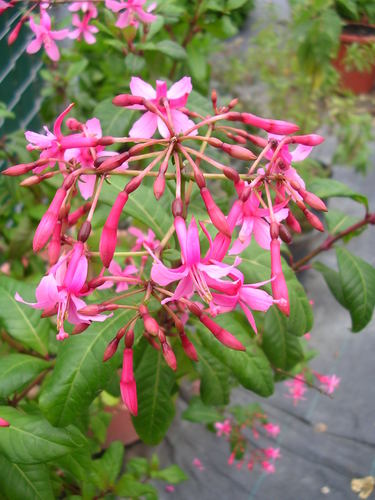
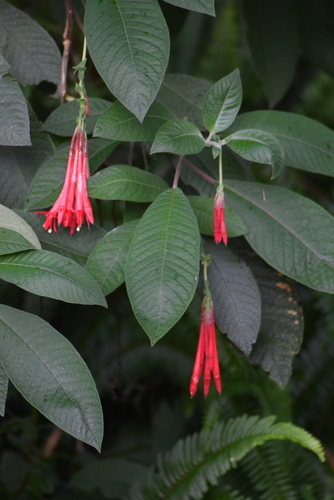
Fuchsia splendens
Zucc.
Platanillo
iNaturalist· cc-by-nc
(c) Luz de los Milagros, some rights reserved (CC BY-NC), uploaded by Luz de los Milagros
iNaturalist· cc-by
(c) Neptalí Ramírez Marcial, some rights reserved (CC BY), uploaded by Neptalí Ramírez Marcial
iNaturalist· cc-by
(c) Neptalí Ramírez Marcial, some rights reserved (CC BY), uploaded by Neptalí Ramírez Marcial
Summary
Source: WikipediaFuchsia splendens is a plant of the genus Fuchsia native to Central America.F. splendens is variable in tube color and length across it range. There are no taxa currently recognized below the rank of species. While often encountered in written works and on the internet, names such as Fuchsia splendens var. cordifolia are not valid.
Description
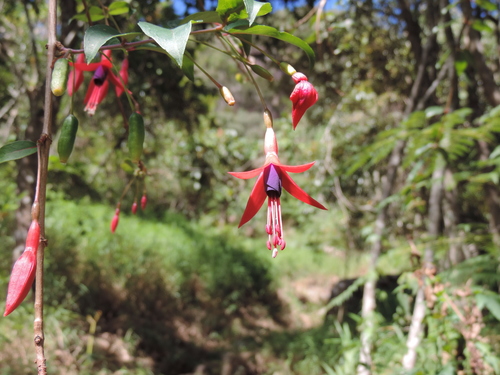
A shrub. It can grow in soil or attached to other plants. It can grow 2.4 m high. The bark on the larger branches peels off in red coloured strips. The leaves are heart shaped and have teeth along the edges. They are green above and paler underneath. The veins can be red underneath. The flower tube is red-pink. The sepals are green with a red base and the petals are grey-green. The fruit is green to purple. The fruit is warty. They are 4 cm long by 1 cm wide.
Edible Uses
The fruit is eaten raw and is a juicy berry that is tart with a peppery aftertaste, yet has a notably lemon-like flavour with no noticeable aftertaste — considered the most enjoyable fuchsia fruit among those sampled. Individual fruits can grow up to 40mm long and 8mm wide.
Traditional Uses
The fruit are eaten raw. They can also be used for preserves.
This uses section is brief — help expand it
Medicinal Uses
None known.
Distribution
A tropical plant. It can grow in heavy shade or full sun. It can tolerate short frosts but not extended cold periods. It needs a fertile well-drained soil. A pH of 5.5-7 is suitable. It suits hardiness zones 9-11.
Where It Grows
Australia, Belize, Central America, Costa Rica, El Salvador, Guatemala, Honduras, Mexico*, Nicaragua, North America,
Cultivation
Succeeds in any fertile well-drained circum-neutral soil. Succeeds in a good loam if sand and leafmold are added. A very adaptable plant, it tolerates the heavy shade of a north-facing wall and also a position in full sun, though the foliage is apt to be somewhat pale when plants grow in full sun. This species is only hardy in the mildest parts of Britain, doing well in Cornwall and S. Devon. A plant at Trengwainton in Cornwall growing out of a shady wall was about 2 metres tall and fruiting heavily in early August 1995. Plants can be cut back to the ground by even quite light frosts but they usually recover well, resprouting from the base in late spring. Plants require greenhouse protection in most parts of Britain. Plants are very susceptible to whitefly. Plants seem to be immune to the predations of rabbits.
Propagation
Sow seed as soon as it is ripe, though spring sowing is also possible. Surface sow in pots in a warm greenhouse, keeping the compost consistently moist. Germination should occur within 6 weeks. Prick seedlings out into individual pots once large enough to handle and grow on under glass for at least the first winter. Plant out in late spring or early summer after the last expected frosts. Inter-nodal greenwood cuttings 5–8cm long taken in May/June root quickly and easily with a high success rate. Overwinter rooted cuttings under glass in their first year before planting out. Inter-nodal half-ripe wood cuttings taken in July/August are equally straightforward — treat as for greenwood cuttings. Cuttings generally root successfully at any point during the growing season.
Other Uses
None known.
Notes
There are about 100 Fuchsia species.
Synonyms
Also Known As
Chilli Pepper Fuchsia (due to bloom shape)
References (8)
- Cundall, P., (ed.), 2004, Gardening Australia: flora: the gardener's bible. ABC Books. p 617
- Etherington, K., & Imwold, D., (Eds), 2001, Botanica's Trees & Shrubs. The illustrated A-Z of over 8500 trees and shrubs. Random House, Australia. p 338
- Facciola, S., 1998, Cornucopia 2: a Source Book of Edible Plants. Kampong Publications, p 163
- Flora 1832(2): Beibl. 102. 1832
- Hibbert, M., 2002, The Aussie Plant Finder 2002, Florilegium. p 106
Show all 8 references Hide references
- Kermath, B. M., et al, 2014, Food Plants in the Americas: A survey of the domesticated, cultivated and wild plants used for Human food in North, Central and South America and the Caribbean. On line draft. p 377
- Lyle, S., 2006, Discovering fruit and nuts. Land Links. p 218
- Plants for a Future database, The Field, Penpol, Lostwithiel, Cornwall, PL22 0NG, UK. http://www.scs.leeds.ac.uk/pfaf/