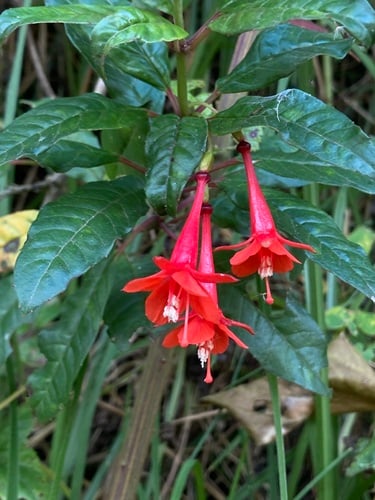
Fuchsia magellanica
Lam.
Fuchsia, Hardy Fuchsia, Ladies' eardrops
iNaturalist· cc-by-nc-sa
(c) Ariel Cabrera Foix, some rights reserved (CC BY-NC-SA), uploaded by Ariel Cabrera Foix
iNaturalist· cc-by-nc
(c) milenamm, some rights reserved (CC BY-NC)
Summary
Source: WikipediaFuchsia magellanica – commonly known as the hummingbird fuchsia, hardy fuchsia or chilco (from Mapudungun: chillko "watery") – is a species of flowering plant in the evening primrose family Onagraceae, native to the lower Southern Cone of southern South America.
Description
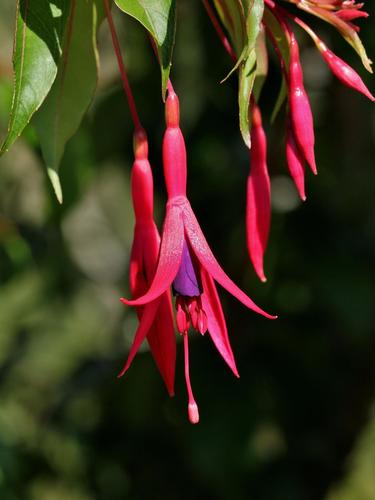
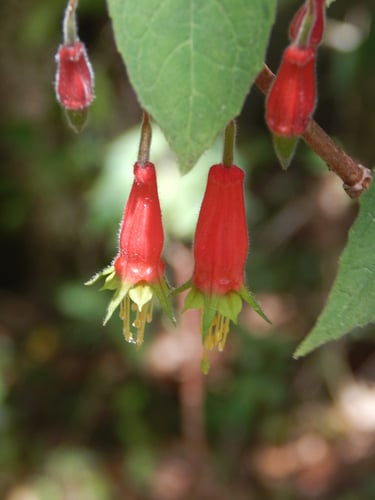
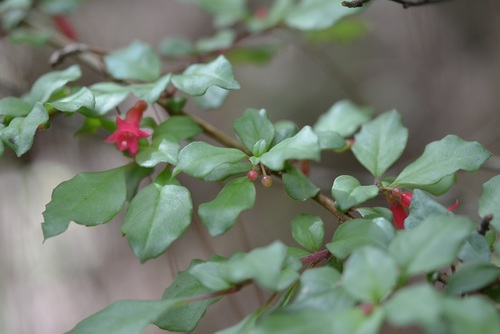
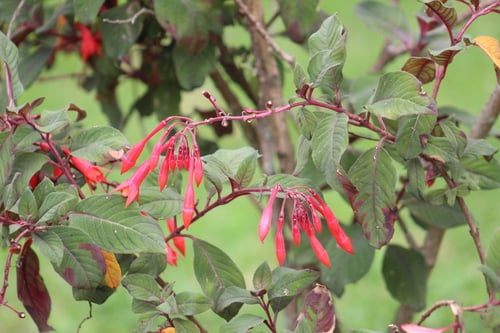
A shrub 1.5-3 m high. It is spreading and the branches are slender. The stems arch over. The bark is papery. The leaves are sword shaped and pointed. They are usually in rings of three. They are 2-4 cm long and have fine teeth around the edge. The flowers are small and crimson. They are 4-5 cm long. They hang down. The sepals are red and the petals are purple. The style and stamens protrude beyond the petals. The flowers are somewhat fleshy. Their stalks are slender. The fruit are purple-black. They are 2.5 cm long.
Edible Uses
The fruit is eaten raw. It is a juicy berry but is not considered very palatable.
Traditional Uses
The fruit are eaten raw. They are also used for marmalade and juice.
This uses section is brief — help expand it
Medicinal Uses
Diuretic and febrifuge.
Distribution
It is a temperate plant. It can tolerate light frosts. It will grow in almost any soil type. It grows up to 2,000 m above sea level. It suits hardiness zones 7-10. Tasmania Herbarium. Arboretum Tasmania. Hobart Botanical Gardens.
Where It Grows
Africa, Argentina, Asia, Australia, Britain, Chile*, Colombia, East Africa, Europe, Falklands, Hawaii, Indonesia, Ireland, Myanmar, New Zealand, Pacific, Peru, Reunion, SE Asia, South America*, Tasmania, USA,
Cultivation
Succeeds in any fertile well-drained circum-neutral soil, preferring one that is rich in humus. Grows well in heavy clay soils. Prefers cool moist conditions and some shade. Succeeds in a good loam if leafmold and sand are added. This species is very resistant to maritime exposure, it can be grown right on the coast. The top growth is hardy to about -10°c, this can be cut right back to the ground in severe winters but the plants usually recover well, growing away quickly in the late spring and flowering by late summer. The young growth in spring, even on mature plants, is frost-tender and so it is best to grow the plants in a position sheltered from the early morning sun. The sub-species F. magellanica myrtifolia often bears a very large crop of fruit. The cultivar 'Ricartonii' can be hardy fairly well north in Britain. A lovely specimen 3 metres tall was seen growing in dappled shade of trees in the Monastery Gardens in York. A very ornamental plant, it is a parent of most of the hardy ornamental fuchsia varieties. Plants seem to be immune to the predations of rabbits. Plants are pollinated by humming birds in the wild, they are good bee plants in Britain.
Propagation
Sow seed as soon as it is ripe, though spring sowing is also possible. Surface sow in pots in a warm greenhouse, keeping the compost consistently moist. Germination should occur within 6 weeks. Prick seedlings out into individual pots once large enough to handle and grow on under glass for at least the first winter. Plant out in late spring or early summer after the last expected frosts. Inter-nodal greenwood cuttings 5–8cm long taken in May/June root quickly and easily with a high success rate. Overwinter rooted cuttings under glass in their first year before planting out. Inter-nodal half-ripe wood cuttings taken in July/August are equally straightforward — treat as for greenwood cuttings. Cuttings generally root successfully at any point during the growing season.
Other Uses
A black dye is obtained from the wood. The plant is highly resistant to maritime exposure and tolerant of trimming, making it a good informal hedge in mild maritime areas — the variety 'Riccartonii' is commonly used for this purpose. The cultivar 'Prostrata' forms a carpet of growth suitable for ground cover when planted approximately 60cm apart each way.
Notes
There are about 100 Fuchsia species. It can be invasive.
Synonyms
Also Known As
Anting balerina, Chilco, Chillko, Earring flower, Kulapepeiao, Pan-swe-le
References (33)
- Barreau, A., et al, 2016, How Can We Teach Our Children if We Cannot Access the Forest? Generational Change in Mapuche Knowledge of Wild Edible Plants in Andean Temperate Ecosystems of Chile. Journal of Ethnobiology 36(2): 412–432
- Bodkin, F., 1991, Encyclopedia Botanica. Cornstalk publishing, p 481
- Brickell, C. (Ed.), 1999, The Royal Horticultural Society A-Z Encyclopedia of Garden Plants. Convent Garden Books. p 451
- Chamorro, M. F., & Ladio, A., 2020, Native and exotic plants with edible fleshy fruits utilized in Patagonia and their role as sources of local functional foods. BMC Complementary Medicine and Therapies. 20:155
- Cordero, S. E., Abello, L. A., & Galvez, F. L., 2017, Plantas silvestres comestibles y medicinales de Chile y otras partes del mundo. CORMA p 67
Show all 33 references Hide references
- Cundall, P., (ed.), 2004, Gardening Australia: flora: the gardener's bible. ABC Books. p 616
- Curtis, W.M., 1963, The Students Flora of Tasmania Vol 2 p 235
- Daly, A. B., 20014, Narrating changing foodways: wild edible plant knowledge and traditional food systems in Mapuche lands of the Andean Temperate Forests, Chile. Masters Thesis Vancouver. p 45
- Encycl. 2:565. 1788
- Etherington, K., & Imwold, D., (Eds), 2001, Botanica's Trees & Shrubs. The illustrated A-Z of over 8500 trees and shrubs. Random House, Australia. p 338
- Flowerdew, B., 2000, Complete Fruit Book. Kyle Cathie Ltd., London. p 173
- Harris, S., Buchanan, A., Connolly, A., 2001, One Hundred Islands: The Flora of the Outer Furneaux. Tas Govt. p 157
- Hibbert, M., 2002, The Aussie Plant Finder 2002, Florilegium. p 106
- Hussey, B.M.J., Keighery, G.J., Cousens, R.D., Dodd, J., Lloyd, S.G., 1997, Western Weeds. A guide to the weeds of Western Australia. Plant Protection Society of Western Australia. p 186
- John, L., & Stevenson, V., 1979, The Complete Book of Fruit. Angus & Robertson p 136
- Kermath, B. M., et al, 2014, Food Plants in the Americas: A survey of the domesticated, cultivated and wild plants used for Human food in North, Central and South America and the Caribbean. On line draft. p 377
- Lazarides, M. & Hince, B., 1993, Handbook of Economic Plants of Australia, CSIRO. p 116
- Leon-Lobos, P., et al, 2022, Patterns of Traditional and Modern Uses of Wild Edible Native Plants of Chile: Challenges and Future Perspectives. Plants (Basel) v 11 (6) Table S1
- Marinelli, J. (Ed), 2004, Plant. DK. p 455
- Martin, J. S. & Villagra M. M., 2013, Productos forestales no madereros de la Region del Maule. p 12
- Paczkowska, G . & Chapman, A.R., 2000, The Western Australian Flora. A Descriptive Calatogue. Western Australian Herbarium. p 414
- Plants for a Future database, The Field, Penpol, Lostwithiel, Cornwall, PL22 0NG, UK. http://www.scs.leeds.ac.uk/pfaf/
- Rapoport, E. H. & Ladio, A. H., 1999, Plantas comestibles. Bosque Volume 20 No. 2. ISSN 0314-8799
- Rapoport, E., H., et al, 2003, Plantas Nativas Comestibles de la Patagonia Andina Argentino/Chilena Parte 1, Department de Ecologi Centro Regional Universitario Briloche p 32
- Roa, J. A. G. & Boada, D. S. G., 2018, Fundación para el Fortalecimiento de la Fruticultura y Plantas Alimenticias no Convencionales en Colombia.
- Staples, G.W. and Herbst, D.R., 2005, A tropical Garden Flora. Bishop Museum Press, Honolulu, Hawaii. p 445
- Sukarya, D. G., (Ed.) 2013, 3,500 Plant Species of the Botanic Gardens of Indonesia. LIPI p 631
- Tasmanian Herbarium Vascular Plants list p 42
- Upson, R., & Lewis R., 2014, Updated Vascular Plant Checklist and Atlas for the Falkland Islands. Falklands Conservation and Kew.
- Velasquez, P. & Montenegro, G., 2017, Chilean Endemic/Native Plant Resources as Functional and Superfoods. Chp. 6 in Superfood and Functional Food - An Overview of Their Processing and Utilization
- World Checklist of Useful Plant Species 2020. Royal Botanic Gardens, Kew
- www.chileflora.com
- Young, J., (Ed.), 2001, Botanica's Pocket Trees and Shrubs. Random House. p 397