Fuchsia excorticata
(J.R. Forst. & G. Forst.) L.f.
Tree fuschia
iNaturalist· cc-by-nc
(c) Jon Sullivan, some rights reserved (CC BY-NC)
iNaturalist· cc-by
(c) John Barkla, some rights reserved (CC BY)
iNaturalist· cc-by-nc
(c) Ryan Tippett, some rights reserved (CC BY-NC), uploaded by Ryan Tippett
Summary
Source: WikipediaFuchsia excorticata, commonly known as the kōtukutuku and tree fuchsia, is a species of tree in the family Onagraceae that is endemic to New Zealand. It is the largest Fuchsia species and is deciduous, an uncommon trait in New Zealand plants. It reaches 13 metres (40 feet) in height with a trunk up to 70 cm (28 in) in diameter. Its range mainly covers the North, South, and Stewart Islands, but can be found as far south as the Auckland Islands. It inhabits lowland to montane ecosystems, and is especially common near streams and forest margins. Its altitudinal range is from 0–1,050 m (0–3,445 ft) above sea level. F. excorticata is noted for its bark, which naturally peels off into thin sheets of paper. Its scientific name, excorticata, reflects this distinctive property. Fuchsia excorticata was first described by the German naturalists Johann Reinhold Forster and Georg Forster in 1775. F. excorticata is self-compatible, but its colourful flowers commonly attract bird pollinators. F. excorticata's fruits are dispersed by fruit-eating animals (frugivores), such as birds. F. excorticata is one of New Zealand's least flammable trees, which earned it the nickname "bucket-of-water" wood by early European settlers as it is very difficult to burn. F. excorticta is a culturally important tree to the indigenous Māori people; it had multiple uses, importantly, the berries were used as a source of food. They were also eaten by early European settlers in the form of jams and puddings. F. excorticata's 2023 assessment in the New Zealand Threat Classification System was "Not Threatened".
Description
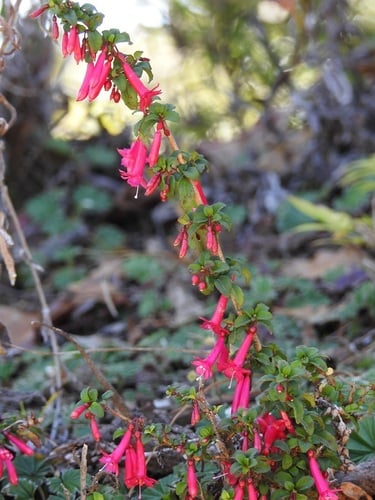
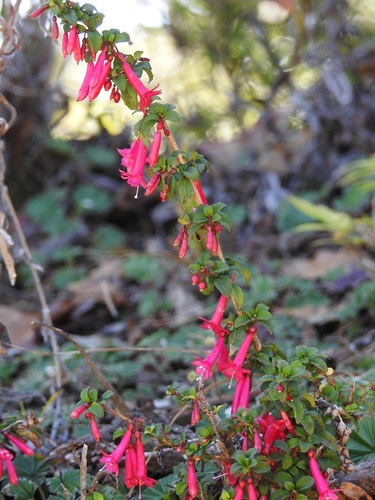
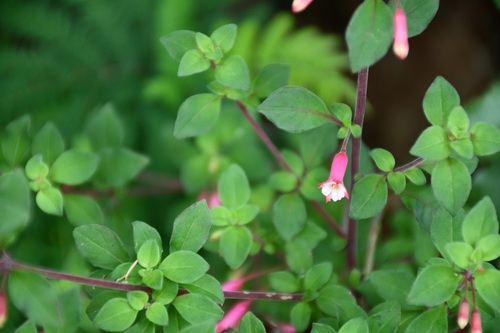
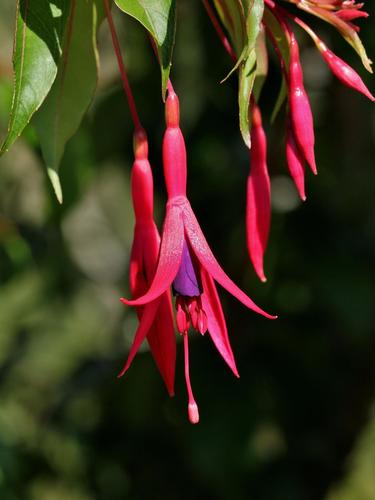
A medium sized tree. It grows to 5-10 m tall. It spreads 1.2 m wide. It loses its leaves in cooler places. The bark is red-brown and papery. It peels off to reveal smooth green inner bark. The leaves have soft texture and are light green. Underneath they are a mixture of silvery pink and green. The flowers are about 2.5 cm long. They hang from the branches. They are bright red when open. The fruit are berries about 2 cm long. They are edible when ripe.
Edible Uses
The fruit can be eaten raw or cooked in pies, tarts, cakes, and desserts. The juicy berries are sweet but astringent, with a unique flavour; combining them with potato flour or corn starch helps temper the slight astringency. The sap is sweet and can be obtained by cutting a length of branch and sucking it out, though it is not freely produced.
Traditional Uses
The fruit are eaten raw. They can also be used in pies, tarts, cakes, desserts and dessert sauces. Adding potato flour or corn starch can temper the astrigent taste. The tree can be tapped for its sweet sap.
Medicinal Uses
None known.
Known Hazards
None noted.
Distribution
It is a temperate plant. It grows on the edges of forests in New Zealand. It needs shade. In New Zealand it grows from sea level to 1060 m altitude. It can survive brief frosts. It can tolerate strong winds but not salty winds. It suits hardiness zones 8-10. Arboretum Tasmania.
Where It Grows
Australia, Britain, Europe, New Zealand*, South America, Tasmania,
Cultivation
Plants can be grown by seed or cuttings. They can also be grown from suckers.
Propagation
Sow seed as soon as it is ripe, though spring sowing is also possible. Surface sow in pots in a warm greenhouse, keeping the compost consistently moist. Germination should occur within 6 weeks. Prick seedlings out into individual pots once large enough to handle and grow on under glass for at least the first winter. Plant out in late spring or early summer after the last expected frosts. Inter-nodal greenwood cuttings 5–8cm long taken in May/June root quickly and easily with a high success rate. Overwinter rooted cuttings under glass in their first year before planting out. Inter-nodal half-ripe wood cuttings taken in July/August are equally straightforward — treat as for greenwood cuttings. Cuttings generally root successfully at any point during the growing season.
Other Uses
A purple dye is obtained from the plant — likely from the pollen — and makes a good ink. The pollen itself is bright blue and was traditionally used by the Maoris as a face powder. The wood is very strong and durable with an attractive grain, but it is hard to work and is used mainly for small items.
Notes
There are about 100 Fuchsia species.
Synonyms
Also Known As
Konini, Kotukutuku
References (20)
- Bodkin, F., 1991, Encyclopedia Botanica. Cornstalk publishing, p 481
- Brooker, 1986,
- Brooker, et al
- Crowe, A., 1997, A Field Guide to the Native Edible Plants of New Zealand. Penguin. p 61
- Cundall, P., (ed.), 2004, Gardening Australia: flora: the gardener's bible. ABC Books. p 616
Show all 20 references Hide references
- Etherington, K., & Imwold, D., (Eds), 2001, Botanica's Trees & Shrubs. The illustrated A-Z of over 8500 trees and shrubs. Random House, Australia. p 337
- Facciola, S., 1998, Cornucopia 2: a Source Book of Edible Plants. Kampong Publications, p 163
- Glowinski, L., 1999, The Complete Book of Fruit Growing in Australia. Lothian. p 183
- Hibbert, M., 2002, The Aussie Plant Finder 2002, Florilegium. p 104
- John, L., & Stevenson, V., 1979, The Complete Book of Fruit. Angus & Robertson p 136
- Lavelle, M., 2008, Wild Flowers of Australia and Oceania. Southwater. p 77
- Lyle, S., 2006, Discovering fruit and nuts. Land Links. p 216
- Matthews, J., 1987, New Zealand Native Plants for your Garden. Pacific Publishers, p 49
- Morley, B. & Everard, B., 1970, Wild Flowers of the World. Ebury press. Plate 133
- Plants for a Future database, The Field, Penpol, Lostwithiel, Cornwall, PL22 0NG, UK. http://www.scs.leeds.ac.uk/pfaf/ (Also as Fuchsia colensoi)
- Ryan, S., 2008, Dicksonia. Rare Plants Manual. Hyland House. p 28
- Salmon, J.T., 1989, The Native Trees of New Zealand. Heinmann Reid p 121
- Skinner, G. & Brown, C., 1981, Simply Living. A gatherer's guide to New Zealand's fields, forests and shores. Reed. p 39
- Suppl. pl. 217. 1782 ("1781")
- Stewart, K., 1984, Collins handguide to the Native Trees of New Zealand. Collins. p 40