Freycinetia scandens
Gaudich.
Climbing pandan
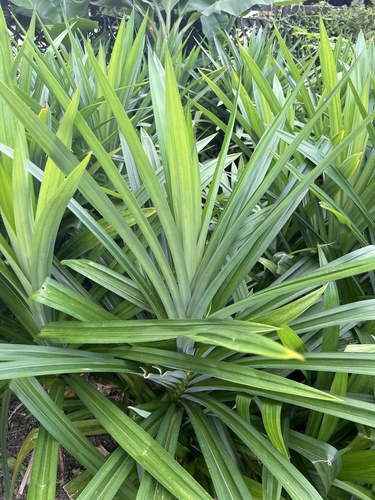
iNaturalist· cc-by-nc
(c) Ronald Ferguson, some rights reserved (CC BY-NC), uploaded by Ronald Ferguson
iNaturalist· cc-by-sa
(c) Greg Tasney, some rights reserved (CC BY-SA), uploaded by Greg Tasney
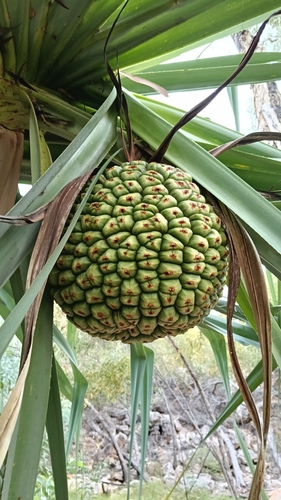
iNaturalist· cc-by-nc
(c) Amanda, some rights reserved (CC BY-NC), uploaded by Amanda
Summary
Source: WikipediaFreycinetia scandens is a species of climbing plant in the family Pandanaceae native to Papua New Guinea, Malesia and Queensland.
Description
A climbing shrub. It climbs up trees to a height of 15 m. The stem is about 1 cm across. The leaves and narrow and thin. They are rather loosely set on the stem. Leaves are 6-12 cm long and 1-2.5 cm wide. The tip of the leaf is pointed. The leaf sheaths do not overlap. They are finely toothed along the edge and on the midrib underneath. The flower branches are oval and 3-4 together. The fruit are about 5.5 cm long by 4 cm wide. They can occur singly or in clusters at the end of the stems. They have many seeds. The fruit when ripe are red. There are small projections over the surface of the fruit.
Edible Uses
The ripe fruit are eaten, though they have a burning sensation in the mouth.
Traditional Uses
The ripe fruit are eaten but burn the mouth.
This uses section is brief — help expand it
Distribution
It is a tropical plant. It grows naturally in the rainforest and in mixed forest. It requires a shady position. It needs plenty of water year round.
Where It Grows
Australia*, Indonesia, Pacific, Papua New Guinea, PNG, SE Asia,
Cultivation
It can be grown from cuttings or by division of the plant. It can also be grown from very fresh seed.
Production
In Australia, fruit occur from January to May.
Notes
There are about 100-175 Freycinetia species.
Synonyms
References (17)
- Beasley, J., 2011, Plants of Tropical North Queensland - the compact guide. Footloose publications. p 142
- Borrell, O.W., 1989, An Annotated Checklist of the Flora of Kairiru Island, New Guinea. Marcellin College, Victoria Australia. p 39
- Cherikoff V. & Isaacs, J., The Bush Food Handbook. How to gather, grow, process and cook Australian Wild Foods. Ti Tree Press, Australia p 200
- Cooper W & Cooper W T, 1994, Fruits of the Rain Forest. RD Press p 144
- Cooper, W. and Cooper, W., 2004, Fruits of the Australian Tropical Rainforest. Nokomis Editions, Victoria, Australia. p 382
Show all 17 references Hide references
- Cribb, A.B. & J.W., 1976, Wild Food in Australia, Fontana. p 65
- Edible and Useful Native Plants (off internet)
- Elliot, W.R., & Jones, D.L., 1992, Encyclopedia of Australian Plants suitable for cultivation. Vol 4. Lothian. p 318
- Haslam, S., 2004, Noosa's Native Plants. Noosa Integrated Catchment Assn. Inc. p 340
- Hibbert, M., 2002, The Aussie Plant Finder 2002, Florilegium. p 103
- Jackes, B.R., 2001, Plants of the Tropics. Rainforest to Heath. An Identification Guide. James Cook University. p 72
- Jones D, L, 1986, Ornamental Rainforest Plants in Australia, Reed Books, p 288, 340
- Jones, D.L. & Gray, B., 1977, Australian Climbing Plants. Reed. p 60, 104
- Melzer, R. & Plumb, J., 2011, Plants of Capricornia. Belgamba, Rockhampton. p 384
- Morley, B.D., & Toelken, H.R., (Eds), 1983, Flowering Plants in Australia. Rigby. p 400
- Ratcliffe D & P., 1987, Australian Native Plants for Indoors. Little Hills press. p 93
- Townsend, K., 1994, Across the Top. Gardening with Australian Plants in the tropics. Society for Growing Australian Plants, Townsville Branch Inc. p 220