Fragaria virginiana
Mill.
Scarlet strawberry, North American strawberry, Virginian strawberry
iNaturalist· cc-by-sa
(c) psweet, some rights reserved (CC BY-SA)
iNaturalist· cc-by
(c) Abby Hyde, some rights reserved (CC BY), uploaded by Abby Hyde
iNaturalist· cc-by-sa
(c) psweet, some rights reserved (CC BY-SA)
Summary
Source: WikipediaFragaria virginiana, known as Virginia strawberry, wild strawberry, common strawberry, or mountain strawberry, is a perennial North American strawberry that grows across much of the United States and southern Canada. It is one of the two species of wild strawberry that were hybridized to create the modern domesticated garden strawberry (Fragaria × ananassa).
Description
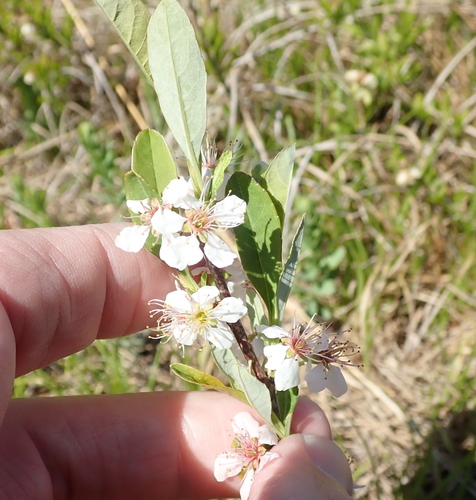
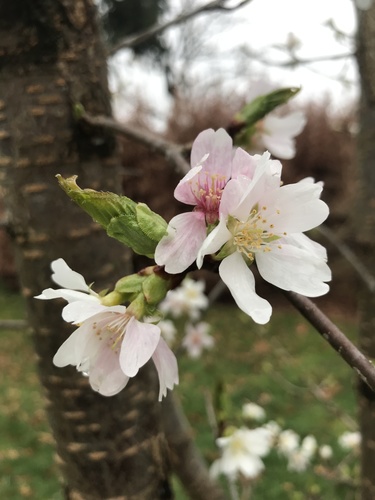
A strawberry plant. It has runners. The leaves are near the base and are compound with 3 leaflets. The leaf tips have many teeth. The flowers have white petals and yellow centres. The fruit are red.
Edible Uses
The fruit, up to 20mm in diameter, can be eaten raw, cooked, or made into preserves — sweet, succulent, and small but delicious. Dried leaves make a very pleasant tea substitute. The plant is rich in vitamin C.
Traditional Uses
The fruit can be eaten fresh. They can be preserved, rolled in crepes and pancakes and used as filling in tarts. They are made into jams and jellies. The leaves can be used for tea.
Medicinal Uses
The whole plant is antiseptic, astringent, emmenagogue, galactogogue, and odontalgic. It has been used to regulate the menstrual cycle. A leaf tea acts as a nerve tonic and is mildly astringent. Dried powdered leaves mixed with oil can be made into a poultice for open sores. A root tea is diuretic and has been used to treat diarrhoea, irregular menses, gonorrhoea, and stomach and lung ailments.
Distribution
It is a temperate plant. They grow in fields and open places. It grows in mountain regions in the Rocky Mountains in Canada. It suits hardiness zones 4-9.
Where It Grows
Alaska, Asia, Australia, Canada, Caucasus, Colombia, Georgia, North America, Philippines, SE Asia, Slovenia, USA,
Cultivation
Prefers a fertile, well-drained, moisture retentive soil in a sunny position. Tolerates semi-shade though fruit production will be reduced when plants grow in such a position. The plants appreciate a mulch of pine or spruce leaves. Along with F, chiloensis, this species is probably a parent of the cultivated strawberries. The cultivar 'Little Scarlet' is a form of this species and this is still occasionally cultivated for its fruit in Britain. An evergreen.
Propagation
Sow seed in early spring in a greenhouse; germination can take 4 weeks or more. Seedlings start very small and slow-growing before picking up pace. Prick out into individual pots when large enough and plant out during summer. Divide runners in July/August for best establishment before the following year's crop. They can be moved the following spring if needed, but should not be allowed to fruit in their first year. Runners can be planted directly into permanent positions.
Other Uses
The fruits can be used as a tooth cleaner — held in the mouth or rubbed over the teeth to remove tartar. The plant acts as a dynamic accumulator, drawing minerals and nutrients from the soil into a more bioavailable form suitable for use as fertilizer or mulch.
Synonyms
Also Known As
Khendro, Rocky Mountain strawberry, Virginski jagodnjak, Wild strawberry
References (38)
- Beckstrom-Sternberg, Stephen M., and James A. Duke. "The Foodplant Database." http://probe.nalusda.gov:8300/cgi-bin/browse/foodplantdb.(ACEDB version 4.0 - data version July 1994) (Also as Fragaria canadensis)
- Bianchini, F., Corbetta, F., and Pistoia, M., 1975, Fruits of the Earth. Cassell. p 158
- Bodkin, F., 1991, Encyclopedia Botanica. Cornstalk publishing, p 478
- Brouk, B., 1975, Plants Consumed by Man. Academic Press, London. p 202
- Bull. Torrey Bot. Club 33:143. 1906 (As Fragaria ovalis)
Show all 38 references Hide references
- Bussman, R. W., et al, 2016, A comparative ethnobotany of Khevsureti, Samtskhe-Javakheti, Tusheti, Svaneti, and Racha-Lechkhumi, Republic of Georgia (Sakartvelo), Caucasus. Journal of Ethnobiology and Ethnomedicine.
- Bussman, R. W. et al, 2017, Ethnobotany of Samtskhe-Javakheti, Sakartvelo (Republic of Georgia), Caucasus. Indian Journal of Traditional Knowledge Vol. 16(1) pp 7-24
- Bussman, R. W., et al, 2021, Unity in diversity—food plants and fungi of Sakartvelo (Republic of Georgia), Caucasus. Journal of Ethnobiology and Ethnomedicine (2021) 17:72 p 14
- Call, C. A., et al, 2004, Participatory Rural Appraisal in the Upland Ecosystem of Mt Malindang, Misamis Occidental, Philippines. Biodiversity Research Programme for Development in Mindanao. p 59
- Duke, J.A., 1992, Handbook of Edible Weeds. CRC Press. p 98
- Elias, T.S. & Dykeman P.A., 1990, Edible Wild Plants. A North American Field guide. Sterling, New York p 91
- Esperanca, M. J., 1988. Surviving in the wild. A glance at the wild plants and their uses. Vol. 2. p 348
- Facciola, S., 1998, Cornucopia 2: a Source Book of Edible Plants. Kampong Publications, p 199 (Also as Fragaria ovalis)
- Fl. bor.-amer. 1:299. 1803 (As Fragaria canadensis)
- Gard. dict. ed. 8: Fragaria no. 2. 1768 (A. N. Duchesne, Hist. nat. frais. 204. 1766, as "races principales") - Duchesne's (1766) usage of binary names for "races principales" do not qualify as species names
- Glowinski, L., 1999, The Complete Book of Fruit Growing in Australia. Lothian. p 150
- Hedrick, U.P., 1919, (Ed.), Sturtevant's edible plants of the world. p 315, 319
- Holloway, P. S. & Alexander, G., 1990, Ethnobotany of the Fort Yukon Region, Alaska. Economic Botany, Vol. 44, No. 2 pp. 214-225
- Illustrated Flora of Central Texas p 944
- Jackes, D. A., Edible Forest Gardens
- John, L., & Stevenson, V., 1979, The Complete Book of Fruit. Angus & Robertson p 268
- Jones, J.K., 1979, Strawberry, in Simmonds, N.W., (ed), Crop Plant Evolution. Longmans. London. p 238
- Kiple, K.F. & Ornelas, K.C., (eds), 2000, The Cambridge World History of Food. CUP p 1859
- MacKinnon, A., et al, 2009, Edible & Medicinal Plants of Canada. Lone Pine. p 178
- Medsger, O. P., 1939, Edible Wild Plants. Macmillan Company. p 20
- Moerman, D. F., 2010, Native American Ethnobotany. Timber Press. p 235
- Plants for a Future database, The Field, Penpol, Lostwithiel, Cornwall, PL22 0NG, UK. http://www.scs.leeds.ac.uk/pfaf/ (Also as Fragaria ovalis)
- Roa, J. A. G. & Boada, D. S. G., 2018, Fundación para el Fortalecimiento de la Fruticultura y Plantas Alimenticias no Convencionales en Colombia.
- Scotter, G. W., & Flygare, H., 1993, Wildflowers of the Canadian Rockies. Hurtig. p 62
- Stubbs, R. D., 1966, An investigation of the Edible and Medicinal Plants used by the Flathead Indians. MA thesis University of Montana. p 65 (As var. glauca)
- Toupal, R. S. & Hollenback, K., 2009, An Ethnobotany of Indiana Dunes National Lakeshore: Plant Uses of the Ojibwa People. Bureau of Applied Research in Anthropology. University of Arizona
- Turner, N., 1995, Food Plants of Coastal First Peoples. Royal BC Museum Handbook p 113
- Turner, N., 1997, Food Plants of Interior First Peoples. Royal BC Museum Handbook p 142
- Turner, N., et al, 2011, "Up on the Mountain": Ethnobotanical Important of Montane Sites in Pacific Coastal North America. Journal of Ethnobiology 31(1): 4-43
- USDA, ARS, National Genetic Resources Program. Germplasm Resources Information Network - (GRIN). [Online Database] National Germplasm Resources Laboratory, Beltsville, Maryland. Available: www.ars-grin.gov/cgi-bin/npgs/html/econ.pl (10 April 2000)
- van Wyk, B., 2005, Food Plants of the World. An illustrated guide. Timber press. p 198
- Wiersema, J. H. & Leon, B., 2013, World Economic Plants. A Standard Reference CRC Press. 2nd Ed. p 310
- World Checklist of Useful Plant Species 2020. Royal Botanic Gardens, Kew