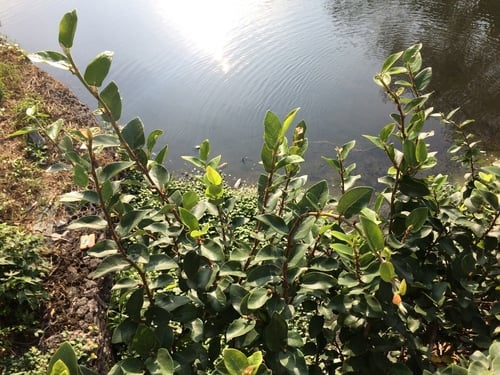
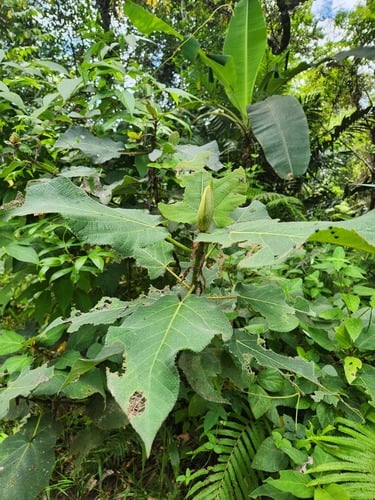
Ficus vallis-choudae
Delile
Haroni fig, False cape fig
iNaturalist· cc-by-nc
(c) Mark Hyde, Bart Wursten and Petra Ballings, some rights reserved (CC BY-NC)
iNaturalist· cc-by-nc
(c) Bart Wursten, some rights reserved (CC BY-NC)
Summary
Source: WikipediaFicus vallis-choudae is a shrub or small to medium sized tree within the family Moraceae, in the genus Ficus and sub-genus, Sycomorus.
Description
A fig. It is a large tree. It grows 5-20 m tall. The crown is wide and spreading. Sometimes it has buttresses near the base. The bark is rough and grey. On leafy twigs the bark is often white or hairy. The skin flakes off when dry. The leaves are stiff. They are dark green and wide oval shape. The base is heart shaped. The leaves are about 20 cm long and 4-24 cm wide. The edge of the leaf has wide teeth and is often wavy. The leaf stalk is 2-11 cm long. There are 4-6 main pairs of veins. The lowest ones reach beyond the middle of the leaf blade. The fruit are figs which occur singly. They are 3-6 cm across. They are round and yellow-orange with orange stripes when ripe. They grow beside or just below the leaves. They grow on short woody stalks. They are succulent and edible.
Edible Uses
The ripe figs are eaten fresh, and are a commonly used food especially popular with children in Western Africa. The bark and leaves are also consumed as vegetables.
Traditional Uses
The ripe figs are eaten fresh.
This uses section is brief — help expand it
Medicinal Uses
In parts of East Africa, the wood is used as material for furniture making and as a source of charcoal. Among the Biafada people, leaves are cooked and eaten as part of a vegetable sauce. Leaf and stem extracts are also used as part of a decoction to treat jaundice and gastro-intentinal conditions. Figs are edible and eaten in parts of Cameroon.
Distribution
A tropical plant. It is common is tropical Africa. It grows in the savannah in regions where the rainfall is 700-1500 mm per year. Mostly it occurs near rivers and lakes due to the groundwater. In Tanzania it grows between 400-1,800 m above sea level. It grows in Miombo woodland in Africa.
Where It Grows
Africa, Angola, Benin, Burkina Faso, Cameroon, Central Africa, Congo DR, Côte d'Ivoire, East Africa, Ethiopia, Ghana, Guinea, Guinée, Guinea-Bissau, Ivory Coast, Kenya, Liberia, Malawi, Mali, Mozambique, Namibia, Nigeria, Senegal, Sierra Leone, South Africa, Southern Africa, Sudan, Tanzania, Togo, Uganda, West Africa, Zambia, Zimbabwe,
Cultivation
Plants grow naturally from seed. The figs have plenty of seed which should be extracted from the figs and dried before sowing. Seed can be stored for 2 months. Plants can be grown by cuttings.
Propagation
Seed - Cuttings.
Other Uses
The wood is used for cheap furniture, domestic utensils, beer pots, grain mortars, stools, water containers, beehives, drums, cattle troughs etc. The wood is used for fuel.
Production
Trees are fast growing. They can be pruned. In Tanzania fruit are available from November to June.
Other Information
The figs are liked in Western Africa. The fruit are eaten especially by children. It is a commonly used food.
Notes
There are about 800-1000 Ficus species. They are mostly in the tropics. There are 120 Ficus species in tropical America.
Also Known As
Aloma-bli, Bambula, Bambulede, Boba, Guibe, Ikuu, Mkuyu, Msaambu, Mtundu, Mumu, Nshembe-sa-bulege, Obologoi, Obori, Wubi
References (40)
- Abbiw, D.K., 1990, Useful Plants of Ghana. West African uses of wild and cultivated plants. Intermediate Technology Publications and the Royal Botanic Gardens, Kew. p 42
- Achigan-Dako, E, et al (Eds), 2009, Catalogue of Traditional Vegetables in Benin. International Foundation for Science.
- Ambe, G., 2001, Les fruits sauvages comestibles des savanes guinéennes de Côte-d’Ivoire : état de la connaissance par une population locale, les Malinké. Biotechnol. Agron. Soc. Environ. 5(1), 43-48
- Asfaw, Z. and Tadesse, M., 2001, Prospects for Sustainable Use and Development of Wild Food Plants in Ethiopia. Economic Botany, Vol. 55, No. 1, pp. 47-62
- Atato, A., et al, 2010, Diversity of Edible Wild Fruit Tree Species of Togo. Global Science Books.
Show all 40 references Hide references
- Burkill, H. M., 1985, The useful plants of west tropical Africa, Vol. 4. Kew.
- Busson, 1965,
- Dale, I. R. and Greenway, P. J., 1961, Kenya Trees and Shrubs. Nairobi. p 323
- Dalziel, J. M., 1937, The Useful plants of west tropical Africa. Crown Agents for the Colonies London.
- FAO, 1988, Traditional Food Plants, FAO Food and Nutrition Paper 42. FAO Rome p 284
- Fowler, D. G., 2007, Zambian Plants: Their Vernacular Names and Uses. Kew. p 49
- Fox, F. W. & Young, M. E. N., 1982, Food from the Veld. Delta Books. p 274
- Gilbert, T., et al, 2017, Diversity and local transformation of indigenous edible fruits in sahelian domain of Cameroon. Journal of Animal & Plant Sciences Vol. 26 (2): 5289-5300
- Grivetti, L. E., 1980, Agricultural development: present and potential role of edible wild plants. Part 2: Sub-Saharan Africa, Report to the Department of State Agency for International Development. p 45
- Grubben, G. J. H. and Denton, O. A. (eds), 2004, Plant Resources of Tropical Africa 2. Vegetables. PROTA, Wageningen, Netherlands. p 562
- Glover et al, 1966b,
- Jardin, C., 1970, List of Foods Used In Africa, FAO Nutrition Information Document Series No 2.p 78, 138
- Kakeya, 1976,
- Katende, A.B., Birnie, A & Tengnas B., 1995, Useful Trees and Shrubs for Uganda. Identification, Propagation and Management for Agricultural and Pastoral Communities. Technical handbook No 10. Regional Soil Conservation Unit, Nairobi, Kenya. p 326
- Kidane, B., et al, 2014, Ethnobotany of Wild and Semi-wild Edible Fruit Species used by Maale and Ari Ethnic Communities in South Ethiopia. Ethnobotany Research and Applications. Vol. 12, 1546-3465-12-455
- Kokwaro, J. O. and Johns. T., Luo Biological Dictionary. p 165
- Le Houerou, H. N., (Ed.), 1980, Browse in Africa. The current state of knowledge. International Livestock Centre for Africa, Ethiopia. p 163
- Lovett, J. C. et al, Field Guide to the Moist Forest Trees of Tanzania. p 109
- Lulekal, E., et al, 2011, Wild edible plants in Ethiopia: a review on their potential to combat food insecurity. Afrika Focus - Vol. 24, No 2. pp 71-121
- Malaisse, F., 1997, Se nourrir en floret claire africaine. Approche ecologique et nutritionnelle. CTA., p 63
- Mengistu, F. & Hager, H., 2008, Wild Edible Fruit Species Cultural Domain, Informant Species Competence and Preference in Three Districts of Amhara Region, Ethiopia. Ethnobotany Research & Applications 6:487-502
- Mutie, F. M., et al, 2023, Important Medicinal and Food Taxa (Orders and Families) in Kenya, Based on Three Quantitative Approaches. Plants 2023, 12, 1145
- Palgrave, K.C., 1996, Trees of Southern Africa. Struik Publishers. p 118
- Peters, C. R., O'Brien, E. M., and Drummond, R.B., 1992, Edible Wild plants of Sub-saharan Africa. Kew. p 152
- Ruffo, C. K., Birnie, A. & Tengnas, B., 2002, Edible Wild Plants of Tanzania. RELMA p 330
- Ruiters-Welcome, A. K., 2019, Food plants of southern Africa. Ph.D. thesis. Univ. of Johannesburg p 80
- Tebkew, M. et al, 2014, Underutilized wild edible plants in the Chilga District, northwestern Ethiopia: focus on wild woody plants. Agriculture & Food Security 3:12
- Terashima, H., et al, 1992, Ethnobotany of the Lega in the Tropical Rainforest of Eastern Zaire (Congo): Part Two, Zone de Walikale, African Study Monographs, Suppl. 19:1-60
- van Wyk, Be., & Gericke, N., 2007, People's plants. A Guide to Useful Plants of Southern Africa. Briza. p 42
- Vivien, J., & Faure, J.J., 1996, Fruitiers Sauvages d'Afrique. Especes du Cameroun. CTA p 221
- von Katja Rembold, 2011, Conservation status of the vascular plants in East African rain forests. Dissertation Universitat Koblenz-Landau p 168
- Welcome, A. K. & Van Wyk, B.-E., 2019, An inventory and analysis of the food plants of southern Africa. South African Journal of Botany 122 (2019) 136–179
- White, F., Dowsett-Lemaire, F. and Chapman, J. D., 2001, Evergreen Forest Flora of Malawi. Kew. p 392
- World Checklist of Useful Plant Species 2020. Royal Botanic Gardens, Kew
- www.figweb.org