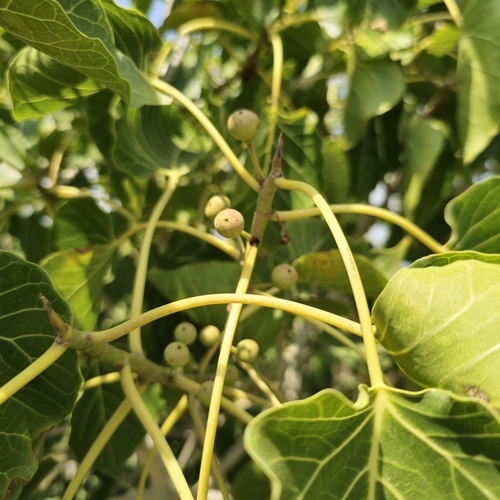
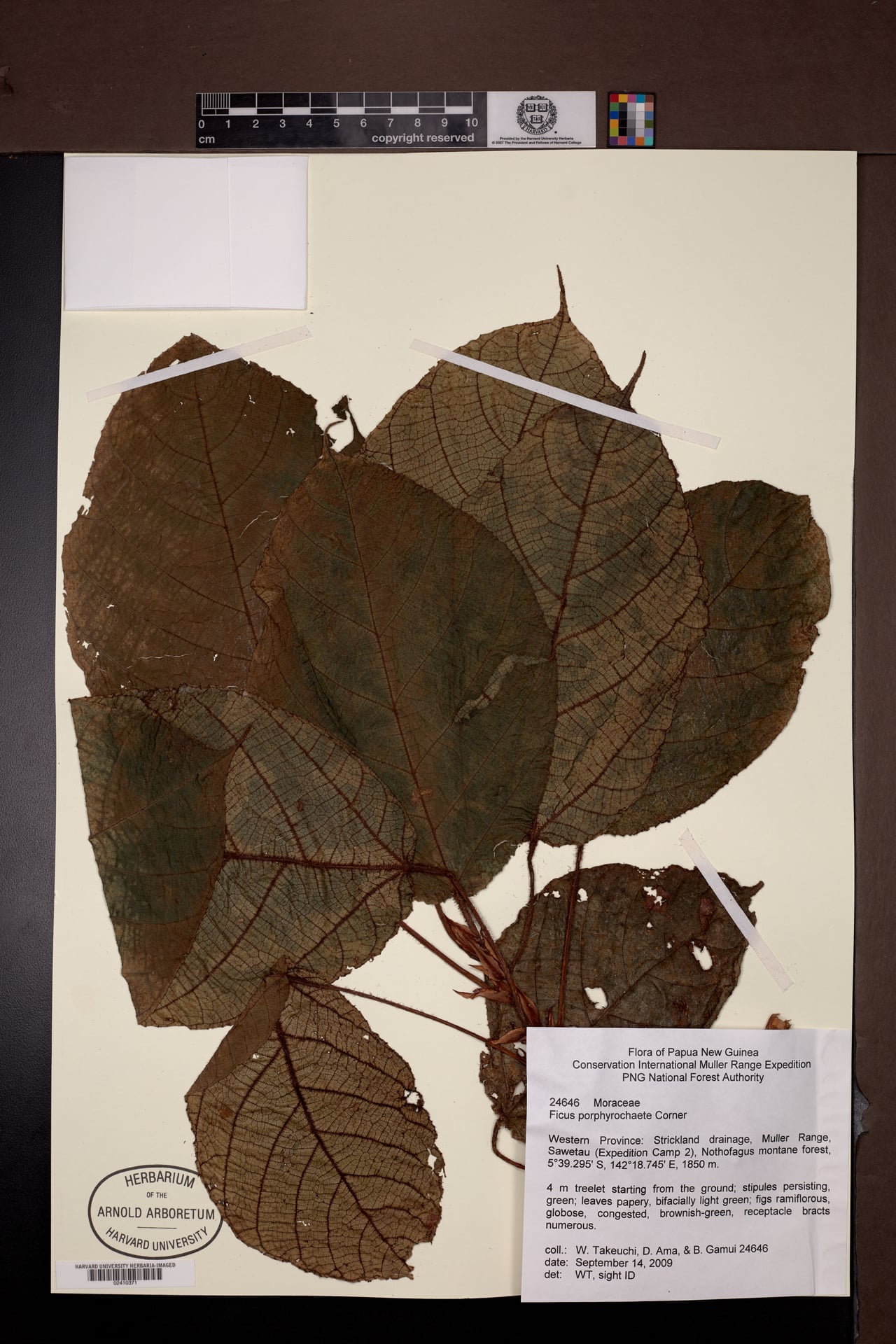
Ficus tinctoria
Forster f.
Dye fig
iNaturalist· cc0
no rights reserved
iNaturalist· cc-by-nc
(c) tavita_togia2016, some rights reserved (CC BY-NC), uploaded by tavita_togia2016
iNaturalist· cc0
no rights reserved
Summary
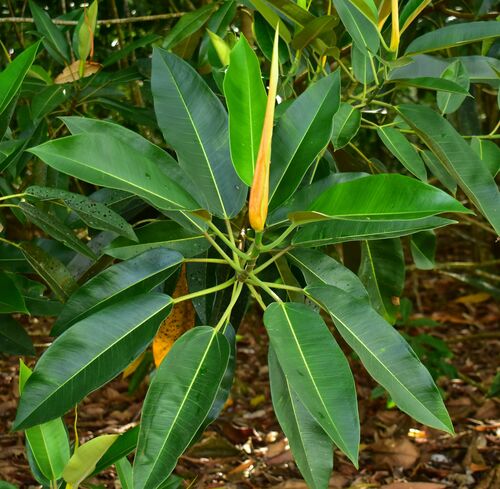
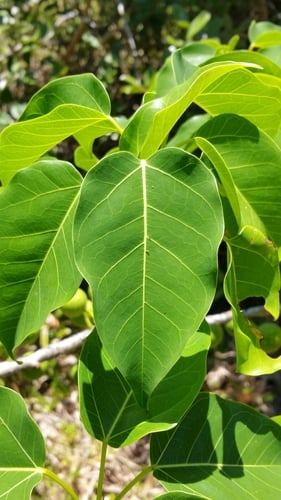
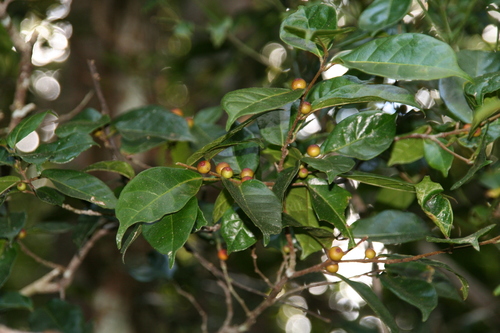
Source: WikipediaFicus tinctoria, also known as dye fig, or humped fig is a hemiepiphytic tree in the genus Ficus. It is also one of the species known as a strangler fig. It is found in Asia, Malesia, northern Australia, and the South Pacific islands. It grows in moist valleys. Palms are favorable host species. Root systems of dye fig can come together to be self-sustaining, but the epiphyte usually falls if the host tree dies or rots away. In Australia it is recorded as a medium-sized tree with smooth, oval green leaves. It is found often growing in rocky areas or over boulders. The leaves are asymmetrical. The small rust-brown fruit of the dye fig are the source of a red dye used in traditional fabric making in parts of Oceania and Indonesia. The fruit is also edible and constitute as a major food source in the low-lying atolls of Micronesia and Polynesia.
Description
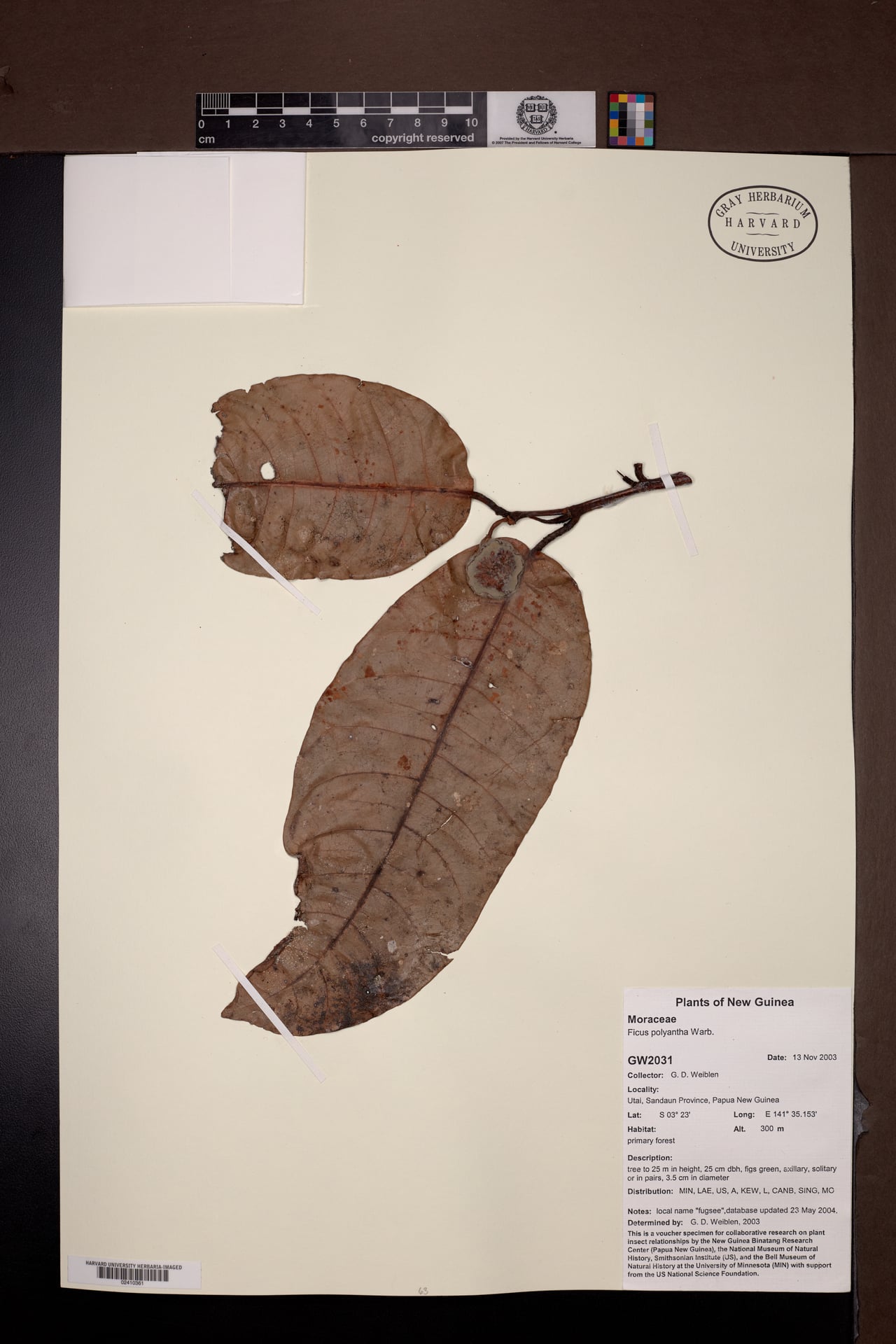
A fig. It is a small tree or shrub 2-4 m high. It can climb and scramble over other plants and be up to 10 m high. The small branches are rough. The small branchlets are yellow or pale brown. The bark is grey or brown and cracked or flaky. The leafy structure at the base of the leaves is sword shaped and 5-10 mm long and thick. The leaves of the tree are yellowish with purple veins and short leaf stalks. The leaves are 4-13 cm long and 2-6 cm wide. The leaf stalk is 0.6-1 cm long. Male and female flowers occur on separate plants. The figs are in the leaf axils and up to 2 cm across and orange coloured. There are some varieties described based on the size of the plant and the size of the figs.
Edible Uses
Young leaf tips are picked and eaten fresh. Fruits are eaten cooked, commonly prepared in coconut milk, or dried, crushed, and sweetened into a puree with coconut toddy.
Traditional Uses
The young tips are picked and eaten. The fruit are eaten cooked. They are often cooked in coconut milk. They can be dried and crushed and made into a puree by sweetening with coconut toddy.
Medicinal Uses
The plant is an important traditional food source, especially in Kiribati, Tuvalu, and Micronesia.
Distribution
A tropical plant. Trees are common on limestone or coral rocks near the sea shore. It tends to be on coral soils. In the Pacific it grows from sea level to 750 m altitude.
Where It Grows
American Samoa, Asia, Australia, Bhutan, Caroline Islands, China, Chuuk, Cook Is., East Timor, FSM, Fiji, Guam, Himalayas, India, Indochina, Indonesia, Kiribati, Laos, Malaysia, Marshall Islands, Micronesia, Myanmar, Nauru, Nepal, Niue, Northeastern India, Pacific, Palau, Papua New Guinea, PNG, Philippines, Pohnpei, Rotuma, Samoa, SE Asia*, Solomon Islands, Sri Lanka, Thailand, Timor-Leste, Tokelau, Tonga, Tuvalu, Vanuatu, Vietnam, Wallis & Futuna,
Cultivation
It normally grows wild. It grows from seed. It can also be grown from cuttings.
Propagation
Seed - germinates best at a temperature around 20°c. Air layering. Tip cuttings around 4 - 12cm long, taken from lateral branches.
Other Uses
The fibre from the bark is made into cordage. A scarlet dye is made from the juice of the fruit, combined with the juice of the fruit from Cordia subcordata. It is used to colour cloth and to paint faces. A red dye is obtained from the roots. A red dye that is used on the face is obtained from the sap. The wood is readily combustible and, as smouldering logs, even when green, it was used to carry fire about in the Solomon Islands.
Production
In Australia, fruit are produced in May to July.
Other Information
Mostly reported as a wild occasional food on the Gazelle Peninsula and New Ireland in Papua New Guinea. It is an important food in Kiribati, Tuvalu and Micronesia.
Notes
There are about 800-1000 Ficus species. They are mostly in the tropics. There are 120 Ficus species in tropical America.
Synonyms
Also Known As
Awal, Awan, Awann, Awen, Coain, Felo, Gawal, Guwan, Gawann, Hawan, Hmei-thai-thei, Hoda, Hodda, Hotda, Howel, Kiro kesik, Mai-hai-sa-pye, Mati, Mok, Nihn, Nin, Nunu, Nyaung-thabye, Oseked, Oseched, Savirewa, Srah, Tagete, Topdo, Te bero, Topodo, 'U'apea, Wach'guy, Wachaguy, Xie ye rong
References (35)
- Altschul, S.V.R., 1973, Drugs and Foods from Little-known Plants. Notes in Harvard University Herbaria. Harvard Univ. Press. Massachusetts. no. 735
- Blench, R., 2004, Fruits and Arboriculture in the Indo-Pacific Region. Indo-Pacific Prehistory Association Bulletin 24. (Taipei Papers Volume 2) p 37
- Borrell, O.W., 1989, An Annotated Checklist of the Flora of Kairiru Island, New Guinea. Marcellin College, Victoria Australia. p 107
- Clarke, W.C. & Thaman, R.R., 1993, Agroforestry in the Pacific Islands: Systems for sustainability. United Nations University Press. New York. p 238
- Cowie, I, 2006, A Survey of Flora and vegetation of the proposed Jaco-Tutuala-Lore National Park. Timor-Lests (East Timor) www.territorystories.nt/gov.au p 50
Show all 35 references Hide references
- Englberger, L., et al, 2005, Carotenoid content of pandanus fruit cultivars and other foods of the republic of Kiribati. Public health nutrition 9(5), 631-643
- Flora of Australia, Volume 3, Hamamelidales to Casuarinales, Australian Government Publishing Service, Canberra (1989) p 60
- Flora of China.
- Fl. ins. austr. 76. 1786
- Franklin, J., Keppel, G., & Whistler, W., 2008, The vegetation and flora of Lakeba, Nayau and Aiwa Islands, Central Lau Group, Fiji. Micronesica 40(1/2): 169–225, 2008
- French, B.R., 1986, Food Plants of Papua New Guinea, A Compendium. Asia Pacific Science Foundation p 64
- Gillaumin, R., 1954, Les Plantes utiles des Nouvelles-Hebrides (fin et complement) In: Journal d'agriculture tropicale et de botanique appliquee Vol. 1, No. 10-12 pp 453-460 (As Ficus neoehudarum)
- Hariyadi, B., 2008, The Entwined Tree: Traditional Natural Resource Management of Serampas, Jambi, Indonesia. Ph. D thesis. Univ. or Hawaii. p 402
- Jansen, A. A. J., et al, (Eds), 1990, Food and Nutrition in Fiji. Volume One. p 52
- Kar, A., et al, 2013, Wild Edible Plant Resources used by the Mizos of Mizoram, India. Kathmandu University Journal of Science, Engineering and Technology. Vol. 9, No. 1, July, 2013, 106-126
- Lebot, V. & Sam, C., Green desert or ‘all you can eat’? How diverse and edible was the flora of Vanuatu before human introductions?. Terra australis 52 p 408
- Liefting, A., et al, Samoan plant names. http://en.wikipedia.org
- Miquel, F.A.W., 1848, London Journal Botany 7: t 6B
- Paczkowska, G . & Chapman, A.R., 2000, The Western Australian Flora. A Descriptive Calatogue. Western Australian Herbarium. p 332
- Parham, B. E. V., 1971, The Vegetation of the Tokelau Islands with special reference to the Plants of Nukunonu Atoll. New Zealand Journal of Botany. 9:4, 576-609
- Peekel, P.G., 1984, (Translation E.E.Henty), Flora of the Bismarck Archipelago for Naturalists, Division of Botany, Lae, PNG. p 147, 146
- Reis, S. V. and Lipp, F. L., 1982, New Plant Sources for Drugs and Foods from the New York Botanical Garden herbarium. Harvard. p 44
- Smith, A.C., 1981, Flora Vitiensis Nova, Lawaii, Kuai, Hawaii, Volume 2 p 191
- Stone, B.,
- Thaman, R. R., 1987, Plants of Kiribati: A listing and analysis of vernacular names. Atoll Research Bulletin No. 296
- Thaman, R. R., et al, 1994, The Flora of Nauru. Atoll Research Bulletin No. 392. Smithsonian Institute p 173
- Thaman, R. R, 2016, The flora of Tuvalu. Atoll Research Bulletin No. 611. Smithsonian Institute p 101
- Walter, A. & Sam C., 2002, Fruits of Oceania. ACIAR Monograph No. 85. Canberra. p 169, 279
- Wheeler, J.R.(ed.), 1992, Flora of the Kimberley Region. CALM, Western Australian Herbarium, p 83
- Whistler, A. S., Edible vascular plants of the Line Islands. Pacific Health Dialog. Vol. 3 No. 2
- Whistler, W. A., 1988, Ethnobotany of Tokelau: The Plants, Their Tokelau Names, and Their Uses. Economic Botany 42(2): 155-176
- Whistler, W.A., 2004, Rainforest Trees of Samoa. Isle Botanica Honolulu, Hawaii. p 109
- World Checklist of Useful Plant Species 2020. Royal Botanic Gardens, Kew
- Yuncker, T. G., 1943, The Flora of Niue Island. Bernice P. Bishop Museum Bulletin 178 p 48
- Yuncker, T.G., 1959, Plants of Tonga, Bernice P. Bishop Museum, Hawaii, Bulletin 220. p 101