Ficus ingens
(Miq.) Miq.
Red-leaved rock fig
iNaturalist· cc-by-nc-sa
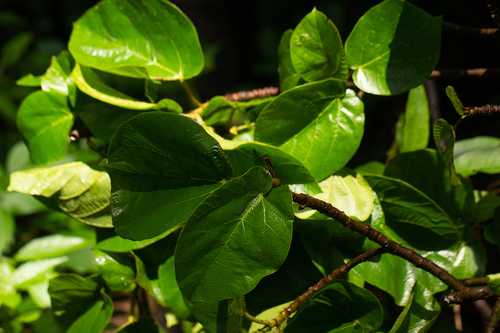
(c) Marco Schmidt, some rights reserved (CC BY-NC-SA)
iNaturalist· cc-by-nc
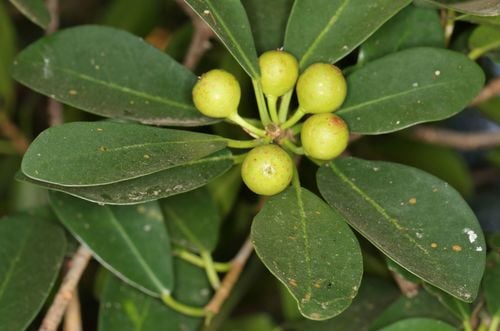
(c) Richard Gill, some rights reserved (CC BY-NC), uploaded by Richard Gill
iNaturalist· cc-by
(c) Wynand Uys, some rights reserved (CC BY), uploaded by Wynand Uys
Summary
Source: WikipediaFicus ingens, the red-leaved fig, is a fig species with an extensive range in the subtropical to dry tropical regions of Africa and southern Arabia. Despite its specific name, which means "huge", or "vast", it is usually a shrub or tree of modest proportions. It is a fig of variable habit depending on the local climate and substrate, typically a stunted subshrub on elevated rocky ridges, or potentially a large tree on warmer plains and lowlands. In 1829 the missionary Robert Moffat found a rare giant specimen, into which seventeen thatch huts of a native tribe were placed, so as to be out of reach of lions.
Description
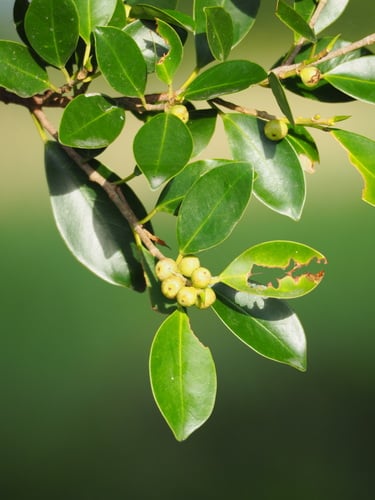
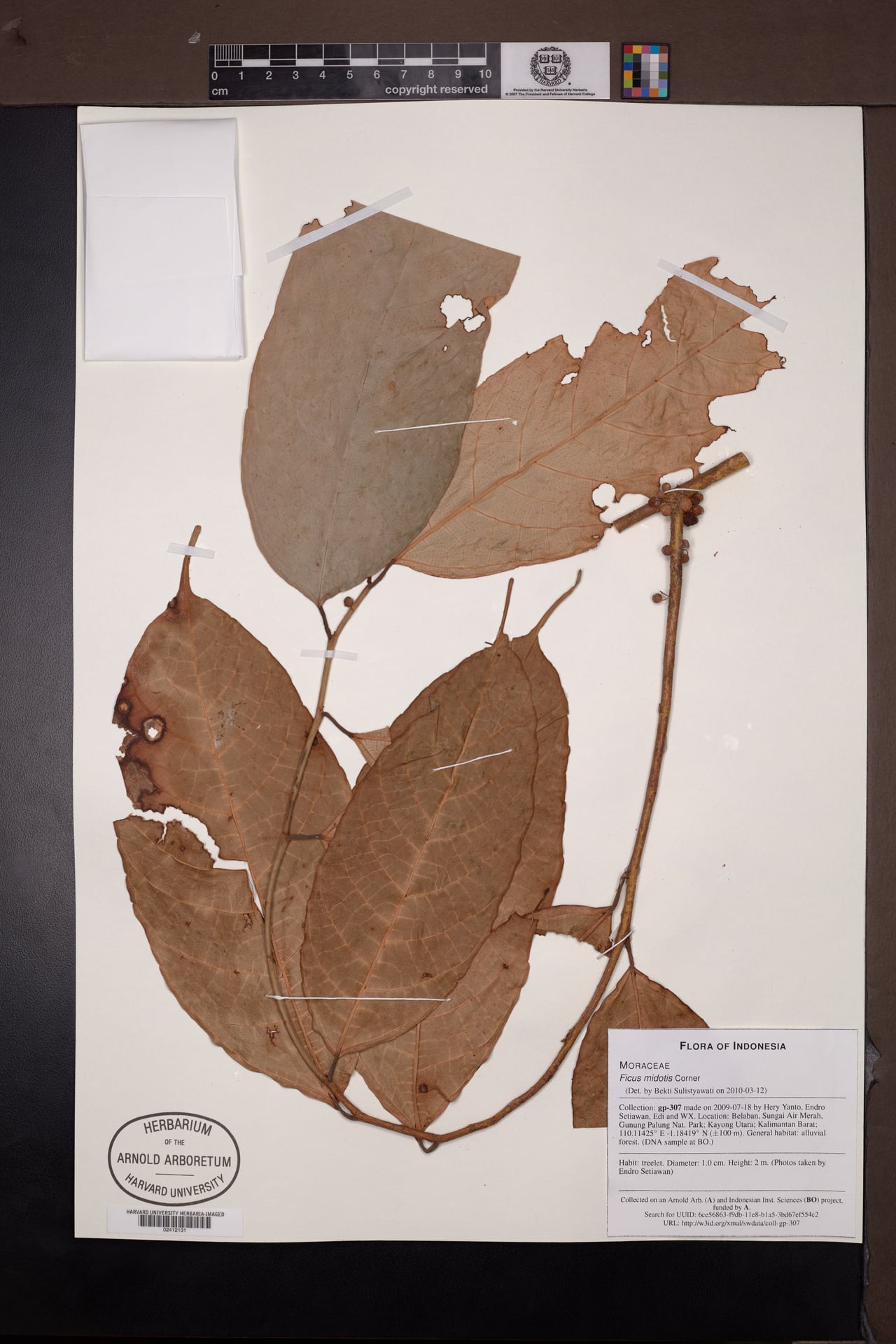
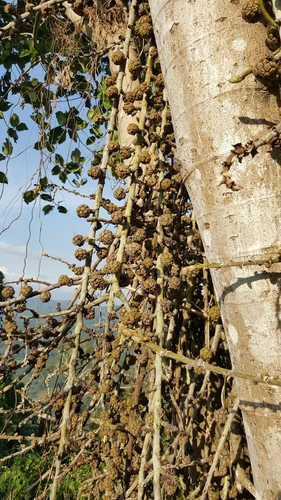
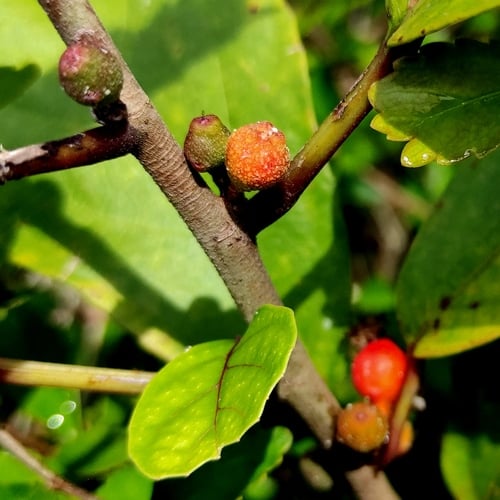
A fig. It is a small tree which loses its leaves. It is an erect tree and has a spreading crown. It grows up to 15 m tall. The branches touch the ground. It grows attached to other plants. The leaves are oval. They are 6-15 cm long by 3-10 cm wide. They are pale green and thinly textured. The new leaves are red. The base is slightly lobed and it tapers towards the tip. The fig fruit grow in the axils of the leaves. The fruit are round and 1-1.5 cm across. They are pale yellow or pink when ripe.
Edible Uses
The ripe figs are eaten raw, particularly by children. Young leaves are cooked and eaten as a vegetable.
Traditional Uses
The figs are eaten raw. The young leaves are cooked as a vegetable.
This uses section is brief — help expand it
Medicinal Uses
A maceration of the leaves is used as a treatment against malaria. A latex obtained from the plant is disinfectant.
Distribution
A tropical plant. They usually grow on dry rocky soils. It is often on rocky slopes in cracks in the rocks. In Zimbabwe they grow between 300 and 1450 m altitude but are mostly at lower altitudes. They grow where the rainfall is below 100 mm. It can grow with annual rainfall between 100-1,300 mm. It is drought resistant. It grows between sea level and 2,100 m above sea level. It grows in the Sahel.
Where It Grows
Africa, Algeria, Angola, Benin, Botswana, Burkina Faso, Burundi, Cameroon, Central Africa, Congo, Côte d'Ivoire, East Africa, Eswatini, Ethiopia, Gambia, Ghana, Guinea, Guinée, Ivory Coast, Kenya, Lesotho, Malawi, Mali, Middle East, Mozambique, Namibia, Niger, Nigeria, North Africa, Rwanda, Sahel, Saudi Arabia, Senegal, Somalia, South Africa, Southern Africa, Sudan, Swaziland, Tanzania, Togo, Uganda, West Africa, Yemen, Zambia, Zimbabwe,
Cultivation
Plants can be grown from seed or cuttings. Fruit should be collected before they drop and the seeds removed. The seeds are small and need to be sown with fine sand. Seeds germinate in 15-30 days. Cuttings can be of softwood or hardwood. They root easily. The wasp pollinator is Platyscapa soraria Wiebes.
Propagation
Seed - Cuttings.
Other Uses
A latex obtained from the plant is used as a disinfectant. It can be used as a substitute for iodine.
Production
Young seedlings grow slowly.
Other Information
The fruit are especially eaten by children.
Notes
There are about 800-1000 Ficus species. They are mostly in the tropics. There are 120 Ficus species in tropical America.
Nutrition
| Part | Moisture | kJ | kcal | Protein | Vit A | Vit C | Iron | Zinc |
|---|---|---|---|---|---|---|---|---|
| Fruit | 75.2 | 255 | 61 | 1.6 | — | 7.6 | 2 | 0.8 |
Synonyms
Also Known As
Bithu, Dharef, Idotsi, Inkhokhokho, Inkimane, Inkiwane, Ja-Ja, Kazu, Kunkwiya, Kwece-kwece, Laze, Lugo, Makiwani, Monogani, Mooma, Msombe, mu-Karenju, Mulumba, Mushavhi, Mutsamvi, Muumo, Nkuwa, N'tonbozi, Ndebela, Ndola, Oduru, Qilinxo, Rooiblaavy, Shirinya, Tinaita, Tinayta, Tshikululu, Umkhonswane, Umthombe
References (54)
- Abbiw, D.K., 1990, Useful Plants of Ghana. West African uses of wild and cultivated plants. Intermediate Technology Publications and the Royal Botanic Gardens, Kew. p 47 (As Ficus ingens var. ingens)
- Addis, G., Asfaw, Z & Woldu, Z., 2013, Ethnobotany of Wild and Semi-wild Edible Plants of Konso Ethnic Community, South Ethiopia. Ethnobotany Research and Applications. 11:121-141
- Al-Fatimi, M. A., Wild Edible Plants Traditionally Collected and Used in Southern Yemen. Research Square. University of Aden. p 18
- Ann. Mus. Bot. Lugduno-Batavum 3:288. 1867-1868 ("1867")
- Batawila, K., et al, 2007, Diversite et gestion des legumes de cueillete au Togo. African Journal of Food, Agriculture, Nutrition and Development 7( 3& 4): 66
Show all 54 references Hide references
- Belem, M., et al, 2017, Strategy of Conservation and Protection of Wild Edible Plants Diversity in Burkina Faso. ANADOLU 27 (2) 2017, 82- 90
- Bernholt, H. et al, 2009, Plant species richness and diversity in urban and peri-urban gardens of Niamey, Niger. Agroforestry Systems 77:159-179
- Burkill, H. M., 1985, The useful plants of west tropical Africa, Vol. 4. Kew.
- Codjia, J. T. C., et al, 2003, Diversity and local valorisation of vegetal edible products in Benin. Cahiers Agricultures 12:1-12
- Dansi, A., et al, 2008, Traditional leafy vegetables and their use in the Benin Republic. Genet Resour Crop Evol (2008) 55:1239–1256
- Drummond, R. B., 1981, Common Trees of the Central Watershed Woodlands of Zimbabwe, National Herbarium Salisbury. p 18
- East African Herbarium records, 1981,
- FAO, 1988, Traditional Food Plants, FAO Food and Nutrition Paper 42. FAO Rome p 282
- Fowler, D. G., 2007, Zambian Plants: Their Vernacular Names and Uses. Kew. p 49
- Fox, F. W. & Young, M. E. N., 1982, Food from the Veld. Delta Books. p 269
- Grubben, G. J. H. and Denton, O. A. (eds), 2004, Plant Resources of Tropical Africa 2. Vegetables. PROTA, Wageningen, Netherlands. p 561
- Harris, F. M. A. and Mohammed, S., 2003, Relying on Nature: Wild Foods in Northern Nigeria. Ambio Vol. 32 No. 1. p 25-30
- INFOODS:FAO/INFOODS Databases
- Jardin, C., 1970, List of Foods Used In Africa, FAO Nutrition Information Document Series No 2.p 78, 137
- Joffe, P., 2007, Creative Gardening with Indigenous Plants. A South African Guide. Briza. p 102
- Kidane, B., et al, 2014, Ethnobotany of Wild and Semi-wild Edible Fruit Species used by Maale and Ari Ethnic Communities in South Ethiopia. Ethnobotany Research and Applications. Vol. 12, 1546-3465-12-455
- Long, C., 2005, Swaziland's Flora - siSwati names and Uses http://www.sntc.org.sz/flora/ (As Ficus ingens var. ingens)
- Lulekal, E., et al, 2011, Wild edible plants in Ethiopia: a review on their potential to combat food insecurity. Afrika Focus - Vol. 24, No 2. pp 71-121
- Magwede, K., van Wyk, B.-E., & van Wyk, A. E., 2019, An inventory of Vhavenḓa useful plants. South African Journal of Botany 122 (2019) 57–89
- Maroyi, A., 2011, The Gathering and Consumption of Wild Edible Plants in Nhema Communal Area, Midlands Province, Zimbabwe. Ecology of Food and Nutrition 50:6, 506-525
- Maroyi, A. & Cheikhyoussef, A., 2017, Traditional knowledge of wild edible fruit in southern Africa: A comparative use patterns in Namibia and Zimbabwe. Indian Journal of Traditional Knowledge. 16(3): 385-392
- Martin, F.W. & Ruberte, R.M., 1979, Edible Leaves of the Tropics. Antillian College Press, Mayaguez, Puerto Rico. p 206
- Maydell, H. von, 1990, Trees and shrubs of the Sahel: their characteristics and uses. Margraf. p 275
- Moksia, F., et al, 2019, Diversity and Socio-Economic Value of Wild Edible Plants in the Mounts Mandara Region, Cameroon. International Journal of Sciences. Vol. 8:10
- MORTIMORE, (As Ficus ingens var. ingens)
- Mutie, F. M., et al, 2023, Important Medicinal and Food Taxa (Orders and Families) in Kenya, Based on Three Quantitative Approaches. Plants 2023, 12, 1145
- Ocho, D. L., et al, 2012, Assessing the levels of food shortage using the traffic light metaphor by analyzing the gathering and consumption of wild food plants, crop parts and crop residues in Konso, Ethiopia. Journal of Ethnobiology and Ethnomedicine 8:30
- Ogle & Grivetti, 1985,
- Ojelel, S., et al, 2019, Wild edible plants used by communities in and around selected forest reserves of Teso-Karamoja region, Uganda. Journal of Ethnobiology and Ethnomedicine (2019) 15:3
- Oryema, C., et al, 2013, Edible wild fruit species of Gulu District, Uganda. International Journal of Biology and Biological Sciences Vol 2(4) pp 068-082
- Palgrave, K.C., 1996, Trees of Southern Africa. Struik Publishers. p 110
- Peters, C. R., O'Brien, E. M., and Drummond, R.B., 1992, Edible Wild plants of Sub-saharan Africa. Kew. p 150
- Regassa, T., et al, 2014, Ethnobotany of Wild and Semi-Wild Edible Plants of Chelia District, West-Central Ethiopia. Science, Technology and Arts Research Journal. 3(4): 122-134
- RILEY & BROKENSHA,
- Ruffo, C. K., Birnie, A. & Tengnas, B., 2002, Edible Wild Plants of Tanzania. RELMA p 333
- Ruiters-Welcome, A. K., 2019, Food plants of southern Africa. Ph.D. thesis. Univ. of Johannesburg p 79
- Schmidt, E., Lotter, M., & McCleland, W., 2007, Trees and shrubs of Mpumalanga and Kruger National Park. Jacana Media p 78
- Shava, S., 2000, The Use of Indigenous Plants as Food by a Rural Community in the Eastern Cape: an Educational Exploration. Masters Thesis Rhodes University. p 65
- Swaziland's Flora Database http://www.sntc.org.sz/flora
- Terra, G.J.A., 1973, Tropical Vegetables. Communication 54e Royal Tropical Institute, Amsterdam, p 46
- van Wyk, B, van Wyk, P, and van Wyk B., 2000, Photographic guide to Trees of Southern Africa. Briza. p 152
- Venter, F & J., 2009, Making the most of Indigenous Trees. Briza. p 164
- Vivien, J., & Faure, J.J., 1996, Fruitiers Sauvages d'Afrique. Especes du Cameroun. CTA p 222
- Wehmeyer, A. S, 1986, Edible Wild Plants of Southern Africa. Data on the Nutrient Contents of over 300 species
- Welcome, A. K. & Van Wyk, B.-E., 2019, An inventory and analysis of the food plants of southern Africa. South African Journal of Botany 122 (2019) 136–179
- Wilson, A. L. & Downs, C. T., 2012, Fruit nutritional composition and non-nutritive traits of indigenous South African tree species. South African Journal of Botany. 78:30-36
- World Checklist of Useful Plant Species 2020. Royal Botanic Gardens, Kew
- www.figweb.org
- www.zimbabweflora.co.zw 2011