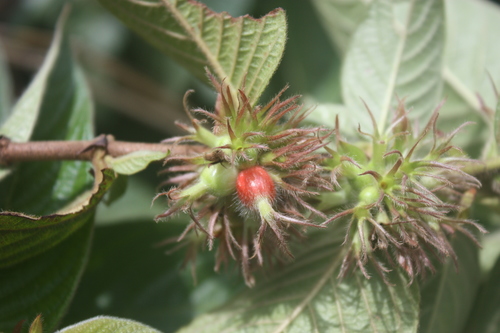
Feretia apodanthera
Delile
iNaturalist· cc-by-nc
(c) ONG OeBenin, some rights reserved (CC BY-NC)
iNaturalist· cc-by-nc
(c) ONG OeBenin, some rights reserved (CC BY-NC)
iNaturalist· cc-by-nc
(c) ONG OeBenin, some rights reserved (CC BY-NC)
Summary
Source: WikipediaFeretia apodanthera is a species of tree in the family Rubiaceae. It was first described by Delile in 1843.
Description
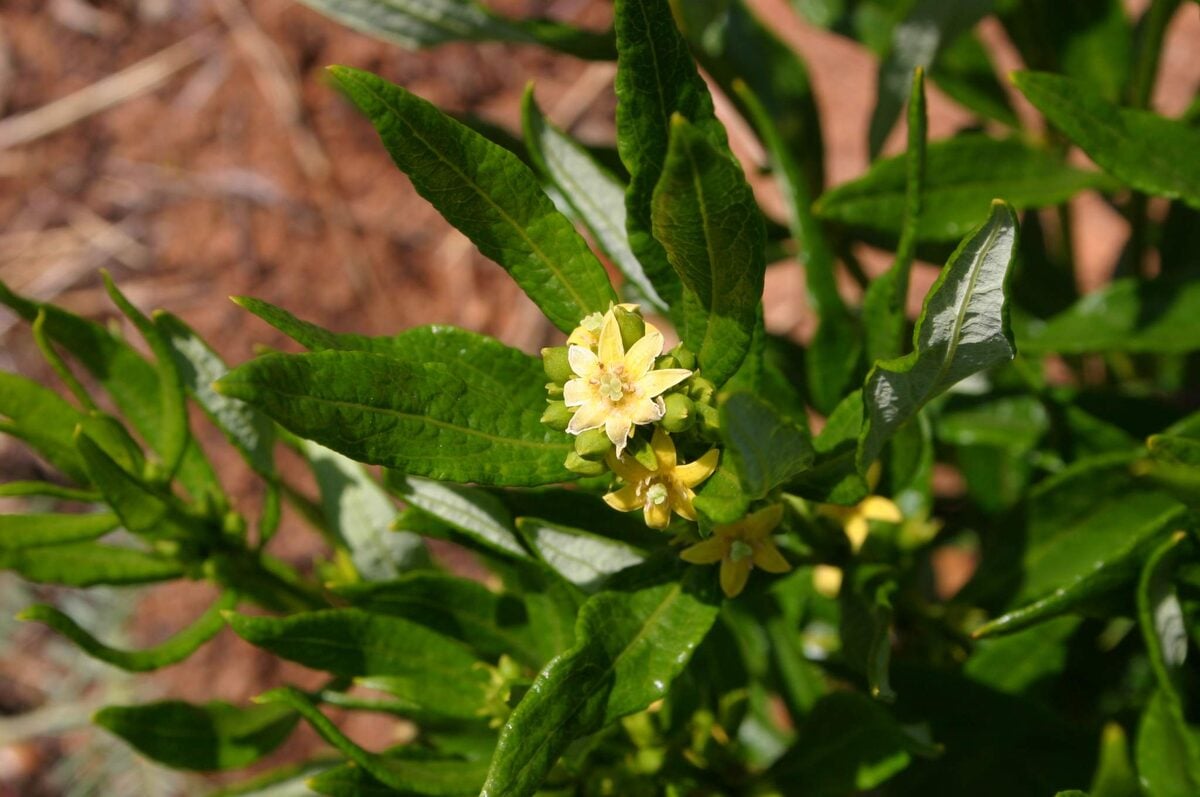
A bushy shrub. It can grow 6 m tall. The branches are winding and twisted. The young bark is red and flaking. It is light brown and cracked when old. Young twigs are hairy. The leaves are small and narrowly oval. They are 4-6 cm long and 2-3 cm wide and have a sharp tip. The leaves occur in flushes. The flowers are white, cream or pink. They are on long thin stalks. They appear together with young leaves at the ends of young branches. The fruit are small black berries with a few seeds. They are 8 mm across.
Edible Uses
Fruit - raw. The red fleshy pulp of ripe fruit is eaten raw as a snack and, especially by herdsmen and children, are used for quenching hunger and thirst. The roasted fruit is used as a substitute for coffee. (Should this be the seed?) The dried leaves are eaten as a vegetable.
Traditional Uses
The seeds are roasted and used to make coffee like drinks. The leaves are dried and used as a vegetable.
This uses section is brief — help expand it
Medicinal Uses
A decoction of the roots is used in the treatment of gonorrhoea, syphilis and leprosy. An infusion is drunk to treat stomach-ache. The powder obtained from pounded roots is used to treat wounds. The fruit is crushed with water and used as an antidote to snake bites.
Distribution
A tropical plant. It grows in savannah bushland. It grows in the Sahel. It is often near rivers and on the edges of water holes. They can be on termite mounds. It can grow in arid places.
Where It Grows
Africa, Burkina Faso, Cameroon, Central Africa, Chad, Congo, East Africa, Ghana, Kenya, Mauritania, Mali, Nigeria, Sahel, Senegal, Sudan, Tanzania, West Africa,
Cultivation
Often found on clay soils in the wild, and also found in soils subject to seasonal inundation. The subspecies F. Apodanthera tanzaniensis has larger fruits than subsp keniensis.
Propagation
Seed - Cuttings.
Other Uses
The fruits are occasionally used as a cosmetic. Used as a cosmetic face mask. Combined with indigo (Indigifera spp.), they are used for making markings on the face. The whirled branches are used as swizzle sticks for mixing drinks. The tree is used for making live fences.
Synonyms
Also Known As
Bitinamusa, Bouhebehi, Djourasounjala, Mbuguswa, Mourgui
References (14)
- Abbiw, D.K., 1990, Useful Plants of Ghana. West African uses of wild and cultivated plants. Intermediate Technology Publications and the Royal Botanic Gardens, Kew. p 41
- Burkill, H. M., 1985, The useful plants of west tropical Africa, Vol. 4. Kew.
- Diarra, N. et al, 2016, Etude ethnobotanique des plantes alimentaires utilisées en période de soudure dans les régions Sud du Mali. Int. J. Biol. Chem. Sci. 10(1): 184-197
- Gilbert, T., et al, 2017, Diversity and local transformation of indigenous edible fruits in sahelian domain of Cameroon. Journal of Animal & Plant Sciences Vol. 26 (2): 5289-5300
- Grivetti, L. E., 1980, Agricultural development: present and potential role of edible wild plants. Part 2: Sub-Saharan Africa, Report to the Department of State Agency for International Development. p 27
Show all 14 references Hide references
- Grubben, G. J. H. and Denton, O. A. (eds), 2004, Plant Resources of Tropical Africa 2. Vegetables. PROTA, Wageningen, Netherlands. p 561
- Jardin, C., 1970, List of Foods Used In Africa, FAO Nutrition Information Document Series No 2.p 78, 136
- Le Houerou, H. N., (Ed.), 1980, Browse in Africa. The current state of knowledge. International Livestock Centre for Africa, Ethiopia. p 163
- Martin, F. W., et al, 1987, Perennial Edible Fruits of the Tropics. USDA Handbook 642 p 76
- Martin, F.W. & Ruberte, R.M., 1979, Edible Leaves of the Tropics. Antillian College Press, Mayaguez, Puerto Rico. p 216
- Maydell, H. von, 1990, Trees and shrubs of the Sahel: their characteristics and uses. Margraf. p 269
- Mpasiwakomu, R. A., 2017, The Diversity and Utilization of Wild Edible and Medicinal Plant Species found in Uvinza Miombo Woodlands, Tanzania. M. Sc. thesis University of Tanzania.
- Vivien, J., & Faure, J.J., 1996, Fruitiers Sauvages d'Afrique. Especes du Cameroun. CTA p 281
- World Checklist of Useful Plant Species 2020. Royal Botanic Gardens, Kew