Vangueria cyanescens
Robyns
Smooth wild medlar, Kalahari wild medlar
iNaturalist· cc-by
(c) Robert Taylor, some rights reserved (CC BY), uploaded by Robert Taylor
iNaturalist· cc-by
(c) Robert Taylor, some rights reserved (CC BY), uploaded by Robert Taylor
Summary
Source: WikipediaVangueria cyanescens, the Kalahari wild-medlar, is a species of flowering plant in the family Rubiaceae. It is found in Angola, Botswana, Namibia, and Zambia. The epithet is a Latin adjective meaning dark or deep blue, referring to the colour of the leaves, especially after drying.
Description
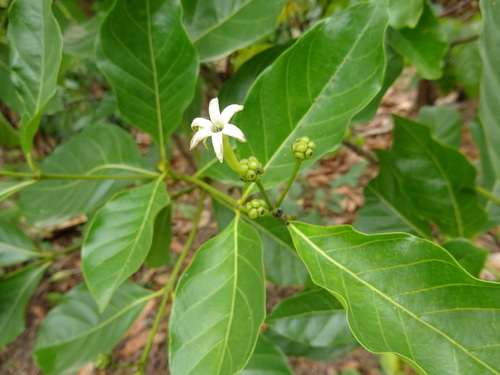
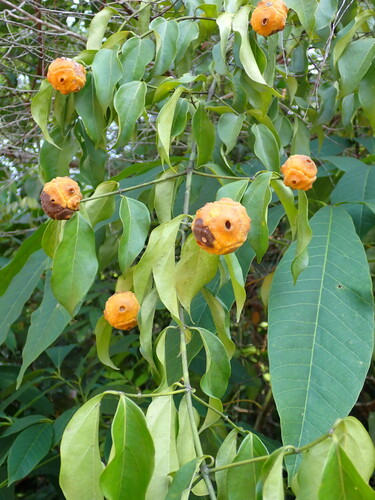
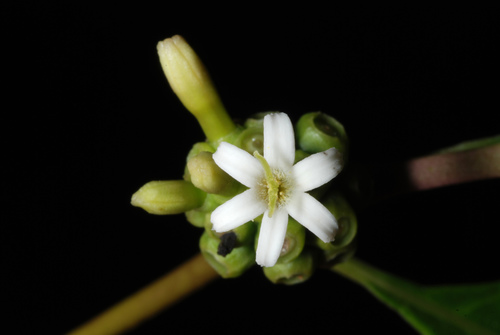
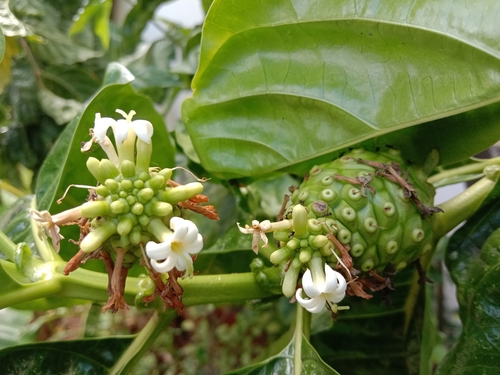
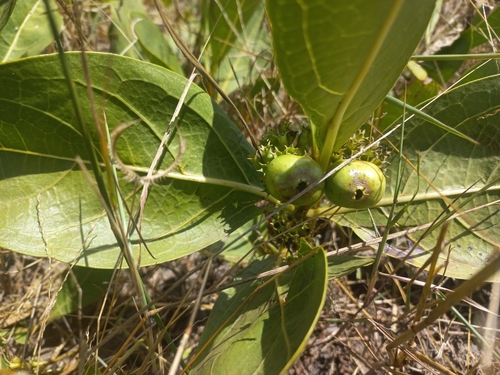
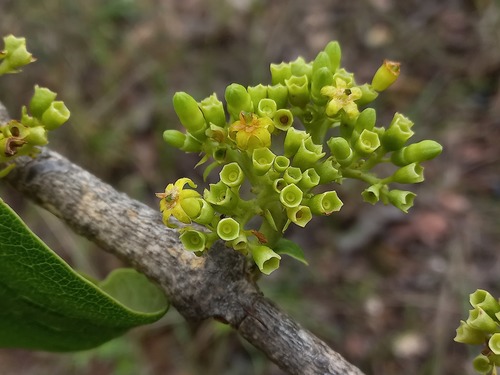
A shrub or small tree. It has many stems and grows 4 m high. The bark is smooth and grey. The leaves are broadly sword shaped. They are 18 cm long by 7 cm wide. They are arranged opposite one another. There are many flowers on branched stalks. The flowers are greenish tubes. The fruit are round and about 3 cm across. They have a ring at the top. They are green but turn yellow-brown when ripe. There are about 5 seeds. The fruit are edible.
Edible Uses
The fruit are eaten raw.
Traditional Uses
The fruit are eaten raw.
This uses section is brief — help expand it
Distribution
It is a tropical plant. It grows in areas of mountainous savannah. It grows in hot arid places with a marked dry season of up to 6-11 months. It can grow in the desert. It grows between 930-1,110 m above sea level. It can grow in arid places.
Where It Grows
Africa, Angola, Botswana, Central Africa, East Africa, Eswatini, Namibia, South Africa, Southern Africa, Southern Africa, Swaziland, Zambia,
Also Known As
Chwere, Emantulwa, Simbumbu, Umntulu
References (9)
- Cunningham, 1985,
- Long, C., 2005, Swaziland's Flora - siSwati names and Uses http://www.sntc.org.sz/flora/
- Mannheimer, C. A. & Curtis. B.A. (eds), 2009, Le Roux and Muller's Field Guide to the Trees and Shrubs of Namibia. Windhoek: Macmillan Education Namibia. p 464
- Ogle & Grivetti, 1985,
- Peters, C. R., O'Brien, E. M., and Drummond, R.B., 1992, Edible Wild plants of Sub-saharan Africa. Kew. p 176
Show all 9 references Hide references
- Royal Botanic Gardens, Kew (1999). Survey of Economic Plants for Arid and Semi-Arid Lands (SEPASAL) database. Published on the Internet; http://www.rbgkew.org.uk/ceb/sepasal/internet [Accessed 10th June 2011]
- Ruiters-Welcome, A. K., 2019, Food plants of southern Africa. Ph.D. thesis. Univ. of Johannesburg p 97
- Swaziland's Flora Database http://www.sntc.org.sz/flora
- World Checklist of Useful Plant Species 2020. Royal Botanic Gardens, Kew