Aiphanes horrida
(Jacq.) Burret
Thorny ruffle palm, Coyure palm, Chonta palm
iNaturalist· cc-by-nc
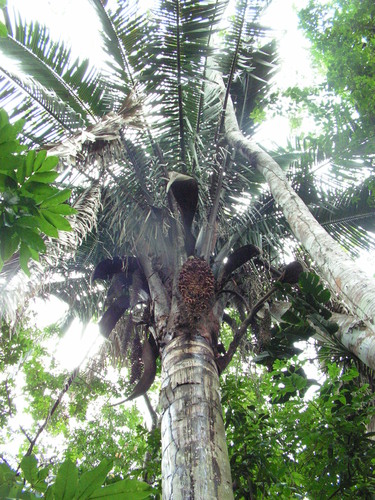
(c) Apipa, some rights reserved (CC BY-NC), uploaded by Apipa
iNaturalist· cc-by
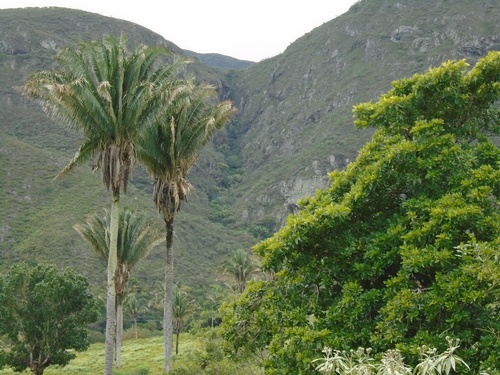
(c) Dick Culbert, some rights reserved (CC BY)
iNaturalist· cc-by-nc
(c) Apipa, some rights reserved (CC BY-NC), uploaded by Apipa
Summary
Source: WikipediaAiphanes horrida is a palm native to northern South America and Trinidad and Tobago. Aiphanes horrida is a solitary, spiny tree. In the wild it grows 3–10 metres tall (9–30 feet) tall with a stem diameter of 6–10 centimetres (2–4 inches); cultivated trees may be as much as 15 m (49') tall with a 15 cm (6") diameter. The epicarp and mesocarp of the fruit are rich in carotene and are eaten in Colombia, while the seeds are used to make candles. In parts of the Colombian Llanos, endocarps are used to play games. The range of the species is found in dry forests between sea level and 1700 m (5600') above sea level in Bolivia, Brazil, Colombia, Peru, Trinidad and Tobago and Venezuela, but is not native to Ecuador. The species is cultivated as an ornamental throughout the tropics. Many authors, including Henderson et al. (1995) and Borchenius and Bernal (1996) use A. aculeata rather than A. horrida, giving Jacquin's description of Caryota horrida a publication date of 1809, three years after Willdenow's 1806 description. On the other hand, Govaerts et al. (2006) gives Jacquin's work a publication date of 1801, giving A. horrida priority over A. aculeata.
Description
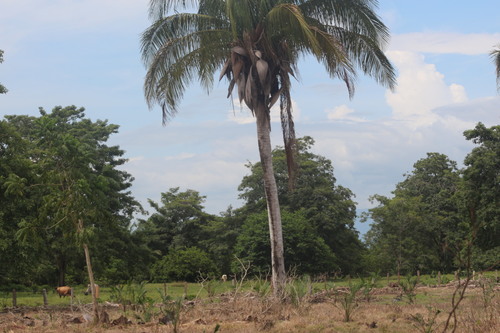
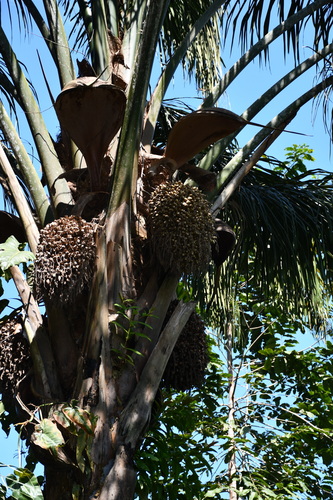
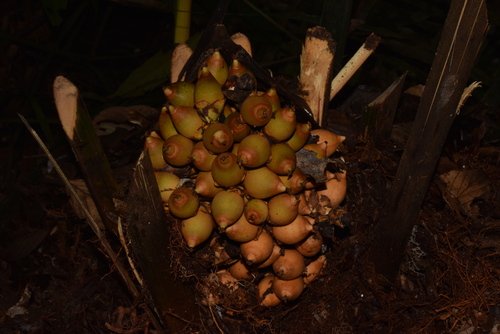
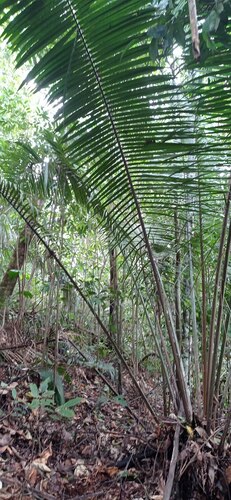
A palm with a single trunk. The trunk is 10 cm across. It grows to 10 m tall. It has long, black, brittle spines on the trunk, leaf stalks and leaflets. The spines are 10 cm long. The spines on the trunk are in rings. It spans 2.4 m wide. The leaves have jagged leaflets. The leaflets are irregularly spaced and with spines on the lower surface. They are dark green and feather like. The leaflets are clustered and have blunt tips. They are somewhat wedge shaped. This gives a ruffled appearance. The flowers are yellow and in short sprays. The fruit are in clusters and are orange-red to scarlet. They are 1-2 cm across. The fruit are edible.
Edible Uses
The orange-red fruits are eaten raw and sold in markets. The seeds are used in candies and for beverages.
Traditional Uses
The fruit are eaten raw. The seeds are used in candies and for drinks.
This uses section is brief — help expand it
Distribution
A tropical and subtropical plant. Large plants grow grow with part shade or full sun. It prefers a rich, damp, well-drained soil. It grows in tropical America between sea level and 1700 m altitude but is more common between 500-1500 m. It suits hardiness zones 11-12.
Where It Grows
Amazon, Andes, Asia, Australia, Bahamas, Belgium, Bermuda, Bolivia, Brazil, Central America, Colombia, Dominican Republic, Ecuador, Europe, Hawaii, Indonesia, North America, Pacific, Panama, Peru, SE Asia, Singapore, South America*, Trinidad & Tobago, USA, Venezuela, West Indies,
Cultivation
It can be grown from seed. Seed germinate readily in about 2 months.
Propagation
Seed - germinates easily in 1 - 2 months.
Other Uses
The seeds are used for playing games.
Production
Seedlings are slow growing in their early years.
Other Information
The fruit are sold in markets.
Notes
There are about 38 Aiphanes species. They grow in tropical America.
Synonyms
Also Known As
Cariota-de-espinho, Chascaraza, Chica chica, Cocos rura, Corozo, Corozo anchame, Corozo colorado, Corozo chiquito, Corozo del orinoco, Coyupe palm, Gualte, Macuguita, Marara, Mararabe, Mararave, Mararay, Pujamo
References (29)
- Balick, M.J. and Beck, H.T., (Ed.), 1990, Useful palms of the World. A Synoptic Bibliography. Colombia p 474 (As Aiphanes caryotifolia), 661 (As Martinezia caryotifolia),
- Bircher, A. G. & Bircher, W. H., 2000, Encyclopedia of Fruit Trees and Edible Flowering Plants in Egypt and the Subtropics. AUC Press. p 15 (As Aiphanes carytaefolia)
- Blomberry, A. & Rodd, T., 1982, Palms. An informative practical guide. Angus & Robertson. p 43
- Daly, D. C., An Index of Common Names of Plants in Acre, Brazil. New York Botanical Garden Universidade Federal do Acre.
- Etherington, K., & Imwold, D., (Eds), 2001, Botanica's Trees & Shrubs. The illustrated A-Z of over 8500 trees and shrubs. Random House, Australia. p 83 (As Aiphanes caryotifolia)
Show all 29 references Hide references
- Etkin, N.L. (Ed.), 1994, Eating on the Wild Side, Univ. of Arizona. p 135 (As Aiphanes caryotifolia)
- Facciola, S., 1998, Cornucopia 2: a Source Book of Edible Plants. Kampong Publications, p 26 (As Aiphanes caryotifolia)
- Grandtner, M. M. & Chevrette, J., 2013, Dictionary of Trees, Volume 2: South America: Nomenclature, Taxonomy and Ecology. Academic Press p 18
- Haynes, J., & McLaughlin, J., 2000, Edible palms and Their Uses. University of Florida Fact sheet MCDE-00-50-1 p 2
- Henderson, A., Galeano, G and Bernal, R., 1995, Field Guide to the Palms of the Americas. Princeton. p 171
- Janick, J. & Paul, R. E. (Eds.), 2008, The Encyclopedia of Fruit & Nuts. CABI p 83 (As Aiphanes aculeata)
- Jones, D.L., 1994, Palms throughout the World. Smithtonian Institution, Washington. p 55, 120
- Jones, D.L., 2000, Palms of Australia 3rd edition. Reed/New Holland. p 113
- Kermath, B. M., et al, 2014, Food Plants in the Americas: A survey of the domesticated, cultivated and wild plants used for Human food in North, Central and South America and the Caribbean. On line draft. p 35 (As Aiphanes aculeata)
- Kew Plants of the World Online
- Lopez-Diago, D. & Garcia, N., 2021, Wild edible fruits of Colombia. Biota ColomBiana 22 (2) p 30
- Lorenzi, H., Bacher, L., Lacerda, M. & Sartori, S., 2006, Brazilian Fruits & Cultivated Exotics. Sao Paulo, Instituto Plantarum de Estuados da Flora Ltda. p 63
- Marcia, M. J., et al, 2011, Palm Uses in Northwestern South America: A Quantitative Review. Bot. Rev. (2011) 77:462-570
- Murilla, E., et al, 2010, Screening of vegetables and fruits from Panama for rich sources of lutein and zeaxanthin. Food Chemistry 122: 167-172
- Mem. Acad. Roy. Sci. Hist. (Berlin) 1804:32. 1807
- Paz, F. S., et al, 2021, Edible Fruit Plant Species in the Amazon Forest Rely Mostly on Bees and Beetles as Pollinators. Journal of Economic Entomology, XX(XX), 2021, 1–13 (As Aiphanes aculeata)
- Riffle, R.L. & Craft, P., 2003, An Encyclopedia of Cultivated Palms. Timber Press. p 24, 246
- Roa, J. A. G. & Boada, D. S. G., 2018, Fundación para el Fortalecimiento de la Fruticultura y Plantas Alimenticias no Convencionales en Colombia.
- Sukarya, D. G., (Ed.) 2013, 3,500 Plant Species of the Botanic Gardens of Indonesia. LIPI p 748
- Torre, de la L., et al, 2008, Enciclopedia de las Plantas Útiles del Ecuador. Herbario QCA. Pontificia Universidad Católica del Ecuador. p 192 (As Aiphanes aculeata)
- USDA, ARS, National Genetic Resources Program. Germplasm Resources Information Network - (GRIN). [Online Database] National Germplasm Resources Laboratory, Beltsville, Maryland. Available: www.ars-grin.gov/cgi-bin/npgs/html/econ.pl (10 April 2000)
- Wiersema, J. H. & Leon, B., 2013, World Economic Plants. A Standard Reference CRC Press. 2nd Ed. p 29
- World Checklist of Useful Plant Species 2020. Royal Botanic Gardens, Kew
- www.desert-tropicals.com