Daemonorops jenkinsiana
(Griff.) Mart.
Devil rattan
iNaturalist· cc-by-nc
(c) Gavin, some rights reserved (CC BY-NC)
iNaturalist· cc-by-nc
(c) Gavin, some rights reserved (CC BY-NC)
iNaturalist· cc-by-nc
(c) Gavin, some rights reserved (CC BY-NC)
Description
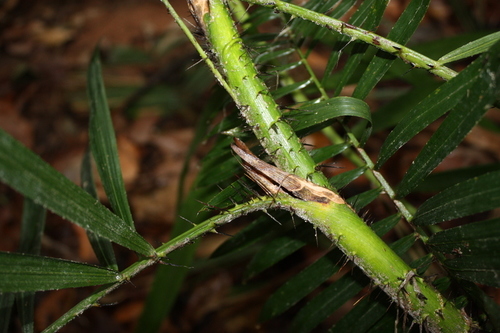
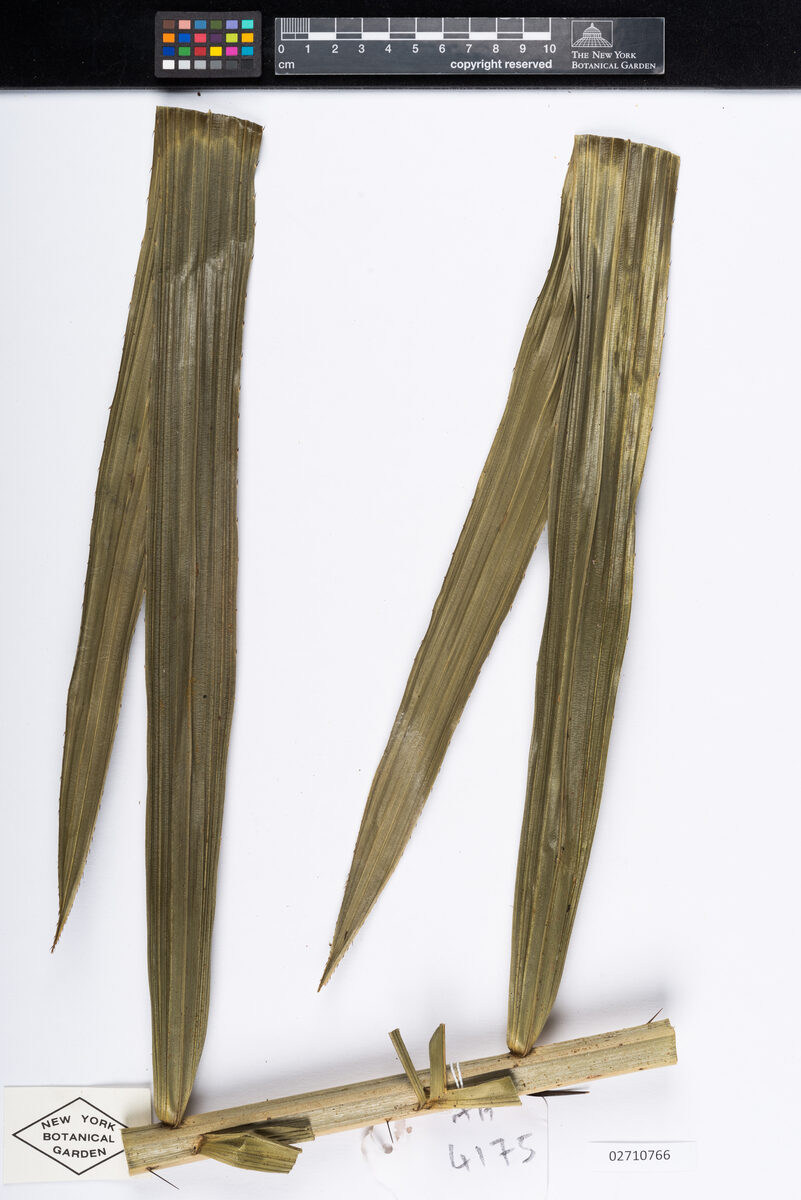
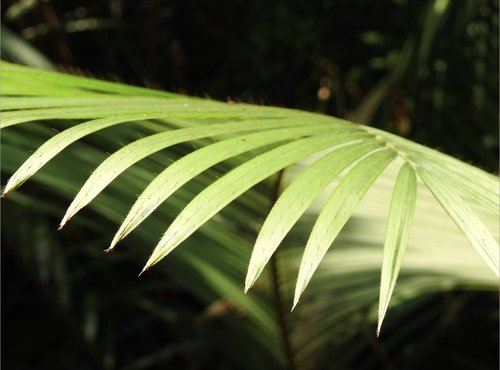
A rattan or vine. It forms dense clumps. It can be climbing and 25 m long. The stems can be 6 cm across. The leaf sheaths are yellowish green with brown to red hairs. The leafy stalks are 3 m long. There are 55-100 narrow leaflets on each side. The leaves have stout spines. There are several leaflets. The fruit are round or oval and yellowish brown. They are 2 cm long and 2 cm across.
Edible Uses
The pulp of ripe fruits is eaten raw. The inner pith of the stem is cooked with fish. The young tender shoots are boiled and eaten. The palm heart is also edible.
Traditional Uses
The pulp of the ripe fruit is eaten raw. The inner pith of the stem is cooked with fish. The young tender shoots are boiled and eaten.
This uses section is brief — help expand it
Distribution
It is a tropical plant. It grows in evergreen forest and scrub between 100-1,000 m altitude in Indochina. In Yunnan.
Where It Grows
Asia, Bangladesh, Bhutan, Cambodia, China, Himalayas, India, Indochina, Laos, Myanmar, Nepal, Northeastern India, SE Asia, Taiwan, Thailand, Vietnam,
Cultivation
Succeeding in the moist tropical lowlands, and also in the subtropics. The plant grows best where the mean annual temperature is in the range 20 - 32°c. Temperatures of 3°c or lower can kill young seedlings. It prefers a mean annual precipitation in excess of 1,500mm. The plant grows best in areas where the shade is around 30 - 50%. Seedlings require more sunlight than others for optimum growth. It prefers a humus-rich, moist, fertile soil. Prefers a pH in the range 4.5 - 6.5. Planted out when 12 months old, by the time the young plants are 24 - 36 months the first stem exceeds 1 metre in length and the first climbing whips appear. Two to three years after establishment, the aerial stems may grow at a rate of 2 metres per year. Flowering begins 5 - 6 years after sowing. At the age of 8 - 10 years,, a clump may already consist of over 30 aerial stems. It has been estimated that the yield could be about 7.9 tonnes/ha 10 - 11 years after establishment, and in the following years harvesting may be carried out 4 times in a rotation of five years. Total projected yield may possibly reach 38.7 tonnes/ha within a management period of 25 years. However, these estimates are in need of critical confirmation. The plant may have the potential to produce an exponential increase in the number of aerial stems, but because of competition between them, most of the suckers may not be able to develop into stems. Although the plant requires the support of a pre-existing tree crop or forest canopy for climbing, it requires sufficient sunlight to encourage the development of aerial stems. However, the new leaves of young seedlings may be scorched by full sunlight. In China, smallholders plant it in scattered clumps in agroforestry systems. On a commercial scale it has been intercropped in forest at a spacing of 3 metres x 4 metres. A dioecious species, both male and female forms need to be grown if fruit and seed are required.
Propagation
Sow the cleaned seeds in a shady position in a nursery seedbed with a high sand content. The germination rate of ripe and fresh seeds may be 85% or more. Most seeds germinate 50 - 60 days after sowing, and after 60 - 90 days the primary leaf emerges. Young seedlings (with the first true leaf unexpanded) are transplanted into plastic pots containing soil plus added nutrients and then kept moist and under 20 - 30% shade. Seedlings are ready to plant out when 12 - 15 months old. Although it can be propagated by vegetative means, propagation by seeds is a more common method. Seeds should be extracted and cleaned before sowing. The moisture content of seeds should be kept higher than 29%. In order to improve germination, the inner integument that covers the embryo is sometimes sliced through in the nursery.
Other Uses
The canes are widely used for all types of weaving and basketware as well as in furniture making. They are both flexible and durable, around10 - 30mm in diameter . The long and slender stems of rattan are put to various uses according to their size, length, flexibility, elasticity and toughness. The most slender canes are employed entire for binding purposes, and in making chairs, blinds, mats, wicker or basketwork, fishing implements, etc. Twisted together, they make very strong cables. The largest and more resistent canes are used entire as cables, the framework of wicker chairs etc. Usually, however, for many purposes the stems are split throughout their length into 2 - 4 or more strips from which the inner soft brittle and spongy portion is removed by means of a knife or same other instrument, so as to leave the external portion, which is hard, tough, flexible, elastic and has its outer surface very clean and smooth as if it had been varnished. Strips vary in width according to the use to which they are to be put. Those for delicate work, such as the network of furniture, small bags, hats, etc, are from 1 - 3mm wide; those employed as lashings in native housebuilding or in fastening the removable head of the Malay axe to its handle are from 5-6 mm wide. Collecting and preparing the stems is very simple. The stem is cut near the ground and detached from the trees by taking a strong hold of its base and thus pulling down the entire plant with its leaves. The most recent growth at the top of the plant is removed and then, handling it from the upper end, the stem is forcibly drawn in the opposite direction between two pieces of wood, thus removing the spiny coverings. It is then cut into lengths of about 5 metres, each piece is bent into two equal parts and the stems are fastened into bundles ready for market. The most valued stems are not thicker than a man's little finger and have a fine polished straw-yellow glassy surface. The seeds are used for making necklaces.
Other Information
The shoots are commonly sold in markets in Laos. It is cultivated.
Synonyms
Also Known As
Golla bet, Huangteng, Maj jenkins, May cat, Raichhawk, Raidang, Saom, Wai
References (17)
- A Rapid Participatory Biodiversity Assessment. 2007, Southern Lao PDR. IUCN p 92
- Dransfield, J., et al, 2004, A preliminary checklist to Thai Palms. Thai For. Bull. (Bot.) 32:32-72
- Evans, T. D., et al, 2002, A Synopsis of the Rattans (Arecaceae: Calamoideae) of Laos and Neighbouring Parts of Indochina. Kew Bulletin, Vol. 57, No. 1 (2002), pp. 1-84
- Hazarika, T. K., et al, 2012, Studies on wild fruits of Mizoram, India used as ethno-medicines. Genetic Resources and Crop Evolution. Published on line 03 February, 2012
- Johnson, D.V., 1998, Tropical palms. Non-wood Forest products 10. FAO Rome. p 66 (As Daemonorops margaritae); (Also as Daemonorops schmidtiana)
Show all 17 references Hide references
- Kar, A., et al, 2013, Wild Edible Plant Resources used by the Mizos of Mizoram, India. Kathmandu University Journal of Science, Engineering and Technology. Vol. 9, No. 1, July, 2013, 106-126
- Kuo, W. H. J., (Ed.) Taiwan's Ethnobotanical Database (1900-2000), http://tk.agron.ntu.edu.tw/ethnobot/DB1.htm (As Daemonorops margaritae)
- Luczaj, L., et al, 2021, Wild food plants and fungi sold in the markets of Luang Prabang, Lao PDR. Journal of Ethnobiology and Ethnomedicine (2021) 17:6
- Murtem, G. & Chaudhrey, P., 2016, An ethnobotanical note on wild edible plants of Upper Eastern Himalaya, India. Brazilian Journal of Biological Sciences, 2016, v. 3, no. 5, p. 63-81
- Pasha, M. K. & Uddin, S. B., 2019, Minor Edible Fruits of Bangladesh. Bangladesh J. Plant Taxon. 26(2): 299–313
- Rec. Bot. Surv. India 2:220. 1902 (As Daemonorops margaritae)
- Sang, D. T., & Mizoue, K. O. N., 2012, Use of Edible Forest Plants among Indigenous Ethnic Minorities in Cat Tien Biosphere Reserve, Vietnam. Asian Journal of Biodiversity Vol. 3 (1), p 23-49 (As Daemonorops pierreanus)
- Turner, N. J. et al, 2011, Edible and Tended Wild Plants, Traditional Ecological Knowledge and Agroecology. Critical Reviews in Plant Sciences, 30:198-225 (As Daemonorops schmidtiana)
- Turreira Garcia, N., et al, 2017, Ethnobotanical knowledgeof the Kuy and Khmer people in Prey Lang, Cambodia. Cambodian Journal of Natural History 2017 (1): 76-101
- Wiersema, J. H. & Leon, B., 2013, World Economic Plants. A Standard Reference CRC Press. 2nd Ed. p 231
- World Checklist of Useful Plant Species 2020. Royal Botanic Gardens, Kew (As Calamus jenkinsiana)
- Xu, You-Kai, et al, 2004, Wild Vegetable Resources and Market Survey in Xishuangbanna, Southwest China. Economic Botany. 58(4): 647-667. (As Daemonorops margaritae)