Fadogia cienkowskii
Schweinf.
iNaturalist· cc-by
(c) Robert Taylor, some rights reserved (CC BY), uploaded by Robert Taylor
iNaturalist· cc-by-nc-sa
(c) Rob Palmer, some rights reserved (CC BY-NC-SA)
Description
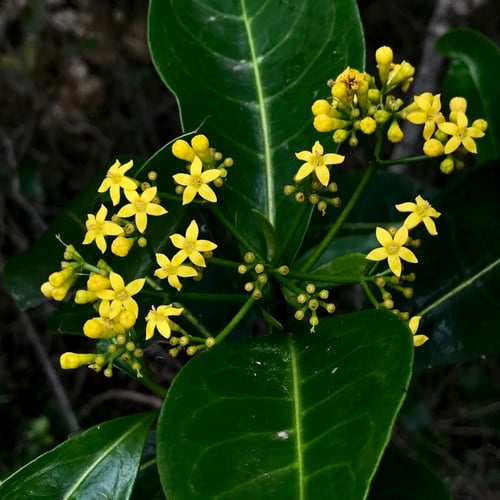
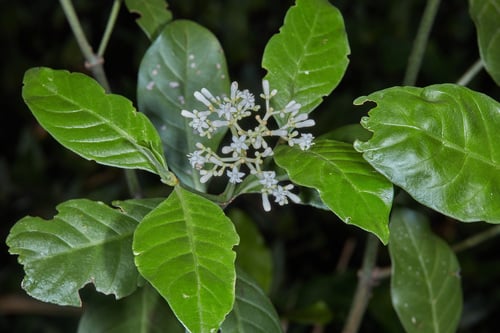
A low growing woody shrub. There is a woody rootstock and one or several stems can grow from this. It grows 1 m high. The stems are hairy. The leaves are in rings of 3-4. They are 2-9 cm long by 1-5 cm wide. They are narrowly oval. There are 2-6 flowers in a group. The fruit is dark green and becoming black and shiny. They are 1 cm across.
Edible Uses
Fruit - raw. The ripe, fleshy fruit has a sweet flavour. The shiny, black, rounded fruit is up to 10mm in diameter, containing 1 - 3 seeds. The green leaves are used for making tea. The nectar from the flowers is sweet and often sucked by children.
Traditional Uses
Caution: The plant contains alkaloids, flavones, saponins and tannins.
This uses section is brief — help expand it
Medicinal Uses
The roots are used for treating infertility.
Known Hazards
The plant contains alkaloids, flavones, saponins and tannins.
Distribution
A tropical plant. It grows in lowlands and highlands. It grows in the savannah in West Africa. It grows in the drier parts of Africa.
Where It Grows
Africa, Angola, Benin, Burkina Faso, Cabinda, Cameroon, Central Africa, Congo, East Africa, Ethiopia, Ghana, Guinea, Guinée, Kenya, Malawi, Mali, Nigeria, Sudan, Tanzania, Uganda, West Africa, Zambia, Zimbabwe,
Cultivation
Plants can withstand annual bush fires, resprouting from the woody rhizome once the fire is past.
Propagation
Seed - best sown as soon as it is ripe.
Also Known As
Bafankodomo, Findokoli, Kindokoli, Kitokoli, Ndumbilu, Sugan, Vikoko
References (16)
- Abbiw, D.K., 1990, Useful Plants of Ghana. West African uses of wild and cultivated plants. Intermediate Technology Publications and the Royal Botanic Gardens, Kew. p 42
- Achigan-Dako, E, et al (Eds), 2009, Catalogue of Traditional Vegetables in Benin. International Foundation for Science.
- Burkill, H. M., 1985, The useful plants of west tropical Africa, Vol. 4. Kew.
- Dalziel, J. M., 1937, The Useful plants of west tropical Africa. Crown Agents for the Colonies London.
- Flora Zambesiaca. http://apps.kew.org/efloras
Show all 16 references Hide references
- Fowler, D. G., 2007, Zambian Plants: Their Vernacular Names and Uses. Kew. p 83
- Fox, F. W. & Young, M. E. N., 1982, Food from the Veld. Delta Books. p 320
- Grubben, G. J. H. and Denton, O. A. (eds), 2004, Plant Resources of Tropical Africa 2. Vegetables. PROTA, Wageningen, Netherlands. p 561
- Jardin, C., 1970, List of Foods Used In Africa, FAO Nutrition Information Document Series No 2.p 77, 136
- Makonda, F. B. S., & Ruffo, C. K., 2011, Species List. NAFORMA, Tanzania
- Martin, F.W. & Ruberte, R.M., 1979, Edible Leaves of the Tropics. Antillian College Press, Mayaguez, Puerto Rico. p 216
- Okigbo, B.N., Vegetables in Tropical Africa, in Opena, R.T. & Kyomo, M.L., 1990, Vegetable Research and development in SADCC countries. Asian Vegetable Research and development Centre. Taiwan. p 45
- Peters, C. R., O'Brien, E. M., and Drummond, R.B., 1992, Edible Wild plants of Sub-saharan Africa. Kew. p 169
- Ruffo, C. K., Birnie, A. & Tengnas, B., 2002, Edible Wild Plants of Tanzania. RELMA p 314
- Vivien, J., & Faure, J.J., 1996, Fruitiers Sauvages d'Afrique. Especes du Cameroun. CTA p 281
- World Checklist of Useful Plant Species 2020. Royal Botanic Gardens, Kew