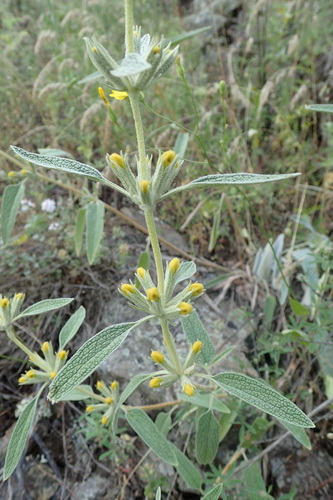
Mosla dianthera - (Buch.
(Buch.-Ham. ex Roxb.)Maxim.
gbif· cc0
decaturjosh
gbif· cc-by-nc
Шильников Дмитрий Сергеевич
gbif· cc-by-nc
Шильников Дмитрий Сергеевич
Description
Mosla dianthera is a ANNUAL growing to 0.3 m (1ft). It is in flower from June to September, and the seeds ripen from July to September. The species is hermaphrodite (has both male and female organs). Suitable for: light (sandy), medium (loamy) and heavy (clay) soils. Suitable pH: mildly acid, neutral and basic (mildly alkaline) soils. It can grow in semi-shade (light woodland) or no shade. It prefers moist soil.
Edible Uses
Young shoots - cooked. Although edible, they are not very pleasant.
Medicinal Uses
Carminative. The leaves are carminative. Recommended in cases of heartburn.
Distribution
E. Asia - China, Japan, Korea, Manchuria.
Where It Grows
TEMPERATE ASIA: Russian Federation (Primorye, Sakhalin), China (Fujian Sheng, Guangdong Sheng, Guangxi Zhuangzu Zizhiqu, Guizhou Sheng, Hubei Sheng, Hunan Sheng, Jiangsu Sheng, Jiangxi Sheng, Shaanxi Sheng, Sichuan Sheng, Yunnan Sheng, Zhejiang Sheng), Korea, Japan (Hokkaidô, Honshu, Kyushu, Ryukyu Islands, Shikoku), Taiwan TROPICAL ASIA: Bhutan, India (north), Nepal, Pakistan, Indochina, Myanmar, Thailand, Indonesia (Sumatera (north))
Cultivation
We have almost no information on this species and do not know if it will succeed outdoors in Britain, though judging by its native range it should be possible to grow it as a hardy annual in most parts of the country. It probably requires a well-drained soil and a sunny position.
Propagation
Seed - we have no information on this species but suggest sowing the seed in situ in mid to late spring.