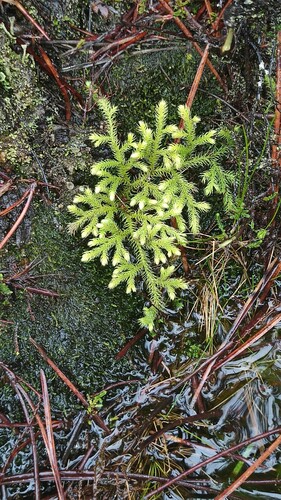
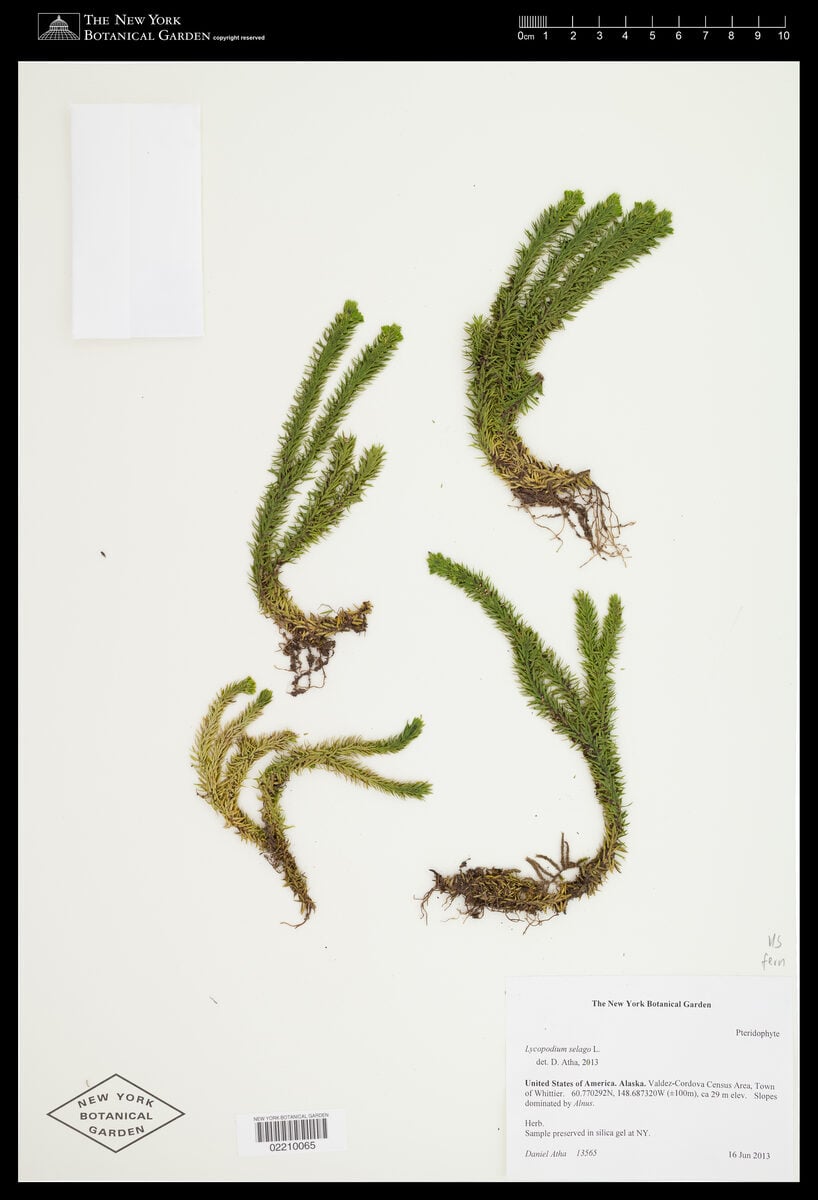
Lycopodium lucidulum
Michx.
Shining Club Moss
gbif· cc-by
Neal Kelso
gbif· cc-by
Neal Kelso
gbif· cc-by
Neal Kelso
Description
Lycopodium lucidulum is a FERN growing to 0.2 m (0ft 8in). See above for USDA hardiness. It is hardy to UK zone 5. Suitable for: light (sandy) and medium (loamy) soils and prefers well-drained soil. Suitable pH: mildly acid, neutral and basic (mildly alkaline) soils. It can grow in full shade (deep woodland) or semi-shade (light woodland). It prefers moist soil.
Edible Uses
The plant is edible.
Known Hazards
Although no records of toxicity have been seen for this species, a number of other members of this genus are said to be toxic and so some caution is advised.
Distribution
N. America - Newfoundland to British Columbia, south to South Carolina, Iowa and Tennessee.
Where It Grows
NORTHERN AMERICA: Canada (Québec, Nova Scotia, Ontario, Prince Edward Island, New Brunswick, Newfoundland and Labrador, Manitoba), United States (Connecticut, Indiana, Maine, Massachusetts, Michigan, New Hampshire, New Jersey, New York, Ohio, Pennsylvania, Rhode Island, Vermont, West Virginia, Iowa, Minnesota, Missouri, Illinois, Wisconsin, Alabama, Arkansas, Delaware, Georgia, Kentucky, Maryland, North Carolina, South Carolina, Tennessee, Virginia)
Cultivation
Thrives in a rough spongy peat in a shady position. Requires a humid atmosphere. Terrestrial members of this genus are hard to establish. The roots are delicate and liable to rot, most water being absorbed through the foliage. Members of this genus are rarely if ever troubled by browsing deer. Although looking more like a moss, this genus is closely related to the ferns.
Propagation
Spores - best sown as soon as they are ripe on the surface of a humus-rich sterilized soil. Keep the compost moist, preferably by putting a plastic bag over the pot. Pot on small clumps of plantlets as soon as they are large enough to handle and keep humid until they are well established. Do not plant outside until the ferns are at least 2 years old and then only in a very well sheltered position. The spores are generally produced in abundance but are difficult to grow successfully. Layering of growing tips.
Other Uses
Mordant. The plant can be used as a mordant in dyeing.