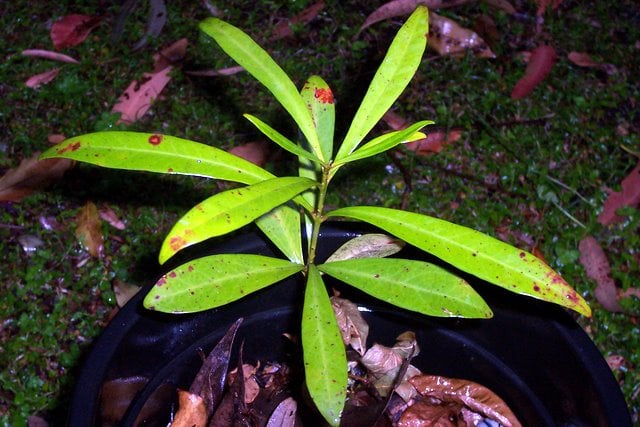
Eugenia luschnathiana
Berg ex Hook. & Jackson
Pitomba
iNaturalist· cc-by-nc-nd
(c) Víctor de Paiva, some rights reserved (CC BY-NC-ND), uploaded by Víctor de Paiva
iNaturalist· cc-by-nc
(c) leojales, some rights reserved (CC BY-NC)
Summary
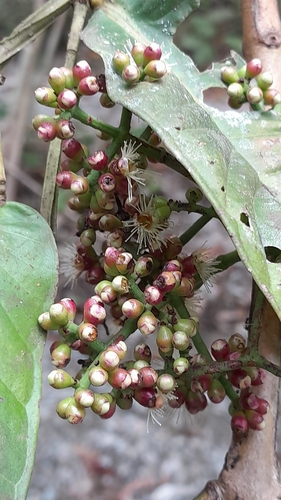
Source: WikipediaEugenia luschnathiana is a flowering plant in the family Myrtaceae, native to the state of Bahia, Brazil. The fruit is known as pitomba-da-bahia, and is also called uvalha do campo, ubaia do campo or uvalheira in Brazil. It shares the name pitomba with another South American species, Talisia esculenta. It is an evergreen shrub or small tree growing to 4–10 m high. The leaves are opposite, 3–7 cm long, oblong-lanceolate, dark green above, pale below, with a short petiole and a leathery texture. The flowers are 1.5–2 cm diameter, with four (rarely five) yellowish-white petals. The fruit is a globose, bright orange-yellow berry 2.5–5 cm long, containing one or two (rarely up to four) 1 cm diameter seeds.
Description
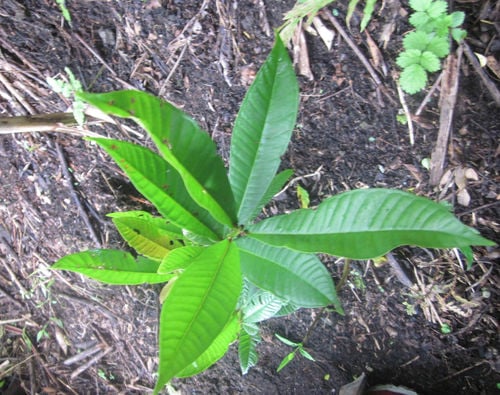
A tree. It grows up to 9 m tall and spreading about 5 m wide. The bark is mottled brown. It has glossy leaves. They are dark green above and pale green underneath. It is evergreen. The fruit are yellow and about 2.5 cm long. They contain 1 to 4 seeds. They have a rose smell.
Edible Uses
Fruit - raw or made into a jelly. The ripe fruit is bright orange, thin-skinned with a soft, melting, juicy flesh and a highly aromatic, slightly acid flavour. Soft and sweet like an apricot. The globose fruit is about 25mm in diameter. Seed - roasted.
Traditional Uses
The fruit are eaten raw. They can be used for jams and jellies. The seeds are roasted and eaten.
This uses section is brief — help expand it
Medicinal Uses
Not specified in available data.
Distribution
A tropical plant. It is native to Brazil. It can grow in subtropical climates but produces a slower growing smaller tree. It can grow on various types of soils. It cannot tolerate alkaline soils. It does best in deep, humid acid soils. It can be grafted onto Eugenia uniflora which can tolerate alkaline soils. It cannot tolerate waterlogging. It cannot tolerate drought especially at flowering and fruiting. It suits hardiness zones 9-12.
Where It Grows
Australia, Brazil*, Cuba, Mexico, South America, West Indies,
Cultivation
It is commonly grown from seed. It can be grafted using veneer grafts. Seeds are collected from ripe fruit and the pulp removed. Seeds are planted fresh. They are best in part shade. Seedlings emerge in 40-50 days.
Propagation
Seed - best sown as soon as it is ripe in a partially shaded position in individual containers. A low germination rate can be expected, with the seed sprouting within 40 - 50 days.
Other Uses
The wood is of average texture, straight-grained, moderately heavy, hard, slightly susceptible to wood-eating organisms. Because of its small dimensions, it is only used for fuel and to make charcoal.
Production
It is fairly slow growing. Grafted trees take 3-4 years before producing fruit while seedling trees take 6-9 years to fruiting. Fruit mature after 4-6 weeks from flowering.
Other Information
It is a popular fruit. It is a cultivated fruit tree.
Notes
There are about 550 Eugenia species. They are mostly in tropical and subtropical South America.
Synonyms
Also Known As
Cucuiri, Uvalha de Campa, Uvalheira
References (23)
- Darley, J.J., 1993, Know and Enjoy Tropical Fruit. P & S Publishers. p 132
- Facciola, S., 1998, Cornucopia 2: a Source Book of Edible Plants. Kampong Publications, p 159 (As Phyllocalyx luschnathianus)
- Garner, R.J., and Chaudhri, S.A., (Ed.) 1976, The Propagation of Tropical fruit Trees. FAO/CAB. p 351
- Grandtner, M. M. & Chevrette, J., 2013, Dictionary of Trees, Volume 2: South America: Nomenclature, Taxonomy and Ecology. Academic Press p 239
- Hedrick, U.P., 1919, (Ed.), Sturtevant's edible plants of the world. p 299
Show all 23 references Hide references
- Hermandez Bermejo, J.E., and Leon, J. (Eds.), 1994, Neglected Crops. 1492 from a different perspective. FAO Plant Production and Protection Series No 26. FAO, Rome. p 16
- Hibbert, M., 2002, The Aussie Plant Finder 2002, Florilegium. p 99
- Kermath, B. M., et al, 2014, Food Plants in the Americas: A survey of the domesticated, cultivated and wild plants used for Human food in North, Central and South America and the Caribbean. On line draft. p 355
- Kiple, K.F. & Ornelas, K.C., (eds), 2000, The Cambridge World History of Food. CUP p 1836
- Llamas, K.A., 2003, Tropical Flowering Plants. Timber Press. p 285
- Lorenzi, H., Bacher, L., Lacerda, M. & Sartori, S., 2006, Brazilian Fruits & Cultivated Exotics. Sao Paulo, Instituto Plantarum de Estuados da Flora Ltda. p 203
- Lorenzi, H., 2009, Brazilian Trees. A Guide to the Identification and Cultivation of Brazilian Native Trees. Instituto Plantarum de Estuados da Flora Ltda. Vol. 3 p 246
- Lyle, S., 2006, Discovering fruit and nuts. Land Links. p 197
- Martin, F. W., et al, 1987, Perennial Edible Fruits of the Tropics. USDA Handbook 642 p 40
- C. F. P. Martius, Fl. bras. 14(1):333. 1857
- Miguel, E., et al, 1989, A checklist of the cultivated plants of Cuba. Kulturpflanze 37. 1989, 211-357
- Morton, Julia F., 1987, Fruits of Warm Climates. Creative Resources Systems, Inc. . p. 392
- Popenoe, W., 1920, Manual of tropical and subtropical fruits. Macmillan. New York.
- Segura, S., et al, 2018, The edible fruit species in Mexico. Genet Resour Crop Evol (2018) 65:1767–1793
- Silva, S. P. 1991. Frutas Brasil. Empresa das Artes. São Paulo.
- Tankard, G., 1990, Tropical fruit. An Australian Guide to Growing and using exotic fruit. Viking p 113
- van Wyk, B., 2005, Food Plants of the World. An illustrated guide. Timber press. p 192
- www.colecionandofrutas.org