Euclea racemosa subsp. schimperi
Murray, (A. DC.) F. White
Bush guarri
gbif· cc0
Prince Molokomme
gbif· cc-by-nc
Troos van der Merwe
gbif· cc-by-nc
Troos van der Merwe
Summary
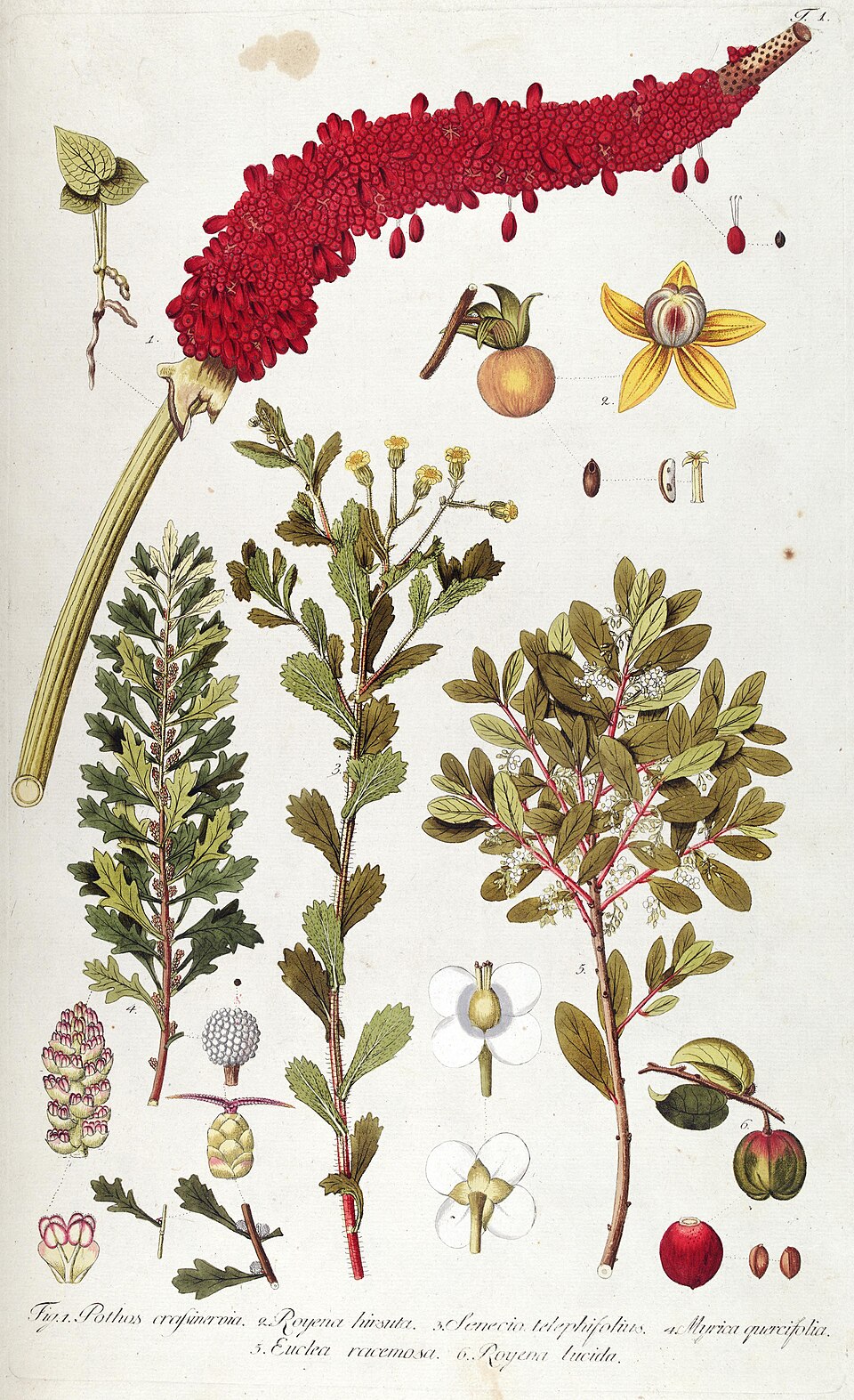
Source: WikipediaEuclea racemosa (the sea guarrie or dune guarrie) is a small to medium-sized evergreen tree that is indigenous to the Indian Ocean coast of Africa from Egypt to South Africa, as well as in Comoros, Oman and Yemen. Euclea racemosa has leathery foliage that can be exceptionally even and dense - making it an ideal plant for hedges. A dioecious tree (male and female flowers on separate trees), it produces small white flowers, which are followed by red, purple and black fruits that attract birds. The berries are used locally to make "Guarrie vinegar". The name guarrie appears to derive from the local Khoe language, in which it is spelled gwarri.
Description
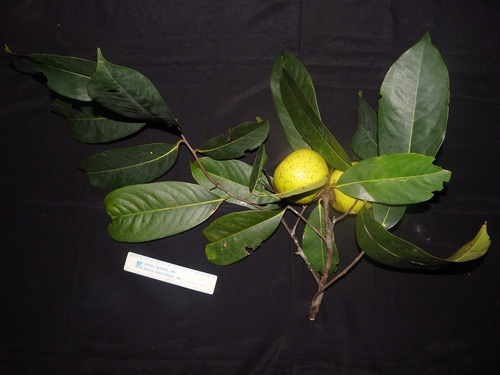
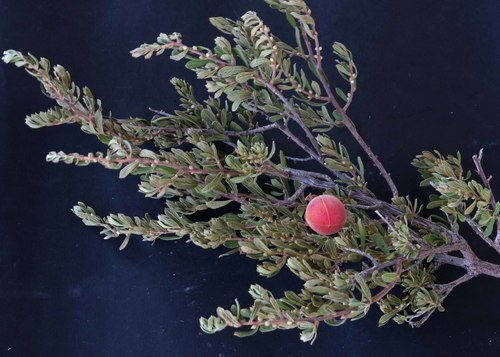
A shrub or small tree. It grows 3-8 m tall. The bark is grey to black. The leaves are near the ends of branches. They are oval and 3-9 cm long by 0.5-3 cm wide. They curl under at the edge. The flowers are small and creamy white. They have a sweet scent. They occur in short sprays in the axils of leaves. These are 4 cm long. The fruit are almost round. They are 8 mm across. They are rich red to purple when mature.
Edible Uses
The thin layer around the seed is eaten, particularly by children. The fruit are also eaten by adults during famines.
Traditional Uses
The thin layer around the seed is eaten.
This uses section is brief — help expand it
Medicinal Uses
Traditional uses (FPI) document consumption of the thin layer around the seed.
Distribution
A tropical plant. It grows in coastal scrub and low altitude bush. It is in areas of moderate rainfall. In Ethiopia it grows between 1,500-2,300 m altitude. It grows in areas with an annual rainfall between 100-150 mm. It can grow in arid places.
Where It Grows
Africa, Botswana, Central Africa, Comoros, Congo, Djibouti, East Africa, Egypt, Eswatini, Ethiopia, Kenya, Lesotho, Malawi, Middle East, Mozambique, North Africa, Oman, Saudi Arabia, Somalia, South Africa, Southern Africa, Sudan, Swaziland, Tanzania, Uganda, Yemen, Zambia, Zimbabwe,
Other Information
The fruit are eaten especially by children. They are eaten by adults during famines.
Synonyms
Also Known As
Dedaho, Emus, Inchitsamuti, Indvodzemnyama, Maayeer, Miessa, Mlalaku, Muenya, Mufitu-mbwe, Mulala, Munhu, Quintana
References (31)
- Addis, G., et al, 2005, Ethnobotanical Study of Edible Wild Plants in Some Selected Districts of Ethiopia. Human Ecology, Vol. 33, No. 1, pp. 83-118
- Alfarhan, A. H., 2005, Flora of Jizan Region. AR 17-7. King Abdulaziz City for Science and Technology (KACST). p 168 (As Euclea schimperi)
- Asfaw, Z. and Tadesse, M., 2001, Prospects for Sustainable Use and Development of Wild Food Plants in Ethiopia. Economic Botany, Vol. 55, No. 1, pp. 47-62 (As Euclea schimperi)
- Bahru, T., et al, 2013, Wild Edible Plants: Sustainable Use and Management by Indigenous Communities in and the Buffer Area of Awah National Park, Ethiopia. Ethiop. J. Sci., 36(2): 93-108
- Bekele-Tesemma A., Birnie, A., & Tengnas, B., 1993, Useful Trees and Shrubs for Ethiopia. Regional Soil Conservation Unit. Technical Handbook No 5. p 234
Show all 31 references Hide references
- Feyssa, D. H., et al, 2011, Seasonal availability an consumption of wild edible plants in semiarid Ethiopia; Implications to food security and climate change adaptation. Journal of Horticulture and Forestry 3(5): 138-149
- Ethiopia: Famine Food Field Guide. http://www.africa.upenn.edu/faminefood/category3.htm (As Euclea schimperi)
- Fowler, D. G., 2007, Zambian Plants: Their Vernacular Names and Uses. Kew. p 24
- Fox, F. W. & Young, M. E. N., 1982, Food from the Veld. Delta Books. p 187
- Goode, P., 1989, Edible Plants of Uganda. FAO p 30 (As Euclea latidens)
- Grivetti, 1976, 1979,
- Grivetti, L. E., 1980, Agricultural development: present and potential role of edible wild plants. Part 2: Sub-Saharan Africa, Report to the Department of State Agency for International Development. p 79
- Jardin, C., 1970, List of Foods Used In Africa, FAO Nutrition Information Document Series No 2.p 135
- Long, C., 2005, Swaziland's Flora - siSwati names and Uses http://www.sntc.org.sz/flora/ (As Euclea schimperi)
- Lulekal, E., et al, 2011, Wild edible plants in Ethiopia: a review on their potential to combat food insecurity. Afrika Focus - Vol. 24, No 2. pp 71-121
- Malaisse, F., 1997, Se nourrir en floret claire africaine. Approche ecologique et nutritionnelle. CTA., p 63 (As Euclea schimperi)
- Maundu, P. et al, 1999, Traditional Food Plants of Kenya. National Museum of Kenya. 288p
- Miller, A. G., Morris, M. & Stuart-Smith, S., 1988, Plants of Dhofar. The Southern Region of Oman, Traditional, Economic and Medicinal Uses. Sultanate of Oman. p 126 (As Euclea schimperi)
- Molla, A., Ethiopian Plant Names. http://www.ethiopic.com/aplants.htm (As Euclea schimperi)
- Ocho, D. L., et al, 2012, Assessing the levels of food shortage using the traffic light metaphor by analyzing the gathering and consumption of wild food plants, crop parts and crop residues in Konso, Ethiopia. Journal of Ethnobiology and Ethnomedicine 8:30
- Ogle and Grivetti, 1985,
- Palgrave, K.C., 1996, Trees of Southern Africa. Struik Publishers. p 740
- Palmer & Pitman, 1972,
- Peters, C. R., O'Brien, E. M., and Drummond, R.B., 1992, Edible Wild plants of Sub-saharan Africa. Kew. p 106
- Plowes, N. J. & Taylor, F. W., 1997, The Processing of Indigenous Fruits and other Wildfoods of Southern Africa. in Smartt, L. & Haq. (Eds) Domestication, Production and Utilization of New Crops. ICUC p 191 (As Euclea schimperi)
- Royal Botanic Gardens, Kew (1999). Survey of Economic Plants for Arid and Semi-Arid Lands (SEPASAL) database. Published on the Internet; http://www.rbgkew.org.uk/ceb/sepasal/internet [Accessed 16th April 2011]
- Ruiters-Welcome, A. K., 2019, Food plants of southern Africa. Ph.D. thesis. Univ. of Johannesburg p 53 (As Euclea schimperi)
- Schmidt, E., Lotter, M., & McCleland, W., 2007, Trees and shrubs of Mpumalanga and Kruger National Park. Jacana Media p 522 (As Euclea schimperi)
- Some Kasigau Woody Plants and their Uses. 2013, National Geographic and Miami University p 30
- Welcome, A. K. & Van Wyk, B.-E., 2019, An inventory and analysis of the food plants of southern Africa. South African Journal of Botany 122 (2019) 136–179 (As Euclea schimperi)
- White, F., Dowsett-Lemaire, F. and Chapman, J. D., 2001, Evergreen Forest Flora of Malawi. Kew. p 229