Corymbia terminalis
(F. Muell.) K. D. Hill & L. A. S. Johnson
Inland Bloodwood, Western Bloodwood
iNaturalist· cc-by-nc
(c) Dean Nicolle, some rights reserved (CC BY-NC), uploaded by Dean Nicolle
iNaturalist· cc-by
(c) Em Lamond, some rights reserved (CC BY)
Summary
Source: WikipediaCorymbia terminalis, also known as tjuta, joolta, bloodwood, desert bloodwood, plains bloodwood, northern bloodwood, western bloodwood or inland bloodwood, is a species of small to medium-sized tree, rarely a mallee that is endemic to Australia. It has rough, tessellated bark on some or all of the trunk, sometimes also on the larger branches, smooth white to cream-coloured bark above, lance-shaped adult leaves, flower buds in groups of seven, white flowers and urn-shaped fruit.
Description
A small tree. It grows 10 m high. It often has several stems. The bark is mottled and rusty or brown. It is scaly. The leaves are pale and yellowish-green. They are pointed at the tip. The buds are cream coloured and 1 cm long. They occur in clusters at the ends of stems. The flowers are cream. They can be pink in the centre. The capsules are urn shaped with thick rims. They have 4 deeply enclosed valves.
Edible Uses
The sap from leaves is pounded and roasted, possibly concentrated through insect damage. Galls, manna, lerp (insect secretions), and nectar can also be consumed.
Traditional Uses
The sap from the leaf is pounded and roasted. It may be the result of insect damage.
This uses section is brief — help expand it
Medicinal Uses
Kino resin, obtained from the trunk, is very astringent. Diluted, it can be taken internally as an effective treatment for dysentery, working because it is not absorbed at all from the stomach and only very slowly from the intestine, and is thus able to directly treat the lower part of the intestine. It can be used as a gargle and mouthwash to treat relaxed throat, loose teeth. Applied externally as a wash, it is an effective styptic and can used to treat cuts and skin problems.
Distribution
A tropical plant. It grows on red, sandy or loamy country. It is also on stony hillsides. It can grow in arid places.
Where It Grows
Australia*,
Cultivation
Corymbia terminalis is native to the arid and semi-arid regions of central and northern Australia. Corymbia species generally require a sunny position, succeeding in a wide range of well-drained, circumneutral soils of low to moderate fertility. The plant develops a lignotuber - this is a woody tuber that starts to develop near the base of seedlings and can become massive in the mature plants of some species. It possesses embedded vegetative buds, allowing the plant to regenerate following crown destruction, for example by fire.
Propagation
Seed - surface sow in a seedtray in a sunny position and do not allow the compost to dry out. Species that come from high altitudes appreciate 6 - 8 weeks cold stratification at 2°c. Pot up the seedlings into individual pots as soon as the second set of seed leaves has developed, if left longer than this they might not move well. Seedlings are planted out in the field when they reach a height of about 25 cm. This should coincide with the onset of the rainy season in tropical countries. The seed has a long viability.
Other Uses
A kino resin is obtained from the trunk. It is used medicinally. Kino resins are rich in tannins and are very astringent. They can be used medicinally, in tanning, as well as for preserving and dyeing natural fibres. The resin oozes naturally from wounds in the trunk and can be tapped by making incisions in the bark. At first it is a thick liquid, but soon hardens upon exposure to the air and sun, typically drying to an amber-like material that consists of dark red angular fragments, rarely larger than a pea. The wood is very red. It is used for building purposes, slabs, posts, joists, etc. It is not highly spoken of, but it is almost the only fairly large timber available in the districts in which it grows.
Notes
There are a 110 Corymbia species mostly originally in Australia.
Synonyms
Also Known As
Desert bloodwood, Kutcha bloodwood
References (21)
- Bodkin, F., 1991, Encyclopedia Botanica. Cornstalk publishing, p 452
- Boomsma, C.D., 1972, Native Tree of South Australia. Woods & Forests Department South Australia, Bulletin No.19. p 176
- Cherikoff V. & Isaacs, J., The Bush Food Handbook. How to gather, grow, process and cook Australian Wild Foods. Ti Tree Press, Australia p 189
- Cribb, A.B. & J.W., 1976, Wild Food in Australia, Fontana. p 187
- Donkin,
Show all 21 references Hide references
- Elliot, W.R., & Jones, D.L., 1992, Encyclopedia of Australian Plants suitable for cultivation. Vol 4. Lothian. p 223
- Facciola, S., 1998, Cornucopia 2: a Source Book of Edible Plants. Kampong Publications, p 141
- Hardwick, G., 2001, Economically Useful Plants for Northern Australia: Master Species List. Crusader eBooks. (As Eucalyptus terminalis)
- Hedrick, U.P., 1919, (Ed.), Sturtevant's edible plants of the world. p 295
- Hiddins, L., 1999, Explore Wild Australia with the Bush Tucker Man. Penguin Books/ABC Books. p 129
- IRVINE,
- Latz, P.K., 1996, Bushfires and Bushtucker: Aboriginal plant use in Central Australia. IAD Press Alice Springs p 189 (As Eucalyptus opaca)
- Latz, P & Wightman, G., 1995, Desert Bush Tucker Identikit. Common Native Food Plants of Central Australia. Parks & Wild Commission Northern territory. p 18 (As Eucalyptus opaca)
- Lazarides, M. & Hince, B., 1993, Handbook of Economic Plants of Australia, CSIRO. p 109
- Low, T., 1991, Wild Food Plants of Australia. Australian Nature FieldGuide, Angus & Robertson. p 186
- Milson. J., 2000, Trees and Shrubs of north-west Queensland. DPI p 208
- Petheram, R. J. and Kok, B., 2003, Plants of the Kimberley Region of Western Australia. UWA Press p 417
- Smith, N. M., 1991, Ethnobotanical Field Notes from the Northern Territory, Australia, J. Adelaide Bot. Gard. 14(1): 1-65 (As Eucalyptus opaca)
- Telopea 6:323. 1995
- Townsend, K., 1994, Across the Top. Gardening with Australian Plants in the tropics. Society for Growing Australian Plants, Townsville Branch Inc. p 204
- Wheeler, J.R.(ed.), 1992, Flora of the Kimberley Region. CALM, Western Australian Herbarium, p 523 (As Eucalyptus opaca)
More from Myrtaceae
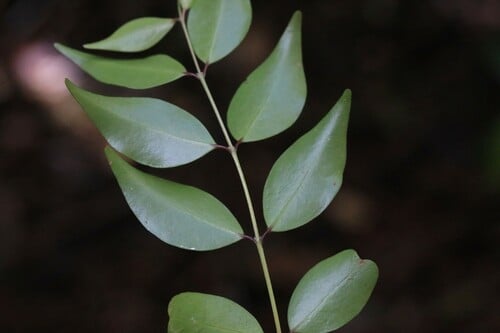
Archirhodomyrtus beckleri
Pink myrtle, Rose myrtle, Beckler's myrtle
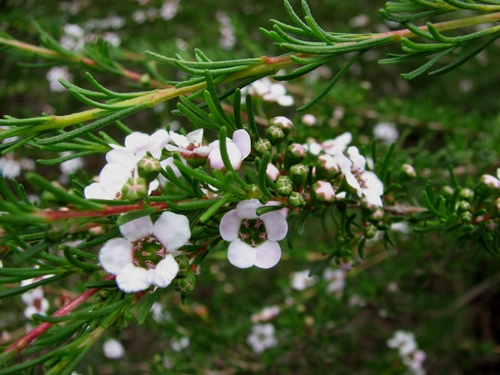
Astartea fascicularis
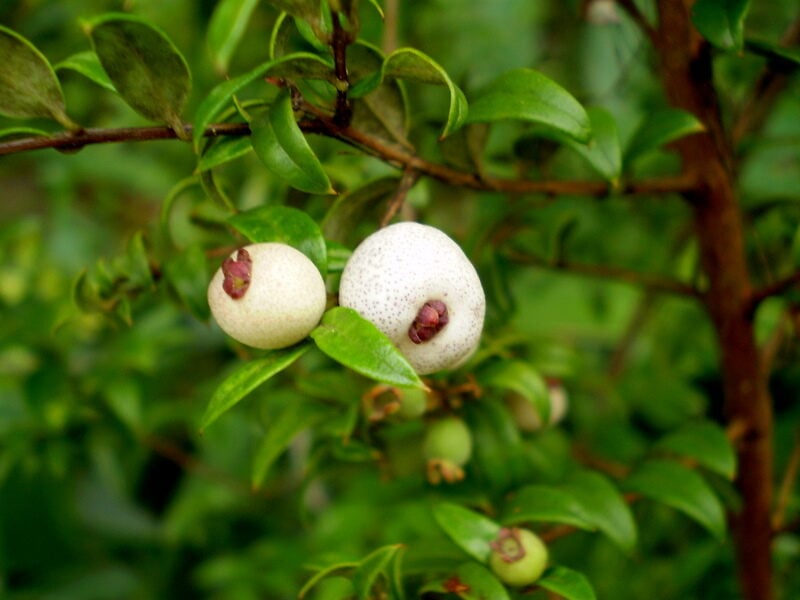
Austromyrtus dulcis
Midjin, Midjimberry, Midgen Berry, Quaker’s Cherry
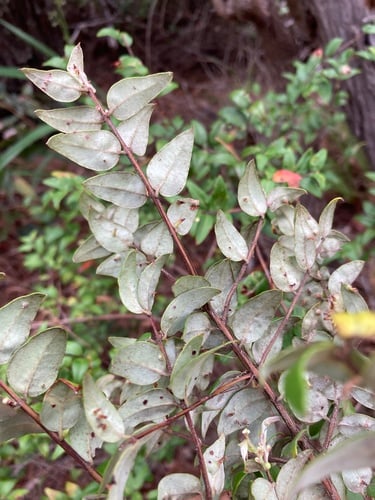
Austromyrtus dulcis x tenuifolia
Hybrid midyim
Austromyrtus glabra
Austromyrtus tenuifolia
Narrow leafed myrtle, Narrow-leafed midgenberry