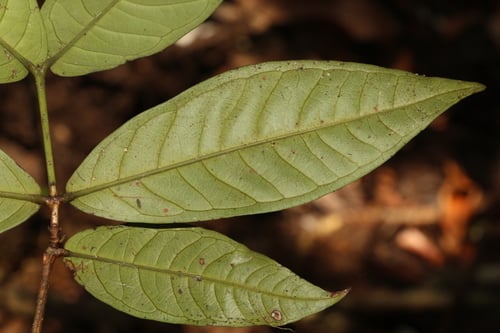
Corymbia polycarpa
(F. Muell.) K.D. Hill & L.A.S. Johnson
Long fruited Bloodwood, Red Bloodwood
iNaturalist· cc-by-nc
(c) Dean Nicolle, some rights reserved (CC BY-NC), uploaded by Dean Nicolle
iNaturalist· cc-by-nc
(c) Dean Nicolle, some rights reserved (CC BY-NC)
Summary
Source: WikipediaCorymbia polycarpa, also known as long-fruited bloodwood or small-flowered bloodwood, is a species of tree that is endemic to northern Australia. Indigenous Australians of different language groups have different names for the tree. The Nungali peoples know the tree as narrga or gunjid, the Mulluk-Mulluk know it as dawart, the Yangman know it as bodog, the Gurindji peoples as jadburru and the Wagiman as jagatjjin. It is a medium-sized tree with rough, tessellated bark on the trunk and branches, lance-shaped to curved adult leaves, flower buds in groups of seven or nine, white or cream-coloured flowers and barrel-shaped fruit.
Description
An medium sized evergreen tree. It grows to 10-20 m high and spreads to 5 m across. The stem is erect and branching. The bark is flaky, rough and grey. The crown is compact. The leaves are dark green above and paler underneath and narrowly sword shaped. They are leathery and taper towards the tip. They are 10-20 cm long by 1.2-3.5 cm wide and have a leaf stalk which is 0.8-2.5 cm long. The young leaves are more rounded and with short stalks. The flower buds are pale green to grey and long. They occur in groups of 3 to 7. The flowers are creamy yellow. They occur in dense heads near the ends of branches. The fruit are long urn shaped capsules. These are woody and narrow towards the neck. They are 1.6-3 cm long by 1-1.5 cm wide. The seeds are yellow brown. They do not have wings.
Edible Uses
The seeds are eaten raw. Insect pupae within galls are consumed. Bloodwood apples—nut-like galls with sweet fluid in the centre—are eaten, as is the sweet manna-like substance produced by insects on the leaves.
Traditional Uses
The seeds are eaten. The insect pupa inside the galls in Northern Australia is eaten. The bloodwood apples are a nut like growth with sweet fluid in the centre is eaten. Insects on the leaves produce a sweet manna like substance which is eaten.
Medicinal Uses
The timber from the tree is a very durable, with an above-ground life expectancy in excess of 40 years which drops to 25 years when used in-ground. The timber is vulnerable to termite attack and untreated sapwood is prone to damage by lyctine borers. It is a hardwood and difficult to work with hand tools. It is mostly used as round timber rather than sawn timber as a result of the numerous kino veins. It has been used as poles, railway sleepers, mining supports, for fencing and house stumps. Indigenous Australians used the gum medicinally as an antiseptic liquid to treat cuts, sores, burns, ulcers and yaws.
Distribution
It is a tropical plant. It does best on light to medium soils. It needs well drained conditions and an open sunny position. It is damaged by drought and frost.
Where It Grows
Australia*, Pacific, Papua New Guinea, PNG,
Cultivation
Plants are grown from seed. Seed should be collected from local sources as these will be better adpated to local conditions.
Propagation
Seed - surface sow in a seedtray in a sunny position and do not allow the compost to dry out. Species that come from high altitudes appreciate 6 - 8 weeks cold stratification at 2°c. Pot up the seedlings into individual pots as soon as the second set of seed leaves has developed, if left longer than this they might not move well. Seedlings are planted out in the field when they reach a height of about 25 cm. This should coincide with the onset of the rainy season in tropical countries. The seed has a long viability.
Other Uses
A kino resin is obtained from the trunk. Kino resins are rich in tannins and are very astringent. They can be used medicinally, in tanning, as well as for preserving and dyeing natural fibres. The resin oozes naturally from wounds in the trunk and can be tapped by making incisions in the bark. At first it is a thick liquid, but soon hardens upon exposure to the air and sun, typically drying to an amber-like material that consists of dark red angular fragments, rarely larger than a pea. The reddish heartwood is heavy, hard and strong, durable in the ground, but affected by wavy grain. The wood is used in the round or split for posts, strainers and other farm timber and occasionally sawn for use in general construction. A good fuel wood
Production
Trees flower in March to June and fruit from June to September.
Notes
The gum is used for medicine. There are a 110 Corymbia species mostly originally in Australia.
Synonyms
Also Known As
Gadga, Wurringilaka
References (18)
- Bodkin, F., 1991, Encyclopedia Botanica. Cornstalk publishing, p 443
- Brock, J., 1993, Native Plants of Northern Australia, Reed. p 176 (Photos)
- Cherikoff V. & Isaacs, J., The Bush Food Handbook. How to gather, grow, process and cook Australian Wild Foods. Ti Tree Press, Australia p 200
- Elliot, W.R., & Jones, D.L., 1992, Encyclopedia of Australian Plants suitable for cultivation. Vol 4. Lothian. p 182 (Photos)
- Hall, N. et al, 1972, The Use of Trees and Shrubs in the Dry Country of Australia, AGPS, Canberra. p 376
Show all 18 references Hide references
- Hearne, D.A., & Rance, S. J., 1975, Trees for Darwin and Northern Australia. AGPS, Canberra p 62
- Kenneally, K.E., Edinger, D. C., and Willing T., 1996, Broome and Beyond, Plants and People of the Dampier Peninsula, Kimberley, Western Australia. Department of Conservation and Land Management. p 144 (Photos)
- Lands, M., 1987, Mayi: Some Bush fruits of Dampierland. Magabala Books, Broome West Australia. p 40
- Lazarides, M. & Hince, B., 1993, Handbook of Economic Plants of Australia, CSIRO. p 106
- Milson. J., 2000, Trees and Shrubs of north-west Queensland. DPI p 204
- Paczkowska, G . & Chapman, A.R., 2000, The Western Australian Flora. A Descriptive Catalogue. Western Australian Herbarium. p 358
- Petheram, R. J. and Kok, B., 2003, Plants of the Kimberley Region of Western Australia. UWA Press p 413
- Smith, M & Kalotas, A. C., 1985, Bardi Plants: An Annotated List of Plants and Their Use by the Bardi Aborigines of Dampierland, in North-western Australia. Rec. West Aust. Mus. 1985, 12(3): 317-359 (As Eucalyptus)
- Telopea 6:254. 1995
- Tiwi Plants and Animals. 2001, Aboriginal flora and fauna knowledge from Bathurst and Melville Islands, northern Australia. Northern Territory Botanical Bulletin; No. 24 p 50
- Townsend, K., 1994, Across the Top. Gardening with Australian Plants in the tropics. Society for Growing Australian Plants, Townsville Branch Inc. p 199
- Vigilante, T., et al, 2013, Island country: Aboriginal connections, values and knowledge of the Western Kimberley islands in the context of an island biological survey. Records of the Western Australian Museum Supplement 81: 145-182
- Wheeler, J.R.(ed.), 1992, Flora of the Kimberley Region. CALM, Western Australian Herbarium, p 524 (Drawing)