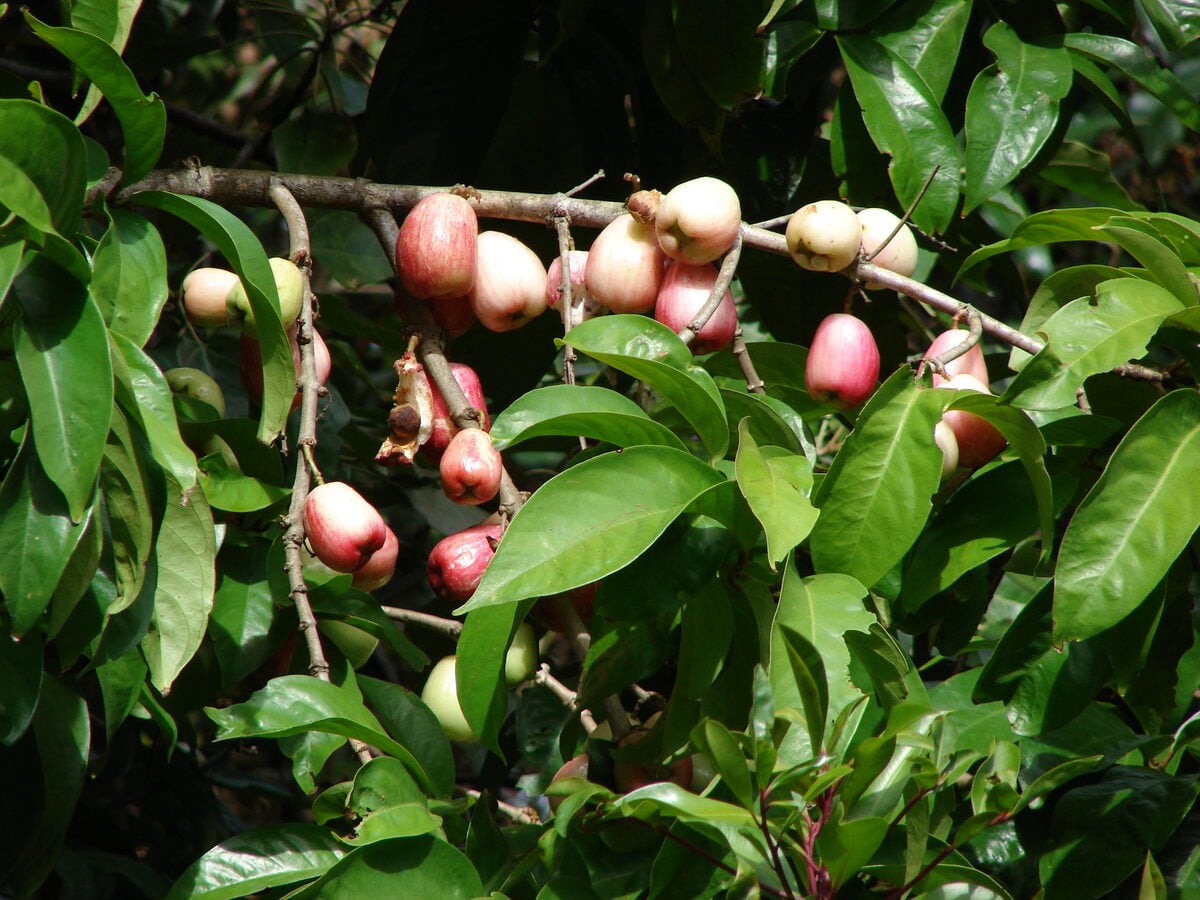
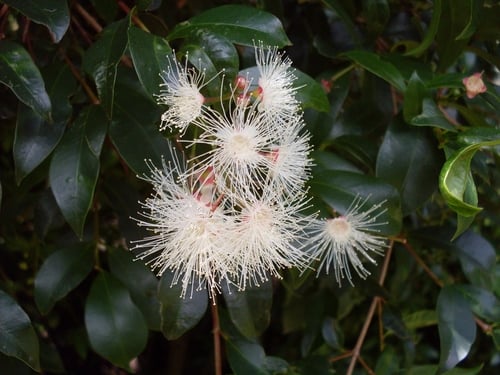
Eucalyptus microtheca
F. Muell.
Coolabah, Coolibah, Flooded Box
iNaturalist· cc-by-nc
(c) Dean Nicolle, some rights reserved (CC BY-NC), uploaded by Dean Nicolle
iNaturalist· cc-by-nc
(c) Dean Nicolle, some rights reserved (CC BY-NC), uploaded by Dean Nicolle
iNaturalist· cc-by-nc
(c) geoffbyrne, some rights reserved (CC BY-NC)
Summary
Source: WikipediaEucalyptus microtheca, with many common names including desert box, coolibah, callaille, targoon, yathoo or coolabah, is a species of tree that is endemic to northern Australia. It has rough, flaky or fibrous bark on the trunk and branches, lance-shaped adult leaves, flower buds in groups of seven, white flowers and spherical to conical fruit. It is widely distributed from the Kimberley region of Western Australia to Cape York in Queensland.
Description
A medium to large tree. It is often sprawling. It grows 10-20 m high and spreads 8-15 m wide. The bark is dark grey and fibrous. This extends to the upper branches. The leaves are grey-green. They are 15 cm long and narrow. The small buds are only 3 mm long and wide. They have a whitish coating and a cone-shaped cap. They occur in clusters. The flowers are white. The capsules are funnel-shaped and 4 mm long.
Edible Uses
The seeds are powdered and made into cakes, which are baked and eaten. Sap from the roots serves as an emergency water source for travellers in dry regions. The plant also produces lerp — a sweet, manna-like substance consisting of waxy, scale-like coverings built by the nymphs of several sap-sucking insect species as protection while feeding. The lerp structures are left behind when the insects pupate and were a traditional food of Australian Aborigines.
Traditional Uses
A sweet manna like substance is edible The seeds can be ground and made into cake and eaten.
This uses section is brief — help expand it
Medicinal Uses
None known.
Known Hazards
Citronellal, an essential oil found in most Eucalyptus species is reported to be mutagenic when used in isolation. In large doses, oil of eucalyptus, like so many essential oils has caused fatalities from intestinal irritation. Death is reported from ingestion of 4 - 24 ml of essential oils, but recoveries are also reported for the same amount. Symptoms include gastroenteric burning and irritation, nausea, vomiting, diarrhoea, oxygen deficiency, ,weakness, dizziness, stupor, difficult respiration, delirium, paralysis, convulsions, and death, usually due to respiratory failure.
Distribution
It grows in warm temperate regions. It can grow in arid or semiarid locations. It needs well drained soils but they can be wet or dry. It can grow in full sun or light shade. It can stand heavy frosts. It grows in areas with an annual rainfall between 125-1,020 mm. It can grow in salty and alkaline soils. It grows below 900 m above sea level.
Where It Grows
Africa, Asia, Australia*, India, Iran, Iraq, Mediterranean, Middle East, Morocco, North Africa, Pakistan, Sudan, Tunisia, USA,
Cultivation
It grows best in areas where annual daytime temperatures are within the range 24 - 39?c, but can tolerate 5 - 45?c. It can be killed by temperatures of -4?c or lower, though new growth will be damaged if the temperature falls to zero. It prefers a mean annual rainfall in the range 250 - 1,---mm, but tolerates 150 - 1,200mm. Requires a sunny position. Succeeds in most soils of at least moderate fertility. Prefers a pH in the range 6.5 - 8, tolerating 6 - 9. The plant often experiences inundation for part of the year and is also able to withstand up to 7 months drought. A potentially very fast-growing species if there is sufficient water, on suitable sites the growth may reach 3 metres per year. Under irrigation it should be possible to grow the tree in deserts. The tree can be harvested after 8 years from a seedling crop and after 6 years from subsequent coppice crops. Annual wood production potential is 3 - 7 m3/ha. The tree is fire tender. Eucalyptus species have not adopted a deciduous habit and continue to grow until it is too cold for them to do so. This makes them more susceptible to damage from sudden cold snaps. If temperature fluctuations are more gradual, as in a woodland for example, the plants have the opportunity to stop growing and become dormant, thus making them more cold resistant. A deep mulch around the roots to prevent the soil from freezing also helps the trees to survive cold conditions. The members of this genus are remarkably adaptable however, there can be a dramatic increase in the hardiness of subsequent generations from the seed of survivors growing in temperate zones. Eucalyptus monocultures are an environmental disaster, they are voracious, allelopathic and encourage the worst possible attitudes to land use and conservation. E. microtheca is most closely related to the widespread Eucalyptus coolabah which is found in similar but drier habitats to the south and south-east It is also closely related to Eucalyptus victrix which is found in even drier habitats from central Australia west to the Pilbara region of Western Australia. Drought tolerant once established
Propagation
Surface sow seed in a sunny position, keeping the compost moist at all times. Species from high altitudes benefit from 6–8 weeks cold stratification at 2°C. Pot seedlings into individual containers as soon as the second set of true leaves develops. Seedlings are ready for field planting when 25–30 cm tall, typically after 3–4 months. Seed remains viable for a long time.
Other Uses
The heartwood is reddish-brown to reddish, clearly distinguished from grey sapwood. The wood is remarkably hard, heavy and elastic — well suited to construction, and used for durable poles, fence posts, bearings, bolts, shafts, frames and wheels, though considered perhaps too hard for cabinet work. It is neither widely used nor highly valued commercially. The wood is also burned as fuel and made into charcoal. The trees have a dense, rounded form that makes them wind resistant and useful for windbreaks and erosion control. They are among the more commonly planted eucalyptus species in the southwestern United States, valued for fast and easy establishment — they tolerate full sun, sub-zero temperatures, and soils of poor fertility.
Notes
There are at least 500 Eucalyptus species mostly originally in Australia.
Synonyms
Also Known As
Coolabah. Coolibah
References (22)
- Bodkin, F., 1991, Encyclopedia Botanica. Cornstalk publishing, p 436
- Boomsma, C.D., 1972, Native Tree of South Australia. Woods & Forests Department South Australia, Bulletin No.19. p 142
- Cherikoff V. & Isaacs, J., The Bush Food Handbook. How to gather, grow, process and cook Australian Wild Foods. Ti Tree Press, Australia p 189
- Cronin, L., 1989, The Concise Australian Flora. Reed. p 195
- Elliot, W.R., & Jones, D.L., 1992, Encyclopedia of Australian Plants suitable for cultivation. Vol 4. Lothian. p 147
Show all 22 references Hide references
- Facciola, S., 1998, Cornucopia 2: a Source Book of Edible Plants. Kampong Publications, p 141
- Hall, N. et al, 1972, The Use of Trees and Shrubs in the Dry Country of Australia, AGPS, Canberra. p 373
- Hearne, D.A., & Rance, S.J., 1975, Trees for Darwin and Northern Australia. AGPS, Canberra p 60
- Hibbert, M., 2002, The Aussie Plant Finder 2002, Florilegium. p 97
- Holliday, I., 1989, A Field Guide to Australian Trees. Hamlyn. p 162
- J. Proc. Linn. Soc., Bot. 3:87. 1859
- Krishen P., 2006, Trees of Delhi, A Field Guide. DK Books. p 180
- Lazarides, M. & Hince, B., 1993, Handbook of Economic Plants of Australia, CSIRO. p 104
- Lord, E.E., & Willis, J.H., 1999, Shrubs and Trees for Australian gardens. Lothian. p 30
- Milson. J., 2000, Trees and Shrubs of north-west Queensland. DPI p 220
- Molyneux, B. and Forrester, S., 1997, The Austraflora A-Z of Australian Plants. Reed. p 88
- Paczkowska, G . & Chapman, A.R., 2000, The Western Australian Flora. A Descriptive Calatogue. Western Australian Herbarium. p 376
- Petheram, R. J. and Kok, B., 2003, Plants of the Kimberley Region of Western Australia. UWA Press p 455
- Townsend, K., 1994, Across the Top. Gardening with Australian Plants in the tropics. Society for Growing Australian Plants, Townsville Branch Inc. p 195
- Urban, A., 1990, Wildflowers of Inland Australia. Portside editions. p 142
- Wheeler, J.R.(ed.), 1992, Flora of the Kimberley Region. CALM, Western Australian Herbarium, p 521
- Williams, K.A.W., 1999, Native Plants of Queensland Volume 4. Keith A.W. Williams North Ipswich, Australia. p 182