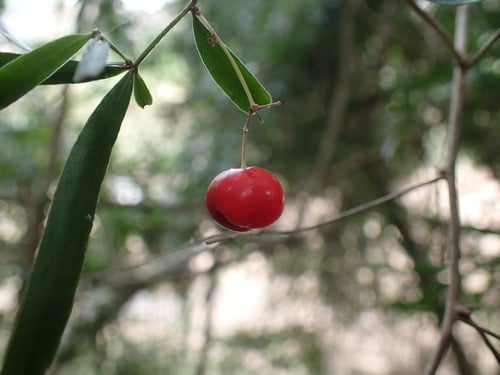
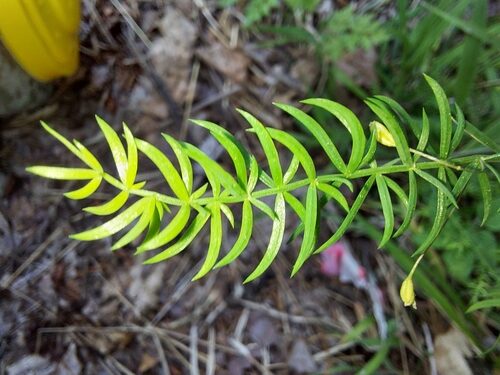
Ophiopogon japonicus - (L.f.)Ker
(L.f.)Ker-Gawl.
Snake's Beard, Dwarf lilyturf, Mondo Grass, Monkey Grass, Dwarf Lilyturf
gbif· cc-by
John Thomlinson
gbif· cc-by-nc
Paola Casale
gbif· cc-by-nc
Paola Casale
Description
Ophiopogon japonicus is an evergreen Perennial growing to 0.3 m (1ft) by 1 m (3ft 3in) at a slow rate. See above for USDA hardiness. It is hardy to UK zone 7. It is in leaf all year, in flower in August, and the seeds ripen from September to October. The species is hermaphrodite (has both male and female organs). Suitable for: light (sandy) and medium (loamy) soils. Suitable pH: mildly acid, neutral and basic (mildly alkaline) soils. It can grow in semi-shade (light woodland) or no shade. It prefers moist or wet soil and can grow in water.
Edible Uses
Root. A bitterness should be removed according to some reports whilst another says that it is sweet and aromatic. Mucilaginous. The root contains about 1.6% protein, 0.5% fat, 80% carbohydrate, 2.3% ash.
Medicinal Uses
Antipyretic Antiscrophulatic Antitussive Aphrodisiac Cancer Emollient Expectorant Nutritive Pectoral Sedative Sialagogue Stomachic Tonic. The root is antitussive, aphrodisiac, expectorant, pectoral, sedative, sialogogue, stomachic and tonic[147, 174, 176, 218, 238]. It is said to have anticancer activity. It is used internally in the treatment of dry coughs, fevers, thirst, dry constipation, insomnia, anxiety and palpitations. It is also frequently used in polyherbal treatments of diabetes mellitus. The roots have an antibacterial action, inhibiting the growth of Staphylococcus, E. coli, Bacillus subtilis, B. typhi etc. The roots are harvested in the spring and dried for later use. The plant is antipyretic, antiscrofulatic, antitussive, emollient, expectorant and tonic. Lowers blood pressure. Nodules on the fibrous roots are used as a nutritive tonic in the treatment of TB.
Distribution
E. Asia - China, Japan, Korea.
Where It Grows
TEMPERATE ASIA: China (Anhui Sheng, Fujian Sheng, Guangdong Sheng, Guangxi Zhuangzu Zizhiqu, Guizhou Sheng, Hebei Sheng, Henan Sheng, Hubei Sheng, Hunan Sheng, Jiangsu Sheng, Jiangxi Sheng, Shaanxi Sheng, Shandong Sheng, Sichuan Sheng, Yunnan Sheng, Zhejiang Sheng), Korea, Japan (Hokkaidô, Honshu, Kyushu, Shikoku), Taiwan TROPICAL ASIA: Philippines (Luzon (Benguet Prov.), Mindanao (Mt. Apo))
Cultivation
Prefers a sandy soil. Succeeds in any moderately fertile well-drained soil and also as a submerged aquatic plant, though it does not flower in such a situation. Succeeds in a sunny position if the soil remains moist all year round, otherwise it should be grown in semi-shade. Plants may require winter protection according to one report, whilst another says that they are hardy to about -20°c. Plants only succeed outdoors in the milder areas of the country. This species is cultivated as a medicinal plant in China.
Propagation
Seed - best sown as soon as it is ripe in a sandy compost in a cold frame. When they are large enough to handle, prick the seedlings out into individual pots and grow them on in the cold frame for at least their first winter. Plant them out into their permanent positions in late spring or early summer, after the last expected frosts. Division in spring.
Other Uses
Soil stabilization. A good carpeting plant that spreads quite freely, it is commonly planted as a ground cover or as a low-maintenance grass substitute. It is particularly valuable for preventing soil erosion. Plants should be spaced about 45cm apart each way.