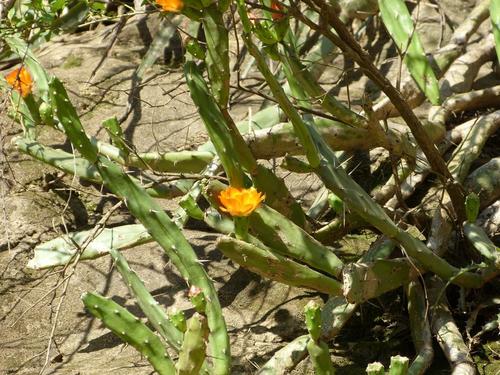
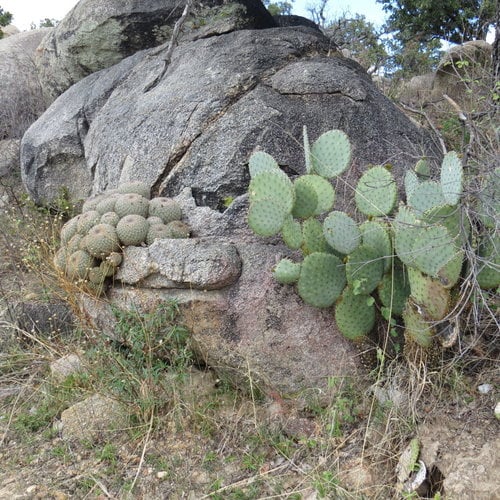
Nopalea cochenillifera - (L.) Salm
(L.) Salm-Dyck
Cochineal plant.
gbif· cc-by-nc-nd
Pieter Bruijsten
gbif· cc-by-nc-nd
Pieter Bruijsten
gbif· cc-by-nc-nd
Pieter Bruijsten
Description
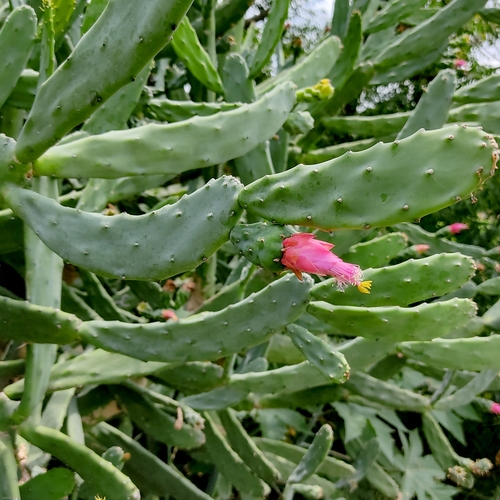
Nopalea cochenillifera is an evergreen Shrub growing to 5 m (16ft) by 5 m (16ft) at a slow rate. See above for USDA hardiness. It is hardy to UK zone 10. Suitable for: light (sandy), medium (loamy) and heavy (clay) soils, prefers well-drained soil and can grow in heavy clay and nutritionally poor soils. Suitable pH: mildly acid, neutral and basic (mildly alkaline) soils and can grow in very acid, very alkaline and saline soils. It cannot grow in the shade. It prefers dry or moist soil and can tolerate drought.
Edible Uses
Edible Portion: Fruit, Stems (pads). The fruits are edible. They are also made into candies. The pads can be eaten after the spines are removed. Young joints are pickled. The red, ellipsoid fruit is 3 to 5cm long by 2.5 to 3 cm wide. The young flattened stems are cooked and eaten as a vegetable.
Medicinal Uses
The fruits and cladodes are applied in folk medicine. The flattened stem sections are used as poultices to treat mycoses (fungal skin infections) and fevers. The roasted branches are sliced and applied as a poultice to relieve pain, swelling, and localized burning sensations resulting from filaria. The grated stem, mixed with corn meal and soft grease, is warmed for external application to relieve heavy chest colds and fever associated with pneumonia. The pads are warmed and placed on the forehead as a refresher. The sap of the plant is used in the treatment of baby's colds and wheezing. The leaves are used in the treatment of spleen problems.
Known Hazards
Species in this genus generally have numerous minutely barbed glochids (hairs) that are easily dislodged when the plant is touched and they then become stuck to the skin where they are difficult to see and remove. They can cause considerable discomfort.
Distribution
Mesoamerica. Central America - Mexico, Panama. Caribbean - Cuba, Puerto Rica.
Where It Grows
Coming Soon
Cultivation
Requires a sunny position. Thriving on neglect, the plant can tolerate almost any conditions so long as the soil is well-drained. Established plants are very drought tolerant. Carbon Farming - Cultivation: regional crop.
Propagation
Plants can be grown from cuttings. Seed. Prickly pear is easily propagated and the tiniest bit of leaf will take root almost anywhere.
Other Uses
The plant is an important hedge plant in arid areas. Other Uses: The flattened stem sections are used as a shampoo for fine, delicate hair. It is also a host for the chocineal insect which produces a red dye colouring for food and drinks. Carbon Farming - Agroforestry Services: living fence. Fodder: bank, insect.
Synonyms
Also Known As
Kaktus nopales, Nagphani, Nopales, Prickly pear, Puchikalli, Tay-cui, True Nopal