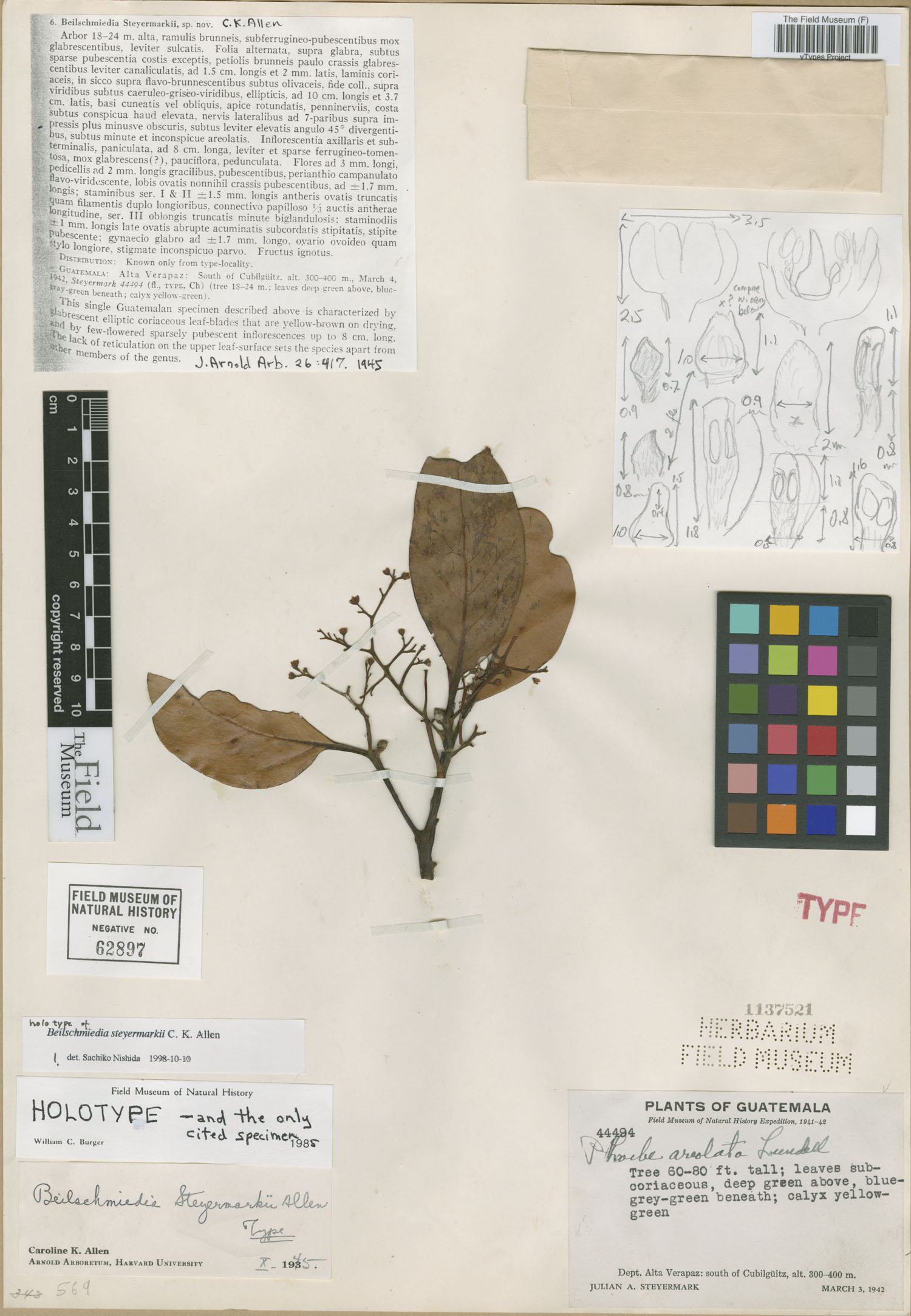
Mezilaurus itauba - (Meisn.) Taub. ex Mez
(Meisn.) Taub. ex Mez
Itauba
No photos yet for Mezilaurus itauba - (Meisn.) Taub. ex Mez
Sign in to contribute a photoDescription
Mezilaurus itauba is an evergreen Tree growing to 30 m (98ft) by 25 m (82ft) at a medium rate. See above for USDA hardiness. It is hardy to UK zone 10. Suitable for: light (sandy) and medium (loamy) soils, prefers well-drained soil and can grow in nutritionally poor soil. Suitable pH: mildly acid, neutral and basic (mildly alkaline) soils. It can grow in semi-shade (light woodland) or no shade. It prefers moist soil.
Edible Uses
Fruit. The fruit is an ellipsoid berry, around 2 x 1cm. No more details.
Medicinal Uses
Abortifacient. The bark is used as an abortifacient.
Distribution
S. America - Brazil, Bolivia, Peru, Ecuador, Colombia, Venezuela, the Guyanas.
Where It Grows
SOUTHERN AMERICA: French Guiana, Guyana, Suriname, Venezuela, Brazil (Acre, Amapá, Amazonas, Mato Grosso, Pará, Rondônia, Roraima), Bolivia, Colombia, Ecuador, Peru
Cultivation
Succeeds in full sun or dappled shade. Although a plant of primary forests, it regenerates easily in open areas.
Propagation
Seed - best sown in a position in light shade, in individual containers, as soon as it is ripe. Germination rates are usually low, occurring in 3 - 5 weeks. Plants grow away slowly.
Other Uses
Essential Furniture Wood. Other Uses An essential oil is obtained from the bark. It contains apiol. The heartwood is a yellow-brown to a dark, lustrous brown; it is not clearly demarcated from the 2 - 5cm wide band of sapwood. The texture is fine; the grain interlocked and sometimes wavy; the surface has an oily aspect. The wood is heavy; moderately hard to hard; elastic; very durable, being very resistant to fungi, dry wood borers and termites, and reported to be highly resistant to marine borer attack. It seasons slowly, with only a low risk of distortion but a high risk of checking; once dry it is moderately stable in service. It has a fairly high blunting effect, stellite-tipped and tungsten carbide tools are recommended; the interlocked grain means that it can be difficult to cut and to plane; nailing and screwing are good, but require pre-boring; gluing is correct for interior purposes only. A high quality wood, it is used sometimes as a substitute for teak (Tectona grandis). It is much used in external heavy construction for items such as bridges, railway ties, marine works, poles etc, for beams; and is also suitable for high class furniture, cabinet making, turnery etc; as well as for cart bodies, boat building, furniture components, joinery etc[341 , 420 , 444 , 848 ].
Synonyms
Also Known As
Itauba