Erythrina subumbrans
(Hassk.) Merrill
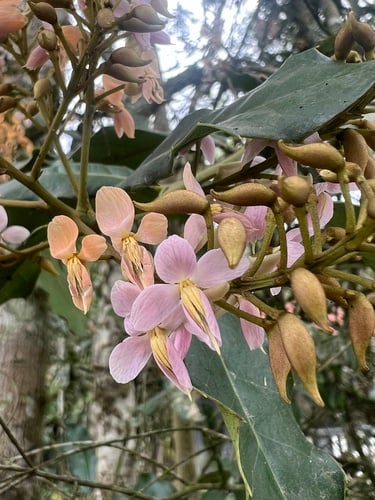
December tree
iNaturalist· cc-by
(c) Paulmathi Vinod, some rights reserved (CC BY), uploaded by Paulmathi Vinod
iNaturalist· cc-by-sa
(c) Dinesh Valke, some rights reserved (CC BY-SA)
Summary
Source: WikipediaErythrina subumbrans, common names Tton Tong or Dadap, is a flowering plant species in the genus Erythrina. The pterocarpans phaseolin, erybraedins A and B are found in the stems of E. subumbrans.
Description
A tall tree. It grows to 15-23 m high. Some kinds have prickles and some do not. The leaves are alternate and have 3 leaflets. The leaflets are smooth. The side 2 leaflets are round and 10-20 cm long. The end leaflet is larger. The flowering groups are 22 cm long. The flowers are red. The fruit are pods 10-14 cm long and 2-2.5 cm wide. They contain 1-5 seeds.
Edible Uses
Very young leaves are steamed and eaten in salads.
Traditional Uses
The very young leaves are steamed and then eaten in salads. The flowers are used as a potherb.
This uses section is brief — help expand it
Medicinal Uses
A decoction of the bark is taken to treat spleen afflictions. A decoction of the leaves is used as a treatment for coughs. The pounded young leaves are applied as a poultice for women soon after giving birth and as a treatment for headache. The juice of the leaves is used as an eye-wash.
Known Hazards
All Erythrina species contain greater or lesser amounts of toxic alkaloids - these can be found in all parts of the plant but are usually most concentrated in the seeds. Concentrations vary from species to species, in some it is low enough that the plant is safely used as a food. In many, the alkaloids are utilized for their medicinal effects. We have no specific information on the concentration of the alkaloids in this species, but care should be exercised in any use of the plant that involves ingestion. These alkaloids have a curare-like action (obtained from Strychnos species) and can cause paralysis and even death by respiratory failure.
Distribution
A tropical plant. It needs light. It grows in dry open forest. It is used as shade for cacao and coffee. In Samoa it grows from sea level to 700 m altitude. In Indonesia it grows between 300-1,500 m above sea level. In southern China it grows between 300-600 m above sea level. In Yunnan.
Where It Grows
American Samoa, Asia, China, Cook Islands, East Timor, Fiji, India, Indochina, Indonesia, Laos, Malaysia, Mauritius, Myanmar, Niue, Pacific, Papua New Guinea, PNG, Philippines, Samoa, SE Asia, Singapore, Sri Lanka, Thailand, Timor-Leste, Vietnam,
Cultivation
Plants can be grown by seeds.
Propagation
Fresh seeds, and those harvested within 3–6 months of maturity, can be sown without any special treatment and germination rates are generally high, often reaching 100%. Seeds over 6 months old may take 12–18 months to germinate due to a hard seed coat that toughens with age. Soaking in hot water or abrading the seed coat can reduce this time considerably — seeds may be added to water just below boiling point and left to soak as it cools for a minimum of one hour, or up to 12 hours for seed 3 or more years old. Alternatively, file the seed coat with a slender triangular file, taking care to avoid damaging the cotyledons or embryo, as this typically results in death from fungal attack or malformed, weakened seedlings. Most species produce strong seedlings in almost any well-drained soil with minimal trouble from damping-off disease. The plant can also be propagated from large cuttings — even those up to 25cm in diameter root easily. Note that seeds from thornless trees generally produce trees with thorns.
Other Uses
Grown as a shade tree in cocoa, coffee and tea plantations, and also used as a shelter crop for taro (Colocasia esculenta) and as a live support for yams (Dioscorea spp.), betel nut (Piper betle), pepper (Piper nigrum) and vanilla (Vanilla planivolia) vines. Loppings provide a quickly decomposing green manure, containing per 100g dry matter: N 1.5–3g, P 0.2–0.35g, K 1–2g. The tree is planted as a pioneer species in reforestation projects in northern Thailand, used in degraded woodland and open areas alongside other fast-growing species that produce dense, weed-suppressing crowns and attract seed-dispersing wildlife, particularly birds and bats. The wood is soft, light and coarse-grained with an uneven texture. The sapwood is not differentiated from the heartwood, which is light straw-coloured. It is used in canoe and raft building.
Notes
2n = 42 There are 108 Erythrina species.
Synonyms
Also Known As
Chengkering, Choe tee, Coral tree, Dadap duri, Dadap lenga, Dadap lesang, Dadap limit, Dadap lisa, Dadap minyak, Dadap rangrang, Dadap ri, Dadap srep, Dedap batik, Dedap, Dhadhak, Gatae palagi, Pohon dadap rangrang, Tawng lang, Tawng pa, Vong hot-da, Ye-kathit
References (19)
- Ambasta, S.P. (Ed.), 2000, The Useful Plants of India. CSIR India. p 204
- Burkill, I.H., 1966, A Dictionary of the Economic Products of the Malay Peninsula. Ministry of Agriculture and Cooperatives, Kuala Lumpur, Malaysia. Vol 1 (A-H) p 962
- Cao, Y., et al, 2020, Ethnobotanical study on wild edible plants used by three trans-boundary ethnic groups in Jiangcheng County, Pu’er, Southwest China. Journal of Ethnobiology and Ethnomedicine (2020) 16:66
- Elevitch, C.R.(ed.), 2006, Traditional Trees of the Pacific Islands: Their Culture, Environment and Use. Permanent Agriculture Resources, Holualoa, Hawaii. p 331
- Gardner, S., et al, 2000, A Field Guide to Forest Trees of Northern Thailand, Kobfai Publishing Project. p 176
Show all 19 references Hide references
- Hariyadi, B., 2008, The Entwined Tree: Traditional Natural Resource Management of Serampas, Jambi, Indonesia. Ph. D thesis. Univ. or Hawaii. p 402
- Kachenchart, B., et al, 2008, Phenology of Edible Plants at Sakaerat Forest. In Proceedings of the FORTROP II: Tropical Forestry Change in a Changing World. Bangkok, Thailand.
- Martin, F.W. & Ruberte, R.M., 1979, Edible Leaves of the Tropics. Antillian College Press, Mayaguez, Puerto Rico. p 199
- Ochse, J.J. et al, 1931, Vegetables of the Dutch East Indies. Asher reprint. p 385
- Pham-Hoang Ho, 1999, An Illustrated Flora of Vietnam. Nha Xuat Ban Tre. p 939
- Philipp. J. Sci., C 5:113. 1910
- PROSEA (Plant Resources of South East Asia) handbook, Volume 11, 1997, Auxilliary plants
- Schmidt-Vogt, D., 2001, Secondary Forests in Swidden Agriculture in the Highland of Thailand. Journal of tropical Forest Science 13(4): 748-767
- Smith, A.C., 1985, Flora Vitiensis Nova, Lawaii, Kuai, Hawaii, Volume 3 p 185
- Sukarya, D. G., (Ed.) 2013, 3,500 Plant Species of the Botanic Gardens of Indonesia. LIPI p 264
- Sutjaritjai, N., et al, 2019, Traditional Uses of Leguminosae among the Karen in Thailand. Plants 2019, 8, 600 p 7
- Terra, G.J.A., 1973, Tropical Vegetables. Communication 54e Royal Tropical Institute, Amsterdam, p 45
- Whistler, W.A., 2004, Rainforest Trees of Samoa. Isle Botanica Honolulu, Hawaii. p 70
- World Checklist of Useful Plant Species 2020. Royal Botanic Gardens, Kew