Erythrina berteroana
Urban
Coral bean
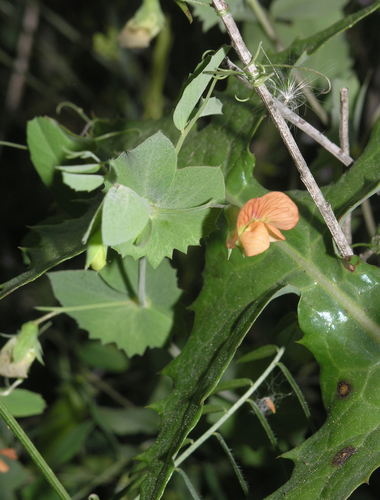
iNaturalist· cc-by-nc
(c) Jo Jiménez, some rights reserved (CC BY-NC), uploaded by Jo Jiménez
iNaturalist· cc-by-nc
(c) yasminch, some rights reserved (CC BY-NC), uploaded by yasminch
iNaturalist· cc-by-nc
(c) Steve Maldonado Silvestrini, some rights reserved (CC BY-NC)
Summary
Source: WikipediaErythrina berteroana is a species of small deciduous tree in the family Fabaceae. It is found in Mexico, Central America and the northern part of South America. Common names include elequeme, gallito, machete, pernila de casa, pito and poró de cerca. It is a common tree in the drier parts of its range and has many traditional uses.
Description
A tree. It grows 6-10 m high. The crown is open. The leaves have 3 leaflets. These are 15 cm long and broadly diamond shaped. The flower clusters are erect and 15-30 cm long with bright red flowers along them. The fruit are woody twisted pods. These are 10-25 cm long and constricted between the seeds. There are many seeds and they are about 1 cm long. They are red with a black line.
Edible Uses
Young shoots, leaves, and buds are eaten in salads, stews, and other dishes. The flowers are cooked and eaten with meat, in stews, and in egg dishes.
Traditional Uses
The young shoots, leaves and buds are eaten in salads, stews and other dishes. The flowers are cooked and eaten with meat, in stews and in egg dishes.
Medicinal Uses
The seeds have long been known to be poisonous, and in recent years there have been obtained from them several alkaloids, some of which resemble curare in their physiological action. A decoction of the young shoots is sometimes employed as a narcotic. There is a belief in Guatemala and Honduras that if leaves are placed under a pillow, they induce deep and refreshing sleep, a statement that needs further investigation before it is accepted as true!.
Known Hazards
Probably the most common lowland tree in the drier parts of Central America, it has many uses. The shoots and unopened flowers are cooked as a vegetable, and the young foliage is used as fodder for cattle. Cut branches are thrust into the ground to take root and grow into living fencing posts. The roots have nitrogen-fixing nodules which enrich the soil. The tree provides shade in coffee plantations and is used as living stakes for growing yams and chayote. The leaves make a useful mulch. The bark and seeds contain toxic alkaloids and can be used to prepare a poison. The timber is lightweight and coarse, but can be carved into objects and used like cork. A yellow dye can be extracted from the bark, and the flowers, leaves and bark are used in traditional medicine.
Distribution
A tropical plant. In Central America it grows between 800-2,000 m altitude.
Where It Grows
Africa, Asia, Belize, Caribbean, Central Africa, Central America*, Colombia, Congo, Costa Rica, Cuba, Dominican Republic, East Africa, El Salvador, Guatemala, Haiti, Hawaii, Honduras, Indonesia, Mexico*, Nicaragua, North America, Pacific, Panama, Paraguay, Peru, Puerto Rico, SE Asia, South America, Tanzania, USA, Venezuela, Virgin Islands, West Indies,
Cultivation
Plants can be grown by seeds or cuttings.
Propagation
Seed - requires pre-treatment, either by simple scarification in order to permit moisture to penetrate the seed, or by pre-soaking the seed in warm water (around 40 °C) for 12 hours. Germination rates of 85 to 90 percent have been obtained in nursery trials using seeds collected during the previous year and stored in cold chambers at 5 °C with a relative humidity of 30 to 40 percent. Germination may be carried out in boxes filled with washed sand, and seedlings may be transplanted to black plastic bags filled with a mix of soil, sand, and compost (2:1:1 in volume). Nursery-grown seedlings can be planted in the field when they reach 20 to 30 cm tall. They can be established either by planting directly in the field or by removing seedlings from nursery beds and planting as bareroot stock, first removing all leaves. When vegetatively propagated, large cuttings, 1.5 to 2.5 metres long and 6 to 10 cm in diameter, taken from 1 - 2 year-old branches may be planted up to 40 cm deep. This method is used to establish living fences.
Other Uses
The handsome seeds of this and related species are often used for making bracelets, necklaces, and other decorative articles. The bark yields a yellow dye used to colour textiles. The white to yellow wood is light in weight. In spite of the fact that the trunks of growing trees are very solid and hard, the dry wood is light in weight, soft and weak, with a specific gravity of about 0.25. It is employed locally as a substitute for cork, for carving images of saints or small toys, and for other similar purposes. The wood is used for fuel. The tree is often planted for living fence-posts, a purpose that it serves admirably, large stems rooting readily and the stems being solid in the ground and long-lived. It is also used for landmarking, windbreaks and erosion control. Most Erythrina species are very easy to grow from cuttings, with even quite large branches striking well. In addition, they generally fix atmospheric nitrogen, have nutrient-rich leaves that make an excellent soil-enriching mulch, often have open crowns that do not overly restrict light, and are also often quite thorny and can provide impenetrable barriers to protect from unwelcome intrusions. Many species are therefore used as living fences to provide boundaries and livestock-proof hedges. The tree is sometimes used as a shade tree for coffee or to support chayote plants (Sechium edule) and vanilla. A mulch made from the leaves of this plant has been shown to result in better phosphorus balances, higher microfauna populations and increased crops yield.
Notes
There are 112-125 Erythrina species. They are mostly in the tropics and subtropics.
Synonyms
Also Known As
Amapola de Cerca, Brucal, Coralillo, Dwarf bucare, Machete, Machetico, Machetillos, Pipi, Pito, Pohon dadap pito
References (21)
- Chizmar Fernandez, C., et al, 2009, Plantas comestibles de Centroamerica. Instituto de Biodiversidad, Costa Rica. p 203
- Facciola, S., 1998, Cornucopia 2: a Source Book of Edible Plants. Kampong Publications, p 104
- Grandtner, M. M. & Chevrette, J., 2013, Dictionary of Trees, Volume 2: South America: Nomenclature, Taxonomy and Ecology. Academic Press p 223
- http://www.ntbg.org/plants/plant details.php
- ILDIS Legumes of the World http:www:ildis.org/Legume/Web
Show all 21 references Hide references
- Jardin, C., 1970, List of Foods Used In Africa, FAO Nutrition Information Document Series No 2.p 76
- Kermath, B. M., et al, 2014, Food Plants in the Americas: A survey of the domesticated, cultivated and wild plants used for Human food in North, Central and South America and the Caribbean. On line draft. p 343
- Kiple, K.F. & Ornelas, K.C., (eds), 2000, The Cambridge World History of Food. CUP p 1762
- Martin, F.W. & Ruberte, R.M., 1979, Edible Leaves of the Tropics. Antillian College Press, Mayaguez, Puerto Rico. p 82, 199
- Morton, J. F., 1994, Pito (Erythrina berteroana) and Chipilin (Crotalaria longirostrata), (Fabaceae), Two Soporific Vegetables of Central America. Economic Botany, Vo. 48, No. 2, pp. 130-138
- Plants of Haiti Smithsonian Institute http://botany.si.edu/antilles/West Indies
- Reis, S. V. and Lipp, F. L., 1982, New Plant Sources for Drugs and Foods from the New York Botanical Garden herbarium. Harvard. p 133
- Staples, G.W. and Herbst, D.R., 2005, A tropical Garden Flora. Bishop Museum Press, Honolulu, Hawaii. p 317
- Sukarya, D. G., (Ed.) 2013, 3,500 Plant Species of the Botanic Gardens of Indonesia. LIPI p 262
- Symb. antill. 5:370. 1908
- Terra, G.J.A., 1973, Tropical Vegetables. Communication 54e Royal Tropical Institute, Amsterdam, p 45
- Turreira-Garcia, N., et al, 2015, Wild edible plant knowledge, distribution and transmission: a case study of the Achi Mayans of Guatemala. Journal of Ethnobiology and Ethnomedicine. 11:52
- USDA, ARS, National Genetic Resources Program. Germplasm Resources Information Network - (GRIN). [Online Database] National Germplasm Resources Laboratory, Beltsville, Maryland. Available: www.ars-grin.gov/cgi-bin/npgs/html/econ.pl (10 April 2000)
- Wiersema, J. H. & Leon, B., 2013, World Economic Plants. A Standard Reference CRC Press. 2nd Ed. p 283
- World Checklist of Useful Plant Species 2020. Royal Botanic Gardens, Kew
- www.worldagroforestrycentre.org/treedb/