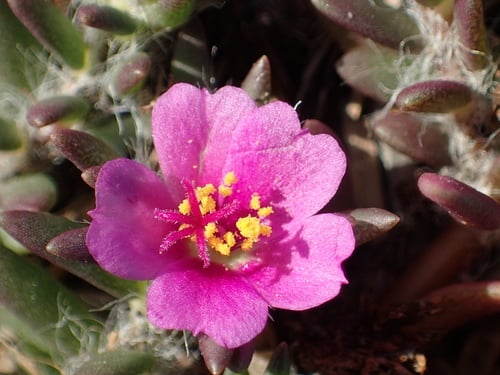
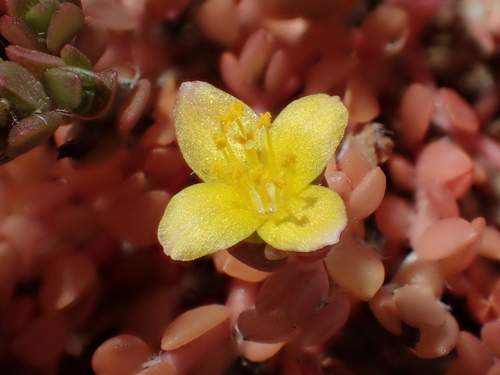
Calandrinia ciliata menziesii - (Hook.f.)MacBr.
(Hook.f.)MacBr.
Redmaids
gbif· cc-by-nc
Arizona State University Vascular Plant Herbarium (ASU-Plants)
gbif· cc-by-nc
Desert Botanical Garden Herbarium (DES-)
gbif· cc-by-nc
Arizona State University Vascular Plant Herbarium (ASU-Plants)
Description
Calandrinia ciliata menziesii is a ANNUAL growing to 0.1 m (0ft 4in) by 0.2 m (0ft 8in). It is frost tender. It is in flower from July to September, and the seeds ripen from August to October. The species is hermaphrodite (has both male and female organs). Suitable for: light (sandy) soils, prefers well-drained soil and can grow in nutritionally poor soil. Suitable pH: mildly acid, neutral and basic (mildly alkaline) soils. It cannot grow in the shade. It prefers dry or moist soil and can tolerate drought.
Edible Uses
Leaves and young shoots - raw, cooked or used as a garnish. The leaves contain oxalic acid and so some caution is advised, see the notes above on toxicity. Seed - raw or ground into a meal. The seed can also be cooked as a piñole. The seed is very small and fiddly to harvest, especially since it ripens intermittently over a period of several weeks. However, it is rich in oil and was often collected in large quantities by native North American Indian tribes.
Known Hazards
The plant contains oxalic acid, so it should only be used in moderation. Oxalic acid can lock up certain of the nutrients in food and, if eaten in excess, can lead to nutritional deficiencies. It is, however, perfectly safe in small amounts and its acid taste adds a nice flavour to salads. Cooking the plant will reduce the quantity of oxalic acid. People with a tendency to rheumatism, arthritis, gout, kidney stones and hyperacidity should take especial caution if including this plant in their diet since it can aggravate their condition.
Distribution
South-western N. America - California.
Where It Grows
Coming Soon
Cultivation
Prefers a hot sunny situation on a poor dry sandy soil. Plants are intolerant of root disturbance, they are best treated as half-hardy annuals and sown in situ.
Propagation
Seed - best sown in situ in spring since it strongly resents root disturbance. Germination usually takes place within 1 - 3 weeks at 20°c.