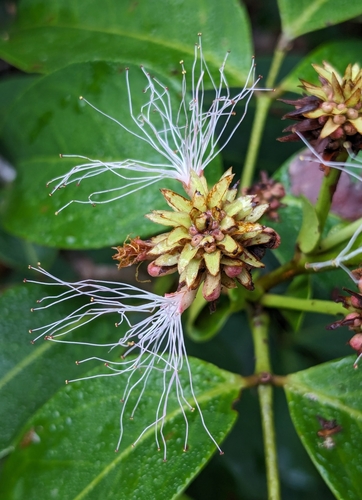
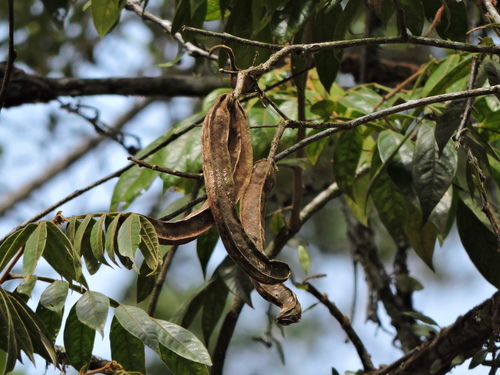
Acacia leucophloea - (Roxb.) Willd.
(Roxb.) Willd.
Kuteera-Gum, White-barked acacia.
No photos yet for Acacia leucophloea - (Roxb.) Willd.
Sign in to contribute a photoDescription
Acacia leucophloea is a deciduous Tree growing to 25 m (82ft) by 25 m (82ft) at a medium rate. See above for USDA hardiness. It is hardy to UK zone 10. The flowers are pollinated by Insects. It can fix Nitrogen. Suitable for: light (sandy), medium (loamy) and heavy (clay) soils, prefers well-drained soil and can grow in nutritionally poor soil. Suitable pH: mildly acid, neutral and basic (mildly alkaline) soils. It cannot grow in the shade. It prefers dry or moist soil and can tolerate drought.
Edible Uses
The germinated seeds are cooked and eaten as a vegetable. They contain crude protein 27 % dry matter. The other major nutrient contents are crude lipid 5 %, crude fibre 7 %, ash 4 % and total crude carbohydrates, 58 %. The seeds are a rich source of minerals such as calcium, magnesium, phosphorus, iron and manganese. The predominant seed protein fractions are globulins and albumins.
Medicinal Uses
The gum obtained from the stem is used medicinally.
Distribution
E. Asia - Indian subcontinent, Myanmar, Thailand, Vietnam, Malaysia, Indonesia.
Where It Grows
TROPICAL ASIA: India (northwest), Sri Lanka, Pakistan, Myanmar, Thailand, Vietnam (south), Indonesia, Malaysia
Cultivation
It grows best in areas with a mean annual rainfall of 400 - 1,500mm, succeeding even in areas where the dry season may persist for 9-10 months. It can succeed in humid areas with a rainfall of 2,000mm, and also in semi arid areas with only 600mm of rain. Succeeds on sands, infertile rocky soils, limestone soils, organic clays and in alluvial areas. Requires a sunny position and a well-drained soil. On fertile soils, A. Leucophloea seedlings grow quickly, up to 60 cm a year. Under irrigation, height growth may reach 7 - 10 m in 5 - 6 years. Seedlings are light demanding and sensitive to weed competition, fire and frost. In order to exploit sufficient soil moisture, seedling root growth generally exceeds shoot growth. The trees produce a deep taproot and, once established, are very tolerant of drought, fire and frost. Trees respond well to coppicing. This species has a symbiotic relationship with certain soil bacteria, these bacteria form nodules on the roots and fix atmospheric nitrogen. Some of this nitrogen is utilized by the growing plant but some can also be used by other plants growing nearby. It fixes atmospheric nitrogen through a symbiotic relationship with Rhizobium bacteria which enables it to survive on infertile sites.
Propagation
Seed - pre-treatment is necessary to break the hard seed coat. To encourage uniform germination, seed should be scarified either by submerging in boiled water that is allowed to cool for 24 hours, or by soaking in sulphuric acid for 10-30 minutes followed by soaking in cool water for 24 hours. The visibly swollen seeds should be sown immediately. Germination can still take 75 days. Viability of dried seeds can be maintained for up to 2 years at room temperature. When sown outdoors, the seed should be sown at a depth of 1 cm in lines 20-25 cm apart. Germination begins within a week. Plants can be established by direct sowing, stump sprouts or seedlings. Direct sowing is preferred because the large roots of seedlings may hamper transplanting.
Other Uses
The tree is suitable as a firebreak due to its fire resistance. A good reforestation species for poor soils in low rainfall areas. Other Uses The source of a low quality gum that is used to adulterate gums of higher quality. A water-soluble gum of fair quality can be extracted from the stem and root bark. The leaves yield a black dye, whilst the bark produces a reddish-brown substance used to manufacture dyes and tannins. The bark contains 11 - 20% tannins, with older trees containing higher quantities. The strong but coarse fibres from the inner bark are used to make fish nets and rough rope. It might be useful for making paper. The brick-red heartwood is very beautiful, strong, heavy and hard It is durable indoors, but decays quickly if in contact with moist soil. The pale yellow sapwood is perishable. The heartwood seasons well and takes a good polish. Although a little hard to work, the wood is used to make decorative furniture. Other commodities produced from the wood include poles, farming implements, carts, wheels, turnery, indoor construction timbers and flooring. The utilization of this species is limited because its wood has irregular interlocked grain, a rough texture and is difficult to work. The wood is appreciated as fuel and is suitable for charcoal production.
Synonyms
Also Known As
Akasia pilang, Arinj, Bilijali, Chalep deng, Haribaval, Hewar, Hivur, Hiwar, Jhira, Katu andara, Keo trang, Kikar, Nimbar, Pattacharaya maram, Pilang, Reru, Reunja, Ronj, Safed babul, Safed kikar, Shvetabarbura, Tanaung, Tellatuma, Velva-yalam, Velvel