Eriosema shirense
Baker f.
iNaturalist· cc-by-nc
(c) Bart Wursten, some rights reserved (CC BY-NC)
iNaturalist· cc-by-nc
(c) Bart Wursten, some rights reserved (CC BY-NC)
iNaturalist· cc-by-nc
(c) Bart Wursten, some rights reserved (CC BY-NC)
Description
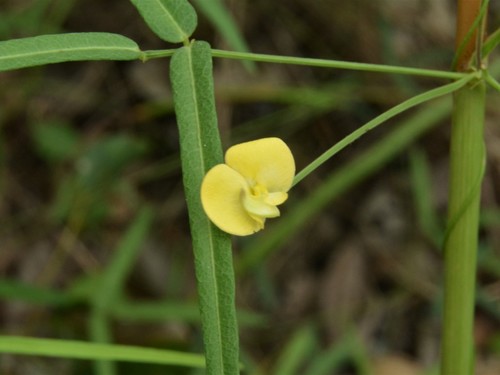
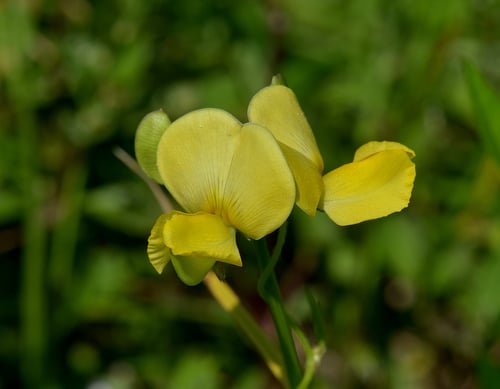
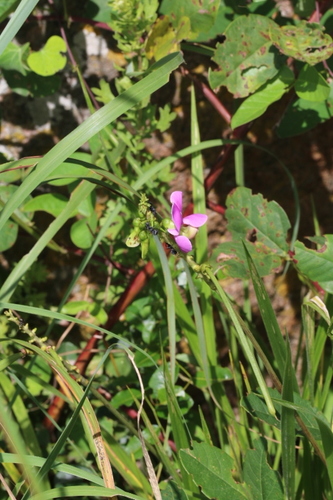
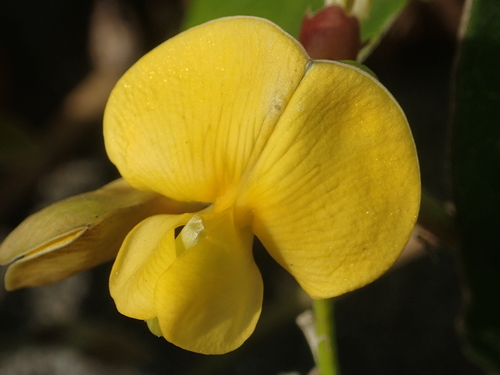
A woody herb. It grows 20 cm high. The taproot develops tubers 1.5 cm across and 2 cm long. The tubers are usually 10-25 cm below the soil surface. The leaves have 3 leaflets. The leaves are hairy and narrowly sword shaped. The flowers are in open groups. They are yellow with dark purple lines. The fruit are small hairy pods. They are 1.5 cm long.
Edible Uses
Root. The small root is peeled and eaten raw - said to be very tasty and to always leave one longing for more. Eaten raw by children.The taproot develops into a globose or ovoid tuber, 15 - 40mm long and 10 - 25mm wide.
Traditional Uses
The roots are eaten raw by children. They are peeled and eaten.
This uses section is brief — help expand it
Distribution
A tropical plant. It grows in grassy and wooded savannah. In Kenya it grows between 1,400-2,200 m altitude. They are often in rocky areas. It can grow in arid places.
Where It Grows
Africa, Angola, Burundi, Cameroon, Central Africa, Central African Republic, CAR, Congo, Côte d'Ivoire, East Africa, Ethiopia, Ivory Coast, Kenya, Malawi, Mozambique, Nigeria, Rwanda, Southern Africa, Tanzania, Uganda, West Africa, Zambia, Zimbabwe,
Cultivation
Plants are grown from seeds.
Propagation
Like many species within the family Fabaceae, once they have ripened and dried the seeds of this species may benefit from scarification before sowing in order to speed up and improve germination. This can usually be done by pouring a small amount of nearly boiling water on the seeds (being careful not to cook them!) and then soaking them for 12 - 24 hours in warm water. By this time they should have imbibed moisture and swollen - if they have not, then carefully make a nick in the seedcoat (being careful not to damage the embryo) and soak for a further 12 hours before sowing.
Other Information
It is eaten especially by children.
Synonyms
Also Known As
Adokolet, Gololo, Kabomola, Kambumukire, Kampompo, Ng'athu, Qamura
References (16)
- Asfaw, Z. and Tadesse, M., 2001, Prospects for Sustainable Use and Development of Wild Food Plants in Ethiopia. Economic Botany, Vol. 55, No. 1, pp. 47-62
- Ashagre, M., et al, 2016, Ethnobotanical study of wild edible plants in Burji District, Segan Area Zone of Southern Nations, Nationalities and Peoples Region (SNNPR), Ethiopia. Journal of Ethnobiology and Ethnomedicine (2016) 12:32
- Burkill, H. M., 1985, The useful plants of west tropical Africa, Vol. 3. Kew.
- Fowler, D. G., 2007, Zambian Plants: Their Vernacular Names and Uses. Kew. p 37
- Jardin, C., 1970, List of Foods Used In Africa, FAO Nutrition Information Document Series No 2.p 76
Show all 16 references Hide references
- Malaisse, F., 1997, Se nourrir en floret claire africaine. Approche ecologique et nutritionnelle. CTA., p 63
- Maroyi, A., 2011, The Gathering and Consumption of Wild Edible Plants in Nhema Communal Area, Midlands Province, Zimbabwe. Ecology of Food and Nutrition 50:6, 506-525
- Maundu, P. et al, 1999, Traditional Food Plants of Kenya. National Museum of Kenya. 288p
- Mutie, F. G., 2020, Conservation of Wild Food Plants and Their Potential for Combatting Food Insecurity in Kenya as Exemplified by the Drylands of Kitui County. Plants 2020, 9, 1017
- Mutie, F. M., et al, 2023, Important Medicinal and Food Taxa (Orders and Families) in Kenya, Based on Three Quantitative Approaches. Plants 2023, 12, 1145
- Ojelel, S. & Kakudidi, E. K., 2015, Wild edible plant species utilized by a subsistence farming community in the Obalanga sub-county, Amuria district, Uganda. Journal of Ethnobiology and Ethnomedicine. 11:7
- Peters, C. R., O'Brien, E. M., and Drummond, R.B., 1992, Edible Wild plants of Sub-saharan Africa. Kew. p 134
- Royal Botanic Gardens, Kew (1999). Survey of Economic Plants for Arid and Semi-Arid Lands (SEPASAL) database. Published on the Internet; http://www.rbgkew.org.uk/ceb/sepasal/internet [Accessed 28th April 2011]
- Trans. Linn. Soc. London, Bot. 4:11. 1894
- Williamson, J., 2005, Useful Plants of Malawi. 3rd. Edition. Mdadzi Book Trust. p 110
- World Checklist of Useful Plant Species 2020. Royal Botanic Gardens, Kew