Eriosema chinense
Vogel
Bush potato, Chinese eriosema
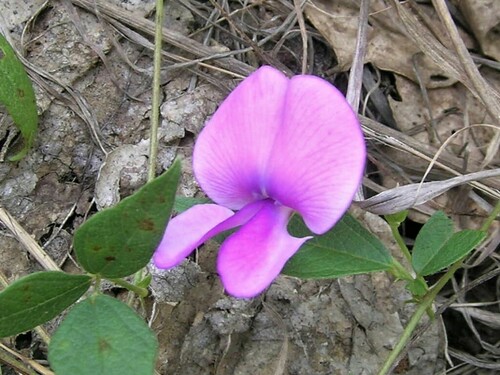
iNaturalist· cc-by-nc-nd
(c) Sunnetchan, some rights reserved (CC BY-NC-ND), uploaded by Sunnetchan
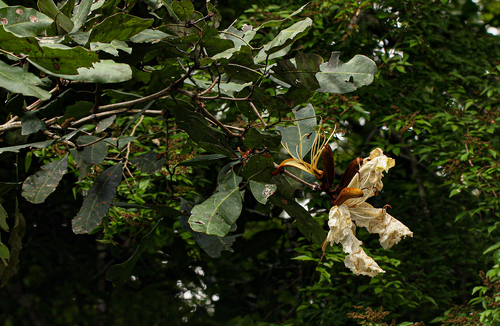
iNaturalist· cc-by-nc
(c) Wanda G Jackson, some rights reserved (CC BY-NC)
Description
An erect small shrub. It grows to 50-90 cm high. The rootstock is tuberous and woody. It has a hairy covering of slightly curved grey hairs close to the plant with more brown and longer hairs spreading out. These last ones are 2.5 mm long. The leaves have one leaflet. These are narrow and oval. They are 2-8 cm long by 0.7-1.8 cm wide. There are a few hairs on the top surface of the leaf and it is very hairy underneath. The flowers are in the axils of leaves. They are 0.7 cm long. The fruit is a pod which does not have a stalk. It is oblong and about 1 cm long by 0.6 cm wide. It turns black eventually. The seeds are mottled brown and green. They are oblong and 4-5 mm long by 2.5 mm wide.
Edible Uses
Tubers - raw or cooked. They are traditionally eaten in various parts of Asia and Australia, either fresh, cooked or roasted. The tubers contain 30% starch on a dry weight basis. The cylindrical tubers are up to 5cm long and 3cm wide.
Traditional Uses
The root tubers are eaten raw or cooked.
This uses section is brief — help expand it
Medicinal Uses
The seeds are astringent, diuretic and tonic. A decoction is given to women to promote discharge of the afterbirth, and to treat leucorrhoea and menstrual derangements. A decoction, combined with ground pepper (Piper species), is used in the treatment of scrofula and diarrhoea. The seed powder is externally applied to check cold sweats.
Distribution
A tropical plant. It mostly grows in drier grassland areas. It can grow in open forest and wet locations. In Papua New Guinea it grows from 10-750 m altitude. In Asia it grows to 2000 m altitude.
Where It Grows
Asia, Australia, Cambodia, China, Himalayas, India, Indochina, Indonesia, Laos, Malaysia, Myanmar, Northeastern India, Pacific, Papua New Guinea, PNG, Philippines, SE Asia, Sri Lanka, Taiwan, Thailand, Vietnam,
Cultivation
The plant is found growing in sandy soils in the wild.
Propagation
Like many species within the family Fabaceae, once they have ripened and dried the seeds of this species may benefit from scarification before sowing in order to speed up and improve germination. This can usually be done by pouring a small amount of nearly boiling water on the seeds (being careful not to cook them!) and then soaking them for 12 - 24 hours in warm water. By this time they should have imbibed moisture and swollen - if they have not, then carefully make a nick in the seedcoat (being careful not to damage the embryo) and soak for a further 12 hours before sowing. Division of tubers
Production
In Australia the plant flowers December to January and produces seeds from January to June.
Notes
Also as Papilionaceae.
Nutrition
| Part | Moisture | kJ | kcal | Protein | Vit A | Vit C | Iron | Zinc |
|---|---|---|---|---|---|---|---|---|
| Root | 66.9 | 401 | 96 | 2.2 | — | 5 | 49.5 | 1 |
Also Known As
Daj kuab tang, Gumbia, Haeo-dam, Haeo-pradu, Haew-pradu, Katil, Kh'o:nz ko:ng, Kitkitil, Kondan, Konden, Kutil, Man-chang, Maotu trungquoc, Mi-keoni, Mukumalak, Pen, Pike-san-gale, Pirlumataka, Rungi, Soh-pen, Te:l tueng, Te:l, Tel, Tii si go po, Til tueng, Wakajini
References (24)
- Ambasta, S.P. (Ed.), 2000, The Useful Plants of India. CSIR India. p 202
- Crawford, I. M., 1982, Traditional Aboriginal Plant Resources in the Kalumburu Area: Aspects in Ethno-economics. Records of the Western Australian Museum Supplement No. 15
- Cribb, A.B. & J.W., 1976, Wild Food in Australia, Fontana. p 160
- Hardwick, G., 2001, Economically Useful Plants for Northern Australia: Master Species List. Crusader eBooks.
- Hiddins, L., 1999, Explore Wild Australia with the Bush Tucker Man. Penguin Books/ABC Books. p 131
Show all 24 references Hide references
- Hu, Shiu-ying, 2005, Food Plants of China. The Chinese University Press. p 473
- Kew Plants of the World onLine
- Lim, T. K., 2015, Edible Medicinal and Non Medicinal Plants. Volume 9, Modified Stems, Roots, Bulbs. Springer p 41
- McMakin, P.D., 2000, Flowering Plants of Thailand. A Field Guide. White Lotus. p 69
- Neogi, B., Prasad, M. N. V. and Rao, R. R., 1989, Ethnobotany of Some Weeds of Khasi and Garo Hills, Meghalaya, Northeastern India. Economic Botany 43(4): 471-479
- Nov. Actorum Acad. Caes. Leop.-Carol. Nat. Cur. 19(suppl. 1):31. 1843
- Paczkowska, G . & Chapman, A.R., 2000, The Western Australian Flora. A Descriptive Calatogue. Western Australian Herbarium. p 429
- Pham-Hoang Ho, 1999, An Illustrated Flora of Vietnam. Nha Xuat Ban Tre. p 971
- Phon, P., 2000, Plants used in Cambodia. © Pauline Dy Phon, Phnom Penh, Cambodia. p 277
- PROSEA handbook Volume 9 Plants yielding non-seed carbohydrates. p 175
- Singh, H.B., Arora R.K.,1978, Wild edible Plants of India. Indian Council of Agricultural Research, New Delhi. p13
- Smith, N. M., 1991, Ethnobotanical Field Notes from the Northern Territory, Australia, J. Adelaide Bot. Gard. 14(1): 1-65
- Sutjaritjai, N., et al, 2019, Traditional Uses of Leguminosae among the Karen in Thailand. Plants 2019, 8, 600 p 7
- Tiwi Plants and Animals. 2001, Aboriginal flora and fauna knowledge from Bathurst and Melville Islands, northern Australia. Northern Territory Botanical Bulletin; No. 24 p 43
- Verdcourt, B., 1979, Manual of New Guinea Legumes. Botany Bulletin No 11, Division of Botany, Lae, Papua New Guinea. p 554 (Drawing)
- Vigilante, T., et al, 2013, Island country: Aboriginal connections, values and knowledge of the Western Kimberley islands in the context of an island biological survey. Records of the Western Australian Museum Supplement 81: 145-182
- Wheeler, J.R.(ed.), 1992, Flora of the Kimberley Region. CALM, Western Australian Herbarium, p 398, 400 (Drawing)
- Wild edible plants of Himachal Pradesh
- World Checklist of Useful Plant Species 2020. Royal Botanic Gardens, Kew