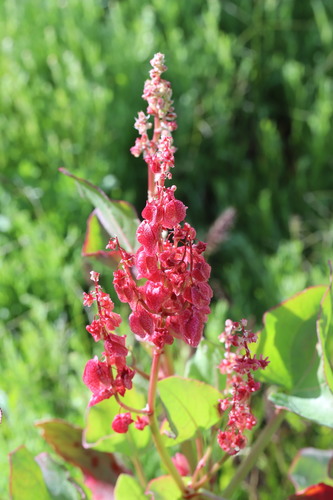
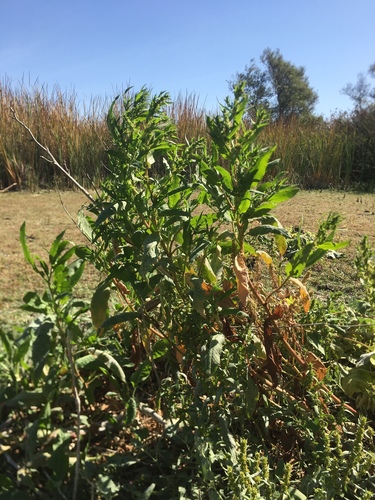
Rheum palmatum tanguticum
Regel.
Da Huang
gbif· cc-by
The New York Botanical Garden
Description
Rheum palmatum tanguticum is a PERENNIAL growing to 2 m (6ft) by 0.8 m (2ft 7in). See above for USDA hardiness. It is hardy to UK zone 6. It is in flower from June to July. The species is hermaphrodite (has both male and female organs) and is pollinated by Wind. Suitable for: medium (loamy) and heavy (clay) soils, prefers well-drained soil and can grow in heavy clay soil. Suitable pH: mildly acid, neutral and basic (mildly alkaline) soils. It can grow in semi-shade (light woodland) or no shade. It prefers moist soil.
Edible Uses
Leaf stem - raw or cooked. The stem is superior in flavour to the common rhubarb and quite tender. An acid flavour, it is sometimes used as a cooked fruit substitute.
Medicinal Uses
Anticholesterolemic Antiseptic Antispasmodic Antitumor Astringent Cholagogue Diuretic Haemostatic Purgative. Rhubarb has a long and proven history of herbal usage, its main effect being a positive and balancing effect upon the whole digestive system. It is one of the most widely used herbs in Chinese medicine. The root is anticholesterolemic, antiseptic, antispasmodic, antitumor, aperient, astringent, cholagogue, demulcent, diuretic, laxative, purgative, stomachic and tonic[4, 7, 9, 21, 91, 171, 176, 238]. The roots contain anthraquinones, which have a purgative effect, and also tannins and bitters, which have an opposite astringent effect. When taken in small doses, it acts as an astringent tonic to the digestive system, whilst larger doses act as a mild laxative. The root is taken internally in the treatment of chronic constipation, diarrhoea, liver and gall bladder complaints, haemorrhoids, menstrual problems and skin eruptions due to an accumulation of toxins. This remedy is not prescribed for pregnant or lactating women, nor for patients with intestinal obstruction. Externally, the root is used in the treatment of burns. The roots are harvested in October from plants that are at least six years old, they are then dried for later use. A homeopathic remedy is prepared from the dried root. This is used especially in the treatment of diarrhoea in teething children.
Known Hazards
Although no specific mention has been seen for this species, the leaves of some if not all members of this genus contain significant quantities of oxalic acid and should not be eaten in any quantity. Oxalic acid can lock up certain minerals in the body, especially calcium, leading to nutritional deficiency. The content of oxalic acid will be reduced if the plant is cooked. People with a tendency to rheumatism, arthritis, gout, kidney stones or hyperacidity should take especial caution if including this plant in their diet since it can aggravate their condition. See Rheum palmatum for possible related information.
Distribution
E. Asia - N.W. China.
Where It Grows
Coming Soon
Cultivation
Prefers a deep, fertile, moderately heavy, humus rich, moisture retentive, well-drained soil in sun or semi-shade. Grows well in heavy clay soils. Plants can be grown in quite coarse grass, which can be cut annually in the autumn. This is a more robust form of the species, it is hardy to at least -15°c. This sub-species is favoured for its medicinal properties over the species and is cultivated as a medicinal plant in China. Plants in this genus seem to be immune to the predations of rabbits. Hybridizes freely with other members of this genus.
Propagation
Seed - best sown in autumn in a shaded cold frame. The seed can also be sown in spring in a cold frame. When large enough to handle, prick the seedlings out into individual pots and grow them on in the greenhouse or cold frame for their first winter, planting them out in the spring. Division in early spring or autumn. Divide up the rootstock with a sharp spade or knife, making sure that there is at least one growth bud on each division. Larger divisions can be planted out direct into their permanent positions. We have found that it is better to pot up the smaller divisions and grow them on in light shade in a cold frame until they are well established before planting them out in late spring or early summer.