Quercus × schuettei
Trel.
Schuette's oak
iNaturalist· cc-by-sa
(c) Douglas Goldman, some rights reserved (CC BY-SA), uploaded by Douglas Goldman
iNaturalist· cc-by-sa
(c) Douglas Goldman, some rights reserved (CC BY-SA), uploaded by Douglas Goldman
iNaturalist· cc-by-nc
(c) Scott Ulian, some rights reserved (CC BY-NC), uploaded by Scott Ulian
Description
Quercus × schuettei is a deciduous Tree growing to 18 m (59ft) by 18 m (59ft) at a fast rate. See above for USDA hardiness. It is hardy to UK zone 5. The flowers are pollinated by Wind. It is noted for attracting wildlife. Suitable for: medium (loamy) and heavy (clay) soils. Suitable pH: neutral soils. It cannot grow in the shade. It prefers moist or wet soil.
Edible Uses
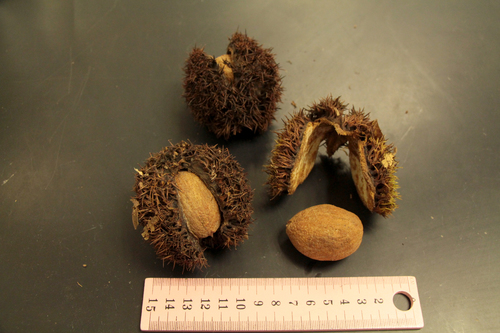
Produces large, edible acorns that are low in tannins. Seed - cooked. The seed can be ground into a powder and used in making bread, dumplings etc and as a thickener in soups. Many trees have sweet seeds with little tannin and the seed can be eaten raw or cooked. If the seed is bitter then this is due to the presence of tannins, these can be leached out by thoroughly washing the dried and ground up seed in water, though many minerals will also be lost. The traditional method of preparing the seed was to bury it in boggy ground overwinter. The germinating seed was dug up in the spring when it would have lost most of its astringency. The roasted seed is a coffee substitute.
Distribution
Naturally occurring hybrid scattered through locations where the ranges of the parent trees coincide (southern Ontario and Quebec south to Kentucky, Missouri and Oklahoma).
Where It Grows
Coming Soon
Cultivation
Schuette Oak is a hybrid between Quercus bicolor (swamp white oak) and Quercus macrocarpa (bur oak). It grows best in rich, humusy, medium to wet soils, but can tolerate soggy soils to drier upland soils. Great for low and high areas on properties. Tolerates a wide range of moisture, pH, and soil types. Bloom Time: April to May. Bloom Description: Yellowish-green. Leaf: Good Fall color. Fall color is a yellowish-brown, sometimes tinged with red. Fruit: Showy.
Propagation
Seed - it quickly loses viability if it is allowed to dry out. It can be stored moist and cool overwinter but is best sown as soon as it is ripe in an outdoor seed bed, though it must be protected from mice, squirrels etc. Small quantities of seed can be sown in deep pots in a cold frame. Plants produce a deep taproot and need to be planted out into their permanent positions as soon as possible, in fact seed sown in situ will produce the best trees. Trees should not be left in a nursery bed for more than 2 growing seasons without being moved or they will transplant very badly.
Other Uses
The leaves of most species in this genus are more or less rich in tannins. A mulch of the leaves can be placed around vulnerable plants in order to repel slugs, snails, grubs etc. Fresh leaves should be used with caution, since these can utilize some of the nitrogen in the soil and this inhibit plant growth. Oak galls are excrescences that are sometimes produced in great numbers on the tree and are caused by the activity of the larvae of different insects. The insects live inside these galls, obtaining their nutrient therein. When the insect pupates and leaves, the gall can be used as a rich source of tannin, that can also be used as a dyestuff. The bark has been used as a mordant for fixing dyes. The wood is hard, heavy, strong, tough, very durable, close grained. The wood is a good fuel. Acorns are abundant and an excellent source of food for wildlife. Schuette’s oak is considered to be a low-maintence tree with good pest resistance. A medium shade tree for moist landscape areas. Specimen or group. Lawns or parks. Street tree. Well suited to soggy soils. Riverbanks.
Synonyms
Also Known As
Schuette Oak a hybrid between Quercus bicolor (swamp white oak) and Quercus macrocarpa (bur oak).