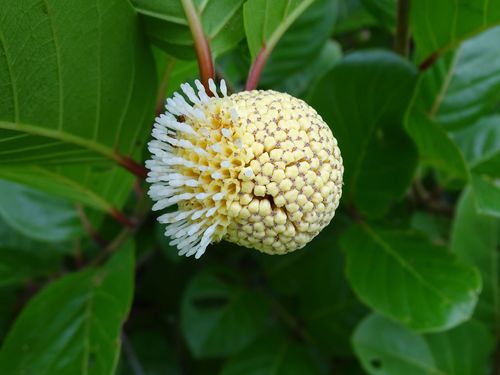
Morinda citrifolia
L.
Noni, Indian Mulberry
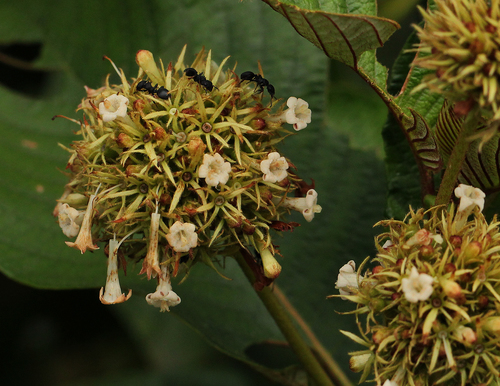
iNaturalist· cc-by-nc
(c) ytw, some rights reserved (CC BY-NC), uploaded by ytw
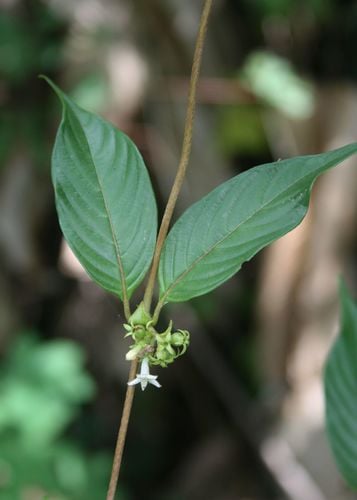
iNaturalist· cc-by-nc
(c) Ryan Rash, some rights reserved (CC BY-NC), uploaded by Ryan Rash
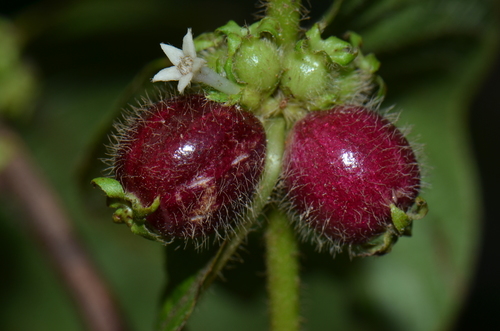
iNaturalist· cc-by-nc
(c) mlkelller, some rights reserved (CC BY-NC)
Description
Morinda citrifolia is an evergreen Tree growing to 6 m (19ft) by 6 m (19ft) at a medium rate. See above for USDA hardiness. It is hardy to UK zone 10 and is frost tender. The flowers are pollinated by Insects. Suitable for: light (sandy), medium (loamy) and heavy (clay) soils, prefers well-drained soil and can grow in nutritionally poor soil. Suitable pH: neutral soils and can grow in saline soils. It can grow in semi-shade (light woodland) or no shade. It prefers moist soil and can tolerate drought. The plant can tolerates strong winds but not maritime exposure.
Edible Uses
Drink. The unripe fruit is used in Indian cooking in sambals and curries. Despite the smell of putrid cheese when ripe, the fruits are eaten raw or are prepared in some way. The ripe fruit is made into a beverage with sugar or syrup. The ovoid fruit is 3 - 10cm long and 2 - 3cm wide. The juice of the fruit is used in Australian bushfoods for dressings, sauces and marinades. Young leaves and blanched shoots - raw or steamed, added to curries etc. They contain 4.5 - 6% protein. The leaves are a rich source of vitamin A. The seeds of some forms are roasted and eaten.
Medicinal Uses
Anthelmintic Antiarthritic Antiasthmatic Antibiotic Antidiarrhoeal Antihaemorrhoidal Antiinflammatory Antiseptic Diuretic Dysentery Emmenagogue Febrifuge Febrifuge Hypotensive Laxative Leprosy Mouthwash Odontalgic Poultice Skin Tonic Urinary. Most parts of noni have been widely used medicinally since ancient times. It was first mentioned in literature in China during the han dynasty (206BC - 23AD). Nowadays, single trees are encouraged or cultivated in gardens mainly for medicinal purposes. The curative properties of the plant parts are ascribed to the presence of medicinally active anthraquinone derivates. The fruit contains rancid smelling capric acid and unpleasant tasting caprylic acid. It is thought that antibiotically active compounds are present. The roots are febrifuge, tonic and antiseptic. They are used to treat stiffness and tetanus and have been proven to combat arterial tension. An infusion of the root is used in treating urinary disorders. The bark is used in a treatment to aid childbirth. Externally, the root is crushed and mixed with oil and is used as a smallpox salve. An infusion of the root bark is used to treat skin diseases. The roots are harvested as required and used in decoctions. The wilted or heated leaf is applied as a poultice to painful swellings in order to bring relief. A poultice of the leaves is applied to wounds or to the head in order to relieve headaches. The crushed leaves, mixed with oil, are applied to the face for the treatment of neuralgia. The leaves are harvested as required during the growing season. The fruits are used as a diuretic, a laxative, an emollient and as an emmenagogue, for treating asthma and other respiratory problems, as a treatment for arthritic and comparable inflammations, in cases of leucorrhoea and sapraemia and for maladies of the inner organs. Liquid pressed from young fruit is snuffed into each nostril to treat bad breath and raspy voice. It is also used in the treatment of mouth ulcers, haemorrhoids, hernia or swollen testicles, headaches, pain caused by barb of poisonous fish, removal of a splinter, childbirth, diabetes, diarrhoea and dysentery, fever, intestinal worms, filariasis, leprosy, and tuberculosis. Young fruits are used to treat high blood pressure. The fruits can be harvested ripe or unripe and are sometimes charred and mixed with salt for medicinal use. The roots, leaves and fruits may have anthelmintic properties. In traditional medicine the parts used are administered raw or as juices and infusions or in ointments and poultices.
Distribution
E. Asia - China, India, Sri Lanka, Myanmar, Thailand, Vietnam, Malaysia, Indonesia, Philippines, New Guinea to Australia.
Where It Grows
TEMPERATE ASIA: China (Hainan Sheng), Japan (Ryukyu Islands), Taiwan TROPICAL ASIA: Bangladesh, India, Sri Lanka, Papua New Guinea, Indochina, India (Andaman and Nicobar Islands), Thailand, Indonesia, Malaysia AUSTRALASIA: Australia (Queensland, Western Australia (northeast), Northern Territory (north))
Cultivation
A persistent and very tolerant plant, noni is widely adapted to a range of tropical and subtropical climates and is commonly found at elevations up to 1,500 metres. It grows best in areas where annual daytime temperatures are within the range 24 - 30°c, but can tolerate 12 - 36°c. It prefers a mean annual rainfall in the range 1,500 - 3,000mm, but tolerates 700 - 4,200mm. Prefers a well-drained, sandy soil and a position in full sun to partial shade. Succeeds in a wide range of soils. Prefers a pH in the range 5 - 6.5, tolerating 4.3 - 7. Established plants are very drought tolerant. Plants can withstand salt-laden winds. Plants have a deep taproot. Flowering and fruiting start in the third year of growth from seed and continue throughout the year. Yield of the bark for use as a dye is reported to be 500 - 1,000 kilos per hectare. The plant can live for at least 25 years. The ability of the seeds to float explains its wide distribution and occurrence on many seashores. Flowering Time: Blooms repeatedly. Bloom Color: White/Near White. Spacing: 15-20 ft. (4.7-6 m).
Propagation
Seed - sow in nursery beds. Germination takes place 3-9 weeks after sowing. After germination, seedlings are transplanted at ca. 1.2 m x 1.2 m in well-tilled soil. The seeds remain viable for at least 6 months.
Other Uses
Dye Fuel Hair Pioneer Wood. Seaside tree. Backyard tree. Accent. Container. Large planter. Screening. Conservatory. Xerophytic. Agroforestry Uses: The plant is a natural pioneer species, rapidly appearing in cultivated ground, after bush fires, deforestation or volcanic activity. It can be used in reforestation projects and, with its wide range of uses, would make a good pioneer species when establishing a woodland garden. It tends to persist, so should only be used within its native range if restoring native woodland. Other Uses A red dye is obtained from the root bark. The basis of the morindone dyeing matter, called Turkish red, is the hydrolysed (red) form of the glycoside morindin. This is the most abundant anthraquinone which is mainly found in the root bark which reaches a concentration of 0.25 - 0.55% in fresh bark in 3 - 5 years. It is similar to that found in Rubia tinctorum. High-yielding bark may be expected after 3 - 5 years. Yield of bark is reported to be 500 - 1,000 kg/ha, containing about 0.25% morindin. Traditionally, Symplocos racemosa (a plant that accumulates aluminium) was used as the mordant to fix the red dye. The fruit pulp can be used to cleanse hair, iron and steel. The yellow-brown wood is soft and splits excessively in drying. Its uses are restricted to fuel and poles.
Synonyms
Also Known As
Noni, Indian Mulberry, Cheese Fruit, Wild Pine, Hog Apple, Ach, Achi, Achu, Ai-nenuk, Ainshi, Al, Ashyuka, Awl Tree, Bamkoro, Bangkoro, Bangkudu, Bartundi, Bengkudu, Bingkuduk, Bula, Canary Wood, Changkudu, Cheesefruit, Dilo, Great Morinda, Gura, Hai be ji, Kattapitalavam, Kemudu, Kesengel, Kikiri, Koonjerung, Kudu, Kukure, Kura, Lada, Lele, Luo ling, Maddi chettu, Maddi, Mangal'wag, Mannanatti, Mekudu, Mengkudu jantan, Mengkudu, Molagha, Munja pavattay, Nen, Nenuka, Ngel, Nguna, Ngurata, Nhau, Nho srok, Nin, No-no, Non, Nono, Nonu, Nuna, Nute, Pache, Pindra, Rotten cheesewood, Surangi, Tagase, Te non, Togaru, Tokoonja, 'ura, Weipwul, Wu ning, Yaw, Yema de huero, Yo baan, awl tree, beach mulberry, bois douleur, bois tortue, bwa torti, canary-wood, east indian mulberry, fitoaty, hag apple, hog apple, ice leaf, indian mulberry, indian mulberry tree, indian mulberry|ahu, indian-mulberry, lengon'antandroy, mengkudu besar, mora de la india, morinda, morindae folium, morindae fructus, murier de java, mûrier de java, noni, nono, pau-azeitona, rotten cheesefruit, yeíawa haráchan.