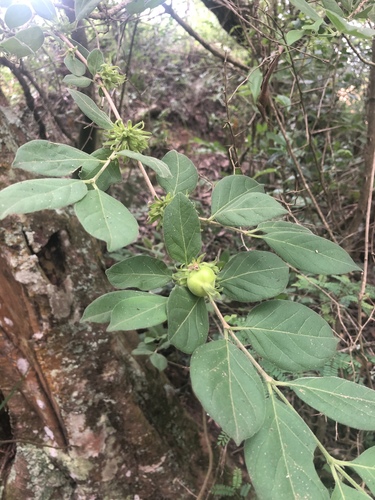
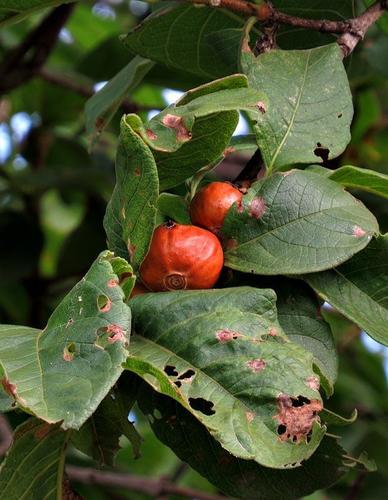
Sabicea villosa
Willd. ex Roem. & Schult.
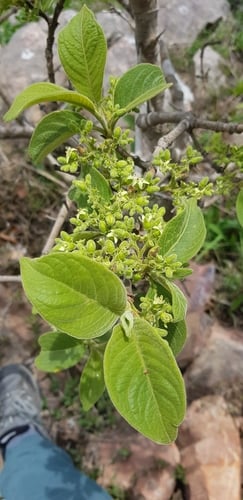
iNaturalist· cc-by-nc
(c) Andreas Berger, some rights reserved (CC BY-NC), uploaded by Andreas Berger
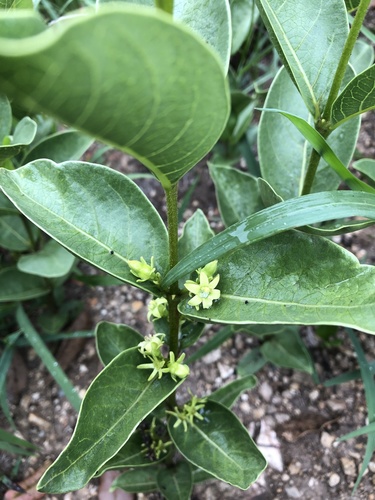
iNaturalist· cc-by-nc
(c) DORIS GREFA, some rights reserved (CC BY-NC)
Summary
Source: WikipediaSabicea villosa, the woolly woodvine, is a species of flowering plant in the family Rubiaceae. It is a perennial dicot with both vine and shrub growth habits that prefers wetlands locations. It is a native plant of Puerto Rico, Central America and South America. Sabicea villosa grows in the rainforest ecosystem on Barro Colorado Island in the Panama Canal that is currently being studied by scientists from the Smithsonean Tropical Research Institute.
Description
A slightly woody vine. It grows 5 m long. The stems are green and 5 mm across. The leaves are opposite and 6-12 cm long by 3-6 cm wide. They are narrowly oval. The flowers are in clusters in the axils of leaves and do not have stalks. The flowers are white, tube shaped and 6-7 mm long. The fruit is a round berry. The fruit are dark red to purple and 7-10 mm long. .
Edible Uses
The fruit is edible.
Distribution
A tropical plant.
Where It Grows
Amazon, Colombia, Ecuador, Dominican Republic, Guiana, Guianas, Guyana, Puerto Rico, South America, Suriname, Venezuela, West Indies,
Synonyms
Also Known As
Curihjau, Fu chunchili, Hierba monte, Huasca mullaca, Kogonemonkamo, Omegiim, Pina de abeja
References (6)
- Barfod, A. S. & Kvist, L. P., 1996, Comparative Ethnobotanical Studies of the Amerindian Groups in Coastal Ecuador. The Danish Academy of Sciences and Letters. p 79
- Etkin, N. L. (Ed.), 1994, Eating on the Wild Side, Univ. of Arizona. p 141
- Kermath, B. M., et al, 2014, Food Plants in the Americas: A survey of the domesticated, cultivated and wild plants used for Human food in North, Central and South America and the Caribbean. On line draft. p 772
- Lopez-Diago, D. & Garcia, N., 2021, Wild edible fruits of Colombia. Biota ColomBiana 22 (2) p 50
- Roa, J. A. G. & Boada, D. S. G., 2018, Fundación para el Fortalecimiento de la Fruticultura y Plantas Alimenticias no Convencionales en Colombia.
Show all 6 references Hide references
- Torre, de la, L., et al, 2008, Enciclopedia de las Plantas Útiles del Ecuador. Herbario QCA. Pontificia Universidad Católica del Ecuador. p 556